
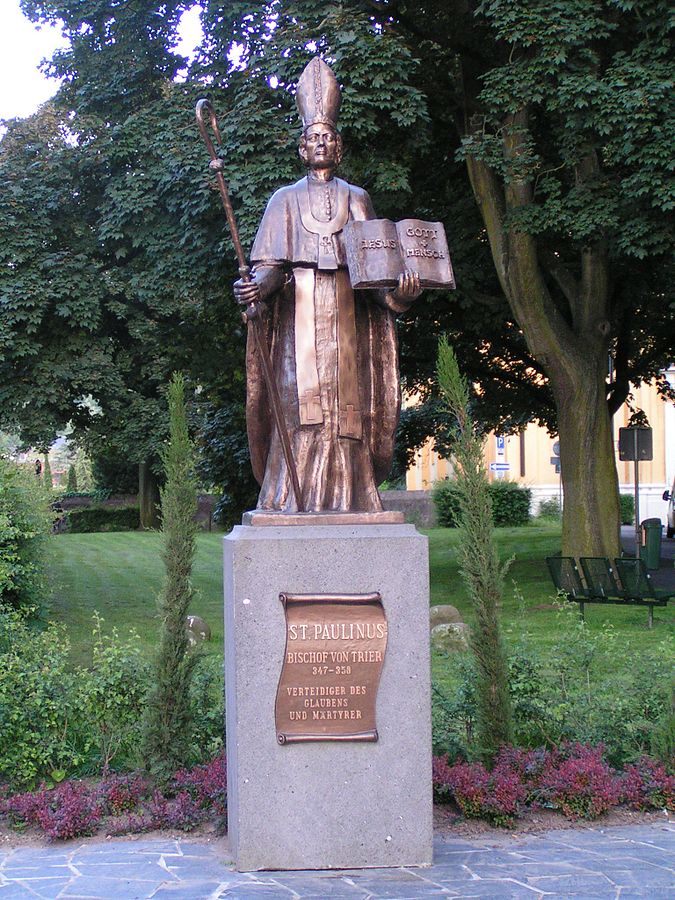
Saint Paulinus of Trier, Orthodoxy in Teaching and Church Unity
This last day of August is the liturgical feast of a great German saint, Saint Paulinus of Trier. Trier, previously known Trèves and Triers, is a city lies on the banks of the Moselle in Germany, between low vine-covered hills of red sandstone in the west of the state of Rhineland-Palatinate, near the border of Luxembourg, deeply entrenched within the important Moselle wine region.
The little information we have about Saint Paulinus tells us that he was a great foe of the Arian heresy. As the history of Christian doctrine puts it, Arianism claimed that Jesus was not really the Son of God, but rather created by God. Hence, he is not divine, but a creature. After being proposed in the early 4th century by the Alexandrian priest Arius, this heresy was widely diffused throughout much of the Eastern and Western Roman empires, thankfully it was condemned in no uncertain terms as heresy at the Council of Nicea in 325.
Within this context emerges the great figure of Saint Paulinus who did all his best to propagate the healthy, consoling and unifying teaching of the Council of Nicea. Saint Paulinus was originally from Gascony, a province of southwestern France and nowadays it is to be found in the east and south of Bordeaux. He was educated in the cathedral school and immediately became a faithful follower of St Maximinus, accompanying him to Trier. Eventually, Paulinus managed to succeed Maximinus by being chosen as bishop of Trier in the year 349.
He was a great friend and supporter of Saint Athanasius and supported wholeheartedly his orthodox doctrine on the divine personhood of Christ. The two first met when Saint Athanasius was exiled by the Arian dissenters to Trier. Upon seeing all this tragic story incredibly unfolding before his very eyes, Saint Paulinus was determined to defend the truth of the faith, particularly at the Synod of Arles in 353. In 355 Paulinus met the same fate as his friend Athanasius, this time being exiled by Emperor Constantius II to Phyrigia, where he died. After his death, his remains were carried to Trier in 395. Today his tomb is found in the crypt of the city’s St Paulinus Church that was rightly rededicated to him.
We commonly say: History repeats itself. Nowadays, the German Church is facing significant challenges concerning its synodal path, a change which is not in line with the Church’s tradition. In fact, the 125 employees, including priests, religion teachers as well as administrative employees, on January 24, 2022, “outed” themselves and launched their #OutinChurch campaign of seven specific demands:
- We want to be able to live and work openly as LGBTIQ+ persons in the church without fear. We want to be able to live and work openly as LGBTIQ+ persons in the church without fear.
- LGBTIQ+ persons must have access to all fields of activity and occupation in the Church without discrimination.
- The church employment rules need to be changed. An open life according to one’s sexual orientation and gender identity, even in a partnership or civil marriage, must never be considered a breach of loyalty or a reason for dismissal.
- Defamatory and outdated statements of church doctrine on sexuality and gender needs to be revised on the basis of theological and human-scientific findings. This is of utmost relevance especially in view of worldwide church responsibility for the human rights of LGBTIQ+ persons.
- The Church must not withhold the blessing of God and access to the sacraments from LGBTIQ+ persons and couples.
- A church that invokes Jesus and his message must firmly oppose all forms of discrimination and promote a culture of diversity.
- In dealing with LGBTIQ+ persons, the Church has caused much suffering throughout its history. We expect the bishops to take responsibility for this on behalf of the Church, to address the institutional history of guilt, and to advocate for the changes we call for.
The Church faces a significant threat in the face of these drastic demands, along with the introduction of the homosexual lifestyle and same sex “marriage” in both Europe and the United States. All of this has unfolded in less than sixty years, from the start of the so-called “Sexual Revolution”.
In Germany itself, the “gay rights” movement has made great inroads, with every bishop in Germany participating in what is called the “Synodal Way”— which is a process of dialogue, organized by the German bishops in collaboration with the Central Committee of German Catholics (ZdK), the largest of several groups in Germany that represent lay Catholics. Participants have strongly demanded for several changes in Church doctrine and practice such as, to take but a few examples, relaxing the requirement of priestly celibacy, Church blessing of homosexual unions and inter-Communion between Catholics and Protestants.
On February 4th, by a vote of 174 to 30, with 6 abstentions, Synodal Way participants made as their own the view calling for women’s ordination in direct contradiction to infallible teaching given by Pope John Paul II in his 1994 apostolic letter Ordinatio Sacerdotalis— namely that the Church has no authority to ordain women to the priesthood and the issue is not open for debate. Moreover, the “plenary meeting of the German Catholic Church’s ‘Synodal Way’ ended on Saturday with votes in favor of draft texts calling for same-sex blessings and changes to the Catechism on homosexuality.” And those votes passed with large majorities: 161 votes to 34, with 11 abstentions for “same-sex blessing”, and 174 votes in favor, 22 against, and 7 abstentions for changing the Catechism’s section on homosexuality.
In May 2021 the former head of the Congregation for the Doctrine of the Faith, Cardinal Gerhard Ludwig Müller in an interview to Kath.net, when he was asked if the German Church was headed toward schism the cardinal frankly stated: “I fear yes, but I hope not.” However, in recent years a number of German bishops have defended the homosexual lifestyle as well as same-sex “marriage” and demanded the Church to change her moral teaching concerning these issues. For instance, in February 2021, Bishop Peter Kohlgraf of Mainz said that Catholics with homosexual inclinations cannot be expected to live chastely as “the inclination is not self-inflicted.”
This drastic situation, which is endangering the Church’s doctrine and unity, is an invitation calling for you and me to pray. Nowadays we need, more than ever before, to pray for the unity in teaching and communion of the Church. Let us make this prayer ardently to the Father, fount of unity in truth. We also invoke Saint Paulinus, the German bishop of Trier, so that the Church in Germany and in the world be united in love through the bonds of the saving truth.
Father, in the Name of Your beloved Son Jesus, in the unity of the Holy Spirit, with the intercession of Mary, the Mother of God and Our Mother and the intercession of Saint Paulinus of Trier, bring your unity of love in truth, caritas in veritate to your Church, particularly in Germany and in every part of the world. Amen.
Saint Paulinus of Trier, great apostle of sound Church doctrine and an extraordinary witness of Church unity, pray for us!

Saint Kateri , Canada’s Protectress
This was the title given to Saint Kateri Tekakwitha, by Pope Benedict XVI, when he canonized her on October 28th, 2012, along with six others, in Saint Peter’ Square (she had been beatified by Pope John Paul II back in 1980). With Saint Joseph as our protector, along with the Canadian martyrs, we seem to[…]Continue reading→

Remembering Father Alphonse de Valk
(Today marks the sixth anniversary of the death of Father Alphonse de Valk, C.S.B., a faithful, courageous and indefatigable Basilian priest, pro-life-and-family apostle, and the founder of Catholic Insight magazine. Here is what we wrote those on his entering into eternity five years ago, as we continue to remember him in our prayers and thoughts)[…]Continue reading→
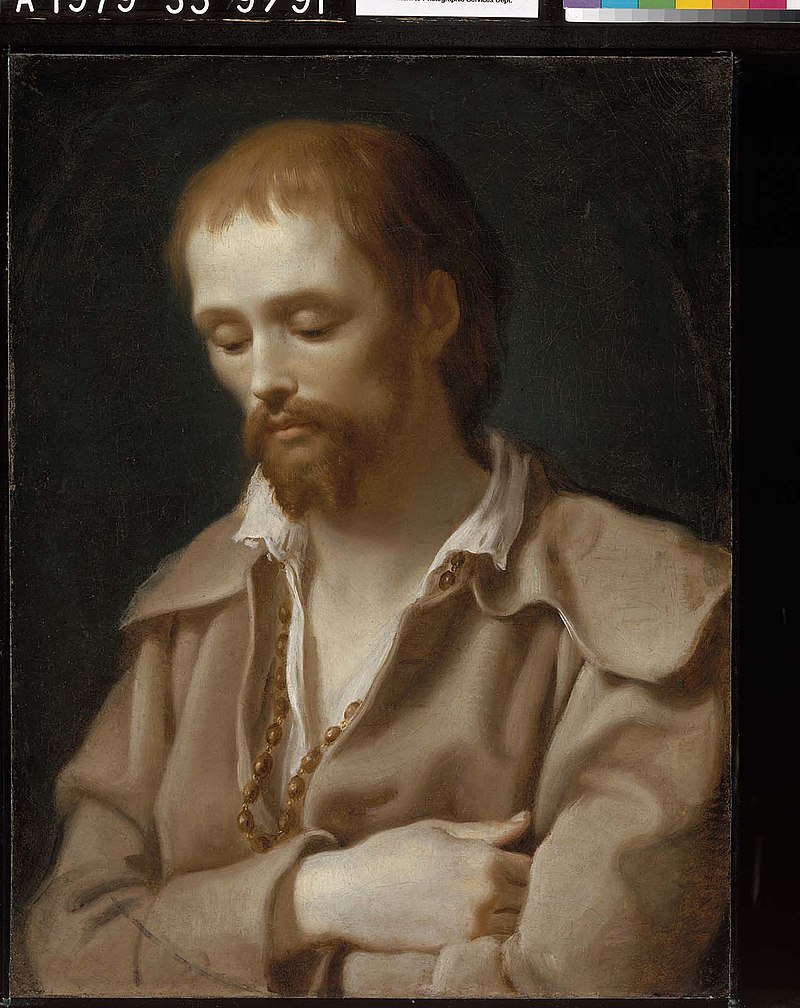
A Tale of Two Benedicts
A grace-filled Holy Week to all our readers! As we await and prepare for the Resurrection about to dawn upon us, we might keep in mind two Benedicts: Pope Emeritus Benedict XVI, requiescat in pace, elected on this day in 2005; and today’s commemoration of the mystic pilgrim, Benedict Joseph Labre, who died on this[…]Continue reading→

My Name is Bernadette
April 16th is a propitious day, for besides the anniversary of Father de Valk’s death, who founded Catholic Insight in its print form decades ago, and the commemoration of the ‘two Benedicts’, mentioned in accompanying posts, today we also recall Saint Bernadette Soubirous, the young visionary to whom the Virgin Mary appeared numerous times at[…]Continue reading→
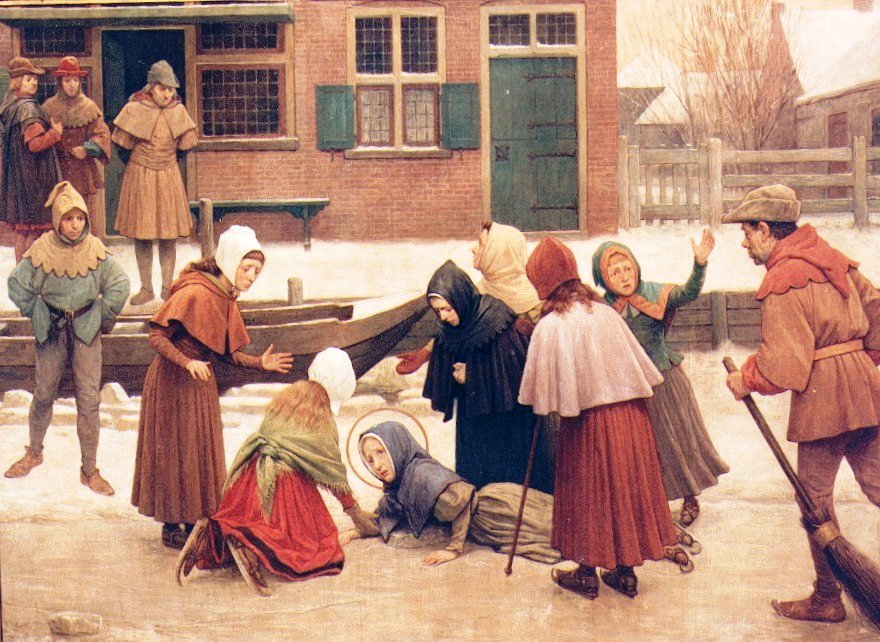
Saint Lydwina of Schiedam and Suffering Joyfully
Saint Lydwina of Schiedam (1380 – 1433) was one of the countless and glorious ‘victim souls’ in the history of the Church, those whose lives are filled with suffering, often of an unimaginable intensity, but who suffer joyfully. She was a fifteen-year old Dutch girl, out skating one day, when she fell and broke one[…]Continue reading→
The Glorious Martyrdoms of Martin and Maximus
As we enter into Eastertide, we recall on this 13th of April Pope Saint Martin I (+655), one of the noblest, if most tragic, of the successors of Saint Peter. Born in Umbria, Italy, he was of noble lineage, with great intelligence combined with charity and love of the poor and the Church. While still[…]Continue reading→

Canonizing Sister Faustina and Divine Mercy
HOMILY OF THE HOLY FATHER MASS IN ST PETER’S SQUARE FOR THE CANONIZATION OF SR MARY FAUSTINA KOWALSKA Sunday, 30 April 2000 1. “Confitemini Domino quoniam bonus, quoniam in saeculum misericordia eius”; “Give thanks to the Lord for he is good; his steadfast love endures for ever” (Ps 118: 1). So the Church sings on the Octave of[…]Continue reading→

Divine Mercy Sunday – An Echo of Every Mass
Reach out your hand and put it in my side. Do not doubt but believe’… ‘My Lord and my God!’ (Jn. 20:18)). Today is Divine Mercy Sunday, and as we celebrate the end of the Easter Octave, we contemplate the wounded side of our Saviour, the Church’s source of life. On Good Friday in the[…]Continue reading→
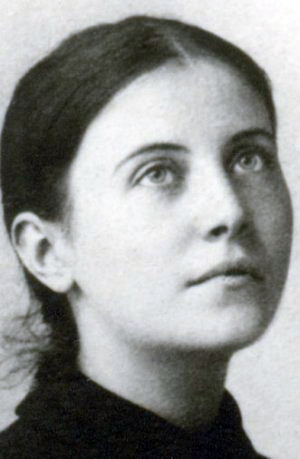
Saint Gemma Galgani
On this April 11th, in 1903 – the same year that the Italian Guiseppe Sarto was elected Pope later that summer as Pius X – a lovely, young Italian woman died, by the name of Gemma Galgani. She lived a brief life of 24 years, as did a number of other young saints, including Pier[…]Continue reading→
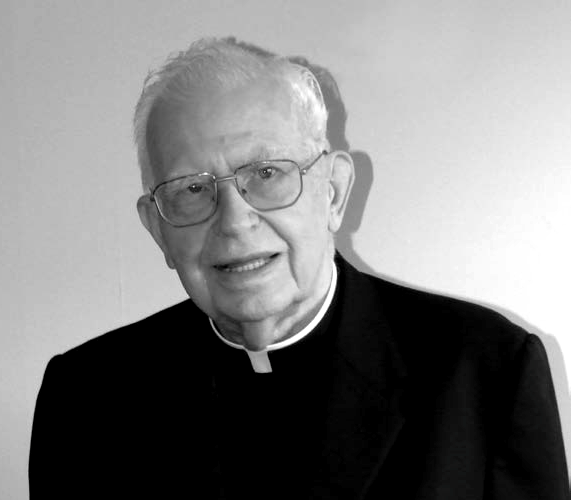
First Holy Communion: Sermon from May 16, 1943
Here is a sermon from the good old days by +Rev. Msgr. Vincent Nicholas Foy (August 14, 1915 – March 13, 2017), from 1943. Readers may recall that Pope Saint Pius X, by the decree Quam Singulari in 1910, lowered the customary age of reception of Holy Communion – after the rigours of the plague[…]Continue reading→