
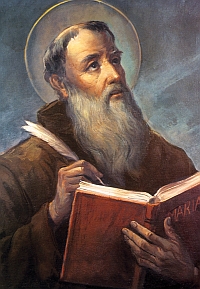
St Lawrence of Brindisi, Staunch Defender of the True Catholic Faith
Today, Thursday 21 July 2022, the entire Catholic communion together with the Capuchin Order, joyfully commemorates St Lawrence of Brindisi. We can easily apply to this holy erudite Capuchin the words addressed by the Lord to prophet Jeremiah: Behold, I have put my words in your mouth (Jer 1:9). St Lawrence’s life was a living icon of the power of God’s Word.
The young Julius Caesar Russo was born on July 22, 1559 from a religious family. As a child he felt already called to embrace the Franciscan family. In fact, when his father died Julius Caesar was entrusted to the care of the Friars Minor. However, as he went to Venice, he came across our brothers, the Capuchins. He entered our Order as a teenager.
Julius Caesar was given the religious name of Lawrence. The twenty-three-year-old was consecrated a priest in 1582, and became an active diplomat of the Holy See. We find him in Italy, Germany, Austria, Hungary, France, Bohemia, Spain as well as Portugal. Even if he was so busy with many important missions entrusted to him by the Pope he made the salvation of his soul a top priority.
His impressive intellectual and academic capabilities were put at the service of the Lord. St Lawrence mastered well Greek, Hebrew, Latin and Syrian. Besides his native Italian tongue he also spoke Spanish and German which he employed during his ministry in Central Europe. It is said of him that he so thoroughly studied the Word of God that he knew the entire Bible by heart, and Saint Lawrence also won the respect of Jewish scholars for his profound knowledge of rabbinic texts.
The erudition of Father Lawrence greatly helped him to cultivate a loving heart full of zeal for Jesus, Mary and the Eucharist. His life story tells us that he used to spend long hours praying in front of the Eucharist in silence. Likewise he took a long time to celebrate the Eucharist, so much carried away in celebrating the holy sacrifice of the altar amid many shed tears. Lawrence’s zeal, intellectual preparation, poverty, wisdom and great devotion for the Church depicted him as the ideal priest for this particular tumultuous time in Church’s history. St Lawrence was the final Counter-Reformation soldier.
With how much clarity did he pass on the Catholic truths of faith particularly to those who have fallen prey to Protestant propaganda! Thanks to his calm nature St Lawrence offered the Biblical and Patristic sources to explain the Papacy, Bishops, Mary as well as the Sacraments. St Lawrence certainly defended the truth against Luther’s attack on the Faith. He also helped define and live out the essence of the great Capuchins who solidified the Franciscan movement in the 1500s and beyond. Lawrence was a multi-tasking man. At one go he was a preacher, teacher and a great administrator of our Order. We find him as a novice master, provincial, and minister general of the Order – all things to all men.
Being totally faithful to his Franciscan calling, Lawrence did everything to preserve and restore peace. The Holy Father and secular princes entrusted St Lawrence with very important diplomatic missions intended to settle divisions brought about among Christian states and between states as well as the rising Ottoman Empire. Lawrence managed to harmonize peace and truth, but did not deny the natural right to self-defence, motivated by our love for Christian Europe. We find him as the chaplain of the Christian army which was assembled in Turks on the counsel of the same Lawrence. This great Capuchin who was fond of his European Christian identity led the troops in battle with his crucifix held high up. History attributes to his intercession and motivating example the German army’s victory.
After fulfilling his mission as special envoy to the King of Spain concerning the actions of the Viceroy of Naples in 1619 he died in Lisbon, Portugal on his 60th birthday, and laid to rest in a monastery in Northern Spain. He was beatified on 1 June 1783 and canonized on December 8, 1881.
On March 19, 1959, the solemnity of Saint Joseph, protector of the Church, Pope St John XXIII proclaimed this great, humble, erudite and zealous Capuchin, St Lawrence of Brindisi, as an Apostolic Doctor of the Church. The reasons behind such a proclamation were his creative and at the same time orthodox writings on the Virgin Mary and for his scholarly and harmonious presentation of Scripture, patristics and fundamental theology. St Lawrence is the third Franciscan Doctor of the Church after Saints Bonaventure and Anthony of Padua/Lisbon.
Here are a few excerpts taken from the Apostolic letter Celsitudo ex humilitate, promulgated by Pope St John on March 19, 1959, the feast of St Joseph, wherein he clarifies some of the reasons for making St Lawrence a Doctor of the Church.
Oh, the inestimable affection of the love of Christ, Who never has never allowed Himself to be lacking to the Church, His Bride, and finds present remedies for the evils that are hurled against her. When the insane daring of the innovators rose up, and the Catholic name was attacked by hostile assaults, when the Faith was languishing in many places among the Christian people, and morals were in steep decline, He raised up Lawrence to defend what was under attack, to avenge what had been destroyed, and to promote that which was conducive to the salvation of all. And since wicked plagues are again being introduced, and men are being ensnared by the inventions of false beliefs and other corruptions, it is useful that this many be placed in a brighter light, so that the Christian faithful may be confirmed towards what is right by the glory of his virtues, and nourished by the precepts of his salutary teaching. Therefore, just as Rome boasts of Lawrence, Christ’s unconquered champion, who by the most dire torments which he suffered, increased the strength of the Church as She was rent by persecution, so Brindisi is held in honor for begetting another Lawrence, who strengthened Her by his zeal for religion and the abundance of his talents as she was afflicted by evil from within and from without. …
In this noble and excellent two things are especially outstanding: his apostolic zeal, and his mastery of doctrine. He taught with his word, he instructed with his pen, he fought with both. Not deeming it enough to withdraw into himself, and dedicate himself to prayer and study in the refuge of his monastery, and occupy himself only with domestic matters, he leaped forth as if he could not contain the force of his spirit, wounded with the love of Christ and his brothers. Speaking from many pulpits about Christian dogma, about morals, the divine writings, and the virtues of the denizens of heaven, he spurred Catholics on to devotion, and moved those who had been swallowed up by the filth of their sins to wash away their crimes, and undertake the emendation of their lives. … outside the sacred precincts, when preaching to those who those who lacked the true religion, he defended it wisely and fearlessly; in meetings with Jews and heretics, he stood as the standard-bearer of the Roman church, and persuaded many to renounce and forswear the opinions of false teaching. …
In the three volumes called “A Sketch of Lutheranism” (Lutheranismi hypotyposis), this defender of the Catholic law, mighty in his great learning, seeks to disabuse the people of the errors which the heretical teachers had spread. Therefore, those who treat of the sacred disciples, and especially those who seek to expound and defend the catholic faith, have in him the means to nourish their minds, to instruct themselves for the defense and persuasion of the truth, and to prepare themselves to work for the salvation of others. If they follow this author who eradicate errors, who made clear what was obscure or doubtful, they may know they walk upon a sure path.
Some other excerpts which speak of God, Christ, the Holy Spirit and the Word of God from St Lawrence of Brindisi’s immense opus are the following:
God is love and all his operations proceed from love. Once he wills to manifest that goodness by sharing His love outside Himself, then the Incarnation becomes the supreme manifestation of His goodness and love and glory. So, Christ was intended before all other creatures and for His own sake. For Him all things were created and to Him all things must be subject and God loves all creatures, in and because of Christ. Christ is the first-born of every creature and the whole of humanity. as well as the created world, finds its foundation and meaning in Him. Moreover, this would have been the case, even if Adam had not sinned.
God is love and all His operations proceed from LOVE…
For Him all things were created and to Him all things must be subject and God loves all creatures, in and because of Christ.
Christ is the first-born of every creature and the whole of humanity as well as the created world, finds its foundation and meaning in Him.
The Holy Spirit sweetens the yoke of the divine law and lightens its weight, so that we may observe God’s commandments with the greatest of ease and even with pleasure.
The word of God is replete with manifold blessings, since it is, so to speak, a treasure of all goods. It is the source of faith, hope, charity, all virtue, all the gifts of the Holy Spirit,
all the beatitudes of the Gospel, all good works, all the rewards of life, all the glory of paradise…
…The word of God is a light to the mind and a fire to the will.
Let us now pray to this little known Doctor of the Church who certainly fulfilled his mission and fulfilled it so well.
O God, who for the glory of your name and the salvation of souls bestowed on the Priest Saint Lawrence of Brindisi a spirit of counsel and fortitude, grant, we pray, that in the same spirit, we may know what must be done and, through his intercession, bring it to completion. Through our Lord Jesus Christ, your Son, who lives and reigns with you in the unity of the Holy Spirit, God, for ever and ever. Amen.

Saint Kateri , Canada’s Protectress
This was the title given to Saint Kateri Tekakwitha, by Pope Benedict XVI, when he canonized her on October 28th, 2012, along with six others, in Saint Peter’ Square (she had been beatified by Pope John Paul II back in 1980). With Saint Joseph as our protector, along with the Canadian martyrs, we seem to[…]Continue reading→

Remembering Father Alphonse de Valk
(Today marks the sixth anniversary of the death of Father Alphonse de Valk, C.S.B., a faithful, courageous and indefatigable Basilian priest, pro-life-and-family apostle, and the founder of Catholic Insight magazine. Here is what we wrote those on his entering into eternity five years ago, as we continue to remember him in our prayers and thoughts)[…]Continue reading→

A Tale of Two Benedicts
A grace-filled Holy Week to all our readers! As we await and prepare for the Resurrection about to dawn upon us, we might keep in mind two Benedicts: Pope Emeritus Benedict XVI, requiescat in pace, elected on this day in 2005; and today’s commemoration of the mystic pilgrim, Benedict Joseph Labre, who died on this[…]Continue reading→

My Name is Bernadette
April 16th is a propitious day, for besides the anniversary of Father de Valk’s death, who founded Catholic Insight in its print form decades ago, and the commemoration of the ‘two Benedicts’, mentioned in accompanying posts, today we also recall Saint Bernadette Soubirous, the young visionary to whom the Virgin Mary appeared numerous times at[…]Continue reading→

Saint Lydwina of Schiedam and Suffering Joyfully
Saint Lydwina of Schiedam (1380 – 1433) was one of the countless and glorious ‘victim souls’ in the history of the Church, those whose lives are filled with suffering, often of an unimaginable intensity, but who suffer joyfully. She was a fifteen-year old Dutch girl, out skating one day, when she fell and broke one[…]Continue reading→

The Glorious Martyrdoms of Martin and Maximus
As we enter into Eastertide, we recall on this 13th of April Pope Saint Martin I (+655), one of the noblest, if most tragic, of the successors of Saint Peter. Born in Umbria, Italy, he was of noble lineage, with great intelligence combined with charity and love of the poor and the Church. While still[…]Continue reading→

Canonizing Sister Faustina and Divine Mercy
HOMILY OF THE HOLY FATHER MASS IN ST PETER’S SQUARE FOR THE CANONIZATION OF SR MARY FAUSTINA KOWALSKA Sunday, 30 April 2000 1. “Confitemini Domino quoniam bonus, quoniam in saeculum misericordia eius”; “Give thanks to the Lord for he is good; his steadfast love endures for ever” (Ps 118: 1). So the Church sings on the Octave of[…]Continue reading→

Divine Mercy Sunday – An Echo of Every Mass
Reach out your hand and put it in my side. Do not doubt but believe’… ‘My Lord and my God!’ (Jn. 20:18)). Today is Divine Mercy Sunday, and as we celebrate the end of the Easter Octave, we contemplate the wounded side of our Saviour, the Church’s source of life. On Good Friday in the[…]Continue reading→
Saint Gemma Galgani
On this April 11th, in 1903 – the same year that the Italian Guiseppe Sarto was elected Pope later that summer as Pius X – a lovely, young Italian woman died, by the name of Gemma Galgani. She lived a brief life of 24 years, as did a number of other young saints, including Pier[…]Continue reading→

First Holy Communion: Sermon from May 16, 1943
Here is a sermon from the good old days by +Rev. Msgr. Vincent Nicholas Foy (August 14, 1915 – March 13, 2017), from 1943. Readers may recall that Pope Saint Pius X, by the decree Quam Singulari in 1910, lowered the customary age of reception of Holy Communion – after the rigours of the plague[…]Continue reading→