
Saint Boniface and ‘Ordinary’ Time
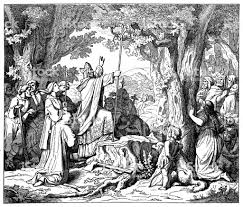
We missed the feast of Saint Boniface this year, as it was trumped by the far greater feast of Pentecost – the second most solemn day in the Church’s calendar, after Easter. But a mention may be in order on this day after, which is also Mary, Mother of the Church, a Church that Boniface did much to establish in what we now call Europe (hence, his being named one of its primary patrons).
Boniface was martyred by a pagan band on June 5th, 754, ending a life of tireless struggle to convert the Frisians, early inhabitants of Germania, steeped in paganism and idolatry. The famous story of his felling of the Donar Oak, which the pagan Frisians held so sacred that any man who harmed the tree would himself die, has become a symbol of Christianity’s dominance over idolatry. Of course, pagans could respond that there is no strict correspondence between violations of the supernatural order and effects in the natural earthly sphere. After all, many modern day pagans, heretics, apostates and even plain old sinners, amongst which latter group I most firmly place myself, commit all sorts of outrages against God everyday, yet go about their business as though nothing was awry. We will only see the full justice of God at the end of time, when all history, and all the choices of each and every individual man, are fulfilled.
More to the point, Boniface is hailed as a hero of sanctity, dedicating himself to the cause of Truth, and leading others thereto, regardless of the difficulties and labours. A friend once mentioned that Boniface’s first mission to the pagans was overall unsuccessful, and it was only after he had received a specific mandate from the Holy Father, along with the name of ‘Boniface’, – the ‘doer of good’, his original name being Winfrid, that his efforts turned the tide of Germania towards Christianity, culminating in shedding his blood (and now Germany stands well in need a good dose of re-conversion). Our work for God must always be done under obedience of some sort, manifesting the voluntas Dei through properly constituted authority.
This is not easy, for authority mediated by fallible human creatures can be, and often is, wrong, or at least imperfect. But in the end God brings great good from the submission of our intellect and will, what the Dogmatic Constitution on the Church, Lumen Gentium, terms the obsequio animi, the assent of our minds. It is only so that we can in the end, in the big picture, with Saint Boniface, as his name implies, fulfill the true ‘good’ that God desires for us and for all.
Speaking of the good, we are back now to the infelicitously named ‘ordinary time’, which is not really ordinary but, as Father de Souza has pointed out, refers to the fact that we count the days by ‘ordinal’ numbers, Feria Secunda, Tertia, Quarta and so on. But ordinary in English is, well, just plain ordinary.
In the usus antiquior, there is an octave of celebration after Pentecost, only fitting for the second highest feast in the Church’s calendar. The other two, Christmas and Easter, still have their eight days, so why not Pentecost? There is an anecdote told of Blessed Pope Paul VI, that he only realized the full extent of the ‘changes’ he had authorized in the Liturgy when, the day after Pentecost, the sacristan laid out green vestments. The Pope supposedly wept. That may be an exaggeration, but the point is made. So in your own way, continue the spirit of Pentecost for a little longer; pray to the Holy Spirit, live and move by His inspirations, and continue this spirit well through the long summer days, all that ‘ordinary’ time, which we can and should make anything but ordinary.
Saint Boniface, ora pro nobis!
Carney’s Amoral Majority
After five defections – euphemistically described as ‘crossing the floor’ – and three by-elections, Mark Carney and his Liberals how have their coveted majority. One wonders what bowls of pottage were offered in back-room deals. In the archaic monarchical system that is the Dominion of Canada, this majority allows the newly-minted Prime Minister to rule[…]Continue reading→

Saint Kateri , Canada’s Protectress
This was the title given to Saint Kateri Tekakwitha, by Pope Benedict XVI, when he canonized her on October 28th, 2012, along with six others, in Saint Peter’ Square (she had been beatified by Pope John Paul II back in 1980). With Saint Joseph as our protector, along with the Canadian martyrs, we seem to[…]Continue reading→
A Closed, Unsustainable, Descending Loop
As a follow-up to my thoughts on Payette’s payout, here be a stark image of where are here in Canada. As the graph shows in, well, graphic terms, since 2025, the public sector has contributed to 95.5% of economic growth. The private sector – which funds the public sector, or is supposed to – has[…]Continue reading→

A Tale of Two Benedicts
A grace-filled Holy Week to all our readers! As we await and prepare for the Resurrection about to dawn upon us, we might keep in mind two Benedicts: Pope Emeritus Benedict XVI, requiescat in pace, elected on this day in 2005; and today’s commemoration of the mystic pilgrim, Benedict Joseph Labre, who died on this[…]Continue reading→

My Name is Bernadette
April 16th is a propitious day, for besides the anniversary of Father de Valk’s death, who founded Catholic Insight in its print form decades ago, and the commemoration of the ‘two Benedicts’, mentioned in accompanying posts, today we also recall Saint Bernadette Soubirous, the young visionary to whom the Virgin Mary appeared numerous times at[…]Continue reading→
Presidential Pardon of Weronika Krawczyk
As a good news, follow-up to our story from Poland, of the persecution of Weronika Krawczyk for her pro-life views, we heard that she has been granted a presidential pardon. One might still wonder why one needs a presidential pardon for simply holding the long-held belief that the child within the womb is a child,[…]Continue reading→

Saint Lydwina of Schiedam and Suffering Joyfully
Saint Lydwina of Schiedam (1380 – 1433) was one of the countless and glorious ‘victim souls’ in the history of the Church, those whose lives are filled with suffering, often of an unimaginable intensity, but who suffer joyfully. She was a fifteen-year old Dutch girl, out skating one day, when she fell and broke one[…]Continue reading→

The Glorious Martyrdoms of Martin and Maximus
As we enter into Eastertide, we recall on this 13th of April Pope Saint Martin I (+655), one of the noblest, if most tragic, of the successors of Saint Peter. Born in Umbria, Italy, he was of noble lineage, with great intelligence combined with charity and love of the poor and the Church. While still[…]Continue reading→
Pope Leo and a Rosary for Peace
Pope Leo XIV has asked Catholics across the world to join him in a Rosary for peace today, at 18:00 Rome time (6 pm), which would be noon from where I write (EST). If you are able, whether at that time or another, and in whatever way you pray, to join in intercession with the[…]Continue reading→
Payette’s Payout
I was glancing through some headlines, and noticed a mention of Julie Payette – engineer and astronaut and sometime the Queen’s representative in Canada – which brought back vague memories. She was appointed Governor-General by Justin Trudeau in 2017. Ms. Payette resigned in 2021, amidst claims that she created a ‘toxic work environment’, with allegations[…]Continue reading→