
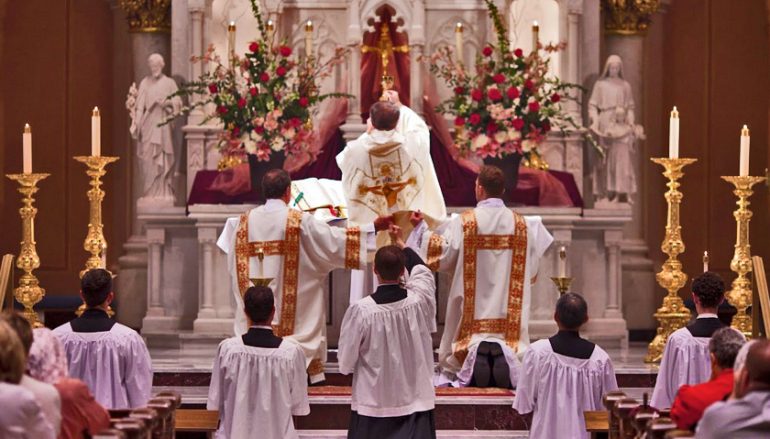
The Pope, the TLM and the Novus Ordo: Who’s Really Following Vatican II?
The Holy Father just cannot let it go: In remarks made the other day on May 7th to liturgical scholars at the Pontifical Liturgical Institute of Sant’Anselmo – yes, I know, Anselm must be rolling in his reliquary – the Pope railed once more against ‘closed-minded’ Catholics, seeking a bygone uniformity in the Liturgy, closed to all reform, and so on. Francis seems to conflate ineluctably that anyone who prefers the traditional Liturgy also rejects Vatican II and all the decrees following therefrom.
I of course cannot read the Pope’s mind, nor his ultimate intent, so will only say this. It is simply not true that all traditionally-minded Catholics (and every Catholic has in some sense to be ‘traditionally minded’) reject the Council. This includes myself, any number of my students, countless families I know and any number of more official reports.
What is more, there is no inherent and necessary connection between the text of the Conciliar Constitution on the Liturgy, Sacrosanctum Concilium, and the Novus Ordo Mass of Pope Paul VI. On the contrary, the Novus Ordo, at least as it is generally celebrated, displays a number of practices that do not correspond to the prescriptions of the Council.
Here are just a few, which follow upon my recent reflection on law and the Church:
- Gregorian chant is supposed to be given ‘pride of place’ in the Liturgy, especially at Mass. There are entire liturgical chant books for the Novus Ordo, almost never used. (A distinct question is how chant fits into the ‘modular’ nature of the new Mass, a question we may address at some point, drawn from difficulties in my own personal experience in trying to do so).
- The pipe organ is to be held in ‘great esteem’ as the primary instrument at Mass, with any other music or instruments admitted only if they be ‘apt for sacred use’.
- Latin is to continue as the primary language of the Liturgy, with some allowance for the vernacular, a prescription that is also found with the highest authority in the apostolic constitution Veterum Sapientia, of Pope Saint John XXIII, promulgated on the very eve of the Council in 1962. How often does one hear any Latin at all?
- There is no prescription in the Council, nor in anything following, to say Mass ‘facing the people’.
- The priest may not ‘add or subtract’ anything from the text of the Liturgy.
- The Council said nothing about saying all the prayers of the Mass out loud and audible, nor of the congregation’s equally audible responses. It did call for ‘active participation’, a phrase that has been widely misunderstood and applied. The original Latin is ‘participatio actuosa’, which means more ‘actualized participation’. This harkens back to Pius XII’s 1947 encyclical on the liturgy, Mediator Dei, wherein he taught that our participation at Mass is primarily interior, by prayer, meditation and offering up one’s own sacrifices with those of the Mass. We need not be always ‘saying something’, far less ‘doing something’ externally.
This is but a partial list – and another could be made of the all the doctrinal and other disciplinary deviations from the Council – from which I hope the reader gleans that the modern Liturgy itself is not exactly ‘in line with Vatican II’. What we witness at most Novus Ordo Masses, sadly, are deviations and distractions, if not outright abuses. Even the devout Masses end up being rather stale four-hymn sandwiches, and the less devout ones come across as performances, the priest and various ministers striving to spruce things up, with whatever theatrics they might: projectors, raucous music, anecdotes, jokes, glad-handing, eye contact, smiles, good mornings, ad-libbing. Often, the congregation seems unaware of what’s going on: talking like they’re at a cocktail party, dressed for the beach or work in the garage, scrolling on their phones, and on it goes. The Fathers of the Council, would be shocked and scandalized at what has transpired from their rather conservative decrees. Read the contemporary reports; most of the bishops back then refused to believe even that Latin and chant would disappear – pshaw! – but some saw dark clouds on the horizon.
There now seems a near universal misunderstanding of what the Mass is in its deepest reality: The sacrifice of Christ, for the people, with grace permeating quietly into the souls of the congregants, still evident in traditional liturgies, which are now filled to bursting. The Novus Ordo Mass could be – and in some places is – done well and reverently. But they are too few and far between.
One could rightly argue that a reform of the Liturgy was required, in light of that principle of Ecclesia semper reformanda, and I for one wish the Council had been more faithfully followed. But what has been put into effect is, to put it gently, not working, as parishes age, empty and, eventually, close. The Church is bleeding like a severed artery, and one wonders whether the Novus Ordo can be repaired – the ‘reform of the reform’. Perhaps we do have to go back to basics, and put into effect the actual words of the Council.
Whatever the future holds, the Good shepherd never leaves His flock untended, and will not abandon His Church. The gates of hell shall not prevail, and there will be places to find the Eternal Sacrifice, well and truly said, for those with eyes to see and ears to hear. Deus semper providebit.
Carney’s Amoral Majority
After five defections – euphemistically described as ‘crossing the floor’ – and three by-elections, Mark Carney and his Liberals how have their coveted majority. One wonders what bowls of pottage were offered in back-room deals. In the archaic monarchical system that is the Dominion of Canada, this majority allows the newly-minted Prime Minister to rule[…]Continue reading→

Saint Kateri , Canada’s Protectress
This was the title given to Saint Kateri Tekakwitha, by Pope Benedict XVI, when he canonized her on October 28th, 2012, along with six others, in Saint Peter’ Square (she had been beatified by Pope John Paul II back in 1980). With Saint Joseph as our protector, along with the Canadian martyrs, we seem to[…]Continue reading→

A Tale of Two Benedicts
A grace-filled Holy Week to all our readers! As we await and prepare for the Resurrection about to dawn upon us, we might keep in mind two Benedicts: Pope Emeritus Benedict XVI, requiescat in pace, elected on this day in 2005; and today’s commemoration of the mystic pilgrim, Benedict Joseph Labre, who died on this[…]Continue reading→

My Name is Bernadette
April 16th is a propitious day, for besides the anniversary of Father de Valk’s death, who founded Catholic Insight in its print form decades ago, and the commemoration of the ‘two Benedicts’, mentioned in accompanying posts, today we also recall Saint Bernadette Soubirous, the young visionary to whom the Virgin Mary appeared numerous times at[…]Continue reading→

Saint Lydwina of Schiedam and Suffering Joyfully
Saint Lydwina of Schiedam (1380 – 1433) was one of the countless and glorious ‘victim souls’ in the history of the Church, those whose lives are filled with suffering, often of an unimaginable intensity, but who suffer joyfully. She was a fifteen-year old Dutch girl, out skating one day, when she fell and broke one[…]Continue reading→

The Glorious Martyrdoms of Martin and Maximus
As we enter into Eastertide, we recall on this 13th of April Pope Saint Martin I (+655), one of the noblest, if most tragic, of the successors of Saint Peter. Born in Umbria, Italy, he was of noble lineage, with great intelligence combined with charity and love of the poor and the Church. While still[…]Continue reading→

Saint Stanislaus of Szczepanów
We celebrate Saint Stanislaus today (+ April 11, 1079), in light of this Easter Octave, a bishop and martyr who accepted the episcopacy only at the direct order of Pope Alexander II. He proved a wise and courageous leader of his flock, put to death by his own king, Boleslaus, for rebuking the monarch’s ‘immoral[…]Continue reading→

Saint Gemma Galgani
On this April 11th, in 1903 – the same year that the Italian Guiseppe Sarto was elected Pope later that summer as Pius X – a lovely, young Italian woman died, by the name of Gemma Galgani. She lived a brief life of 24 years, as did a number of other young saints, including Pier[…]Continue reading→
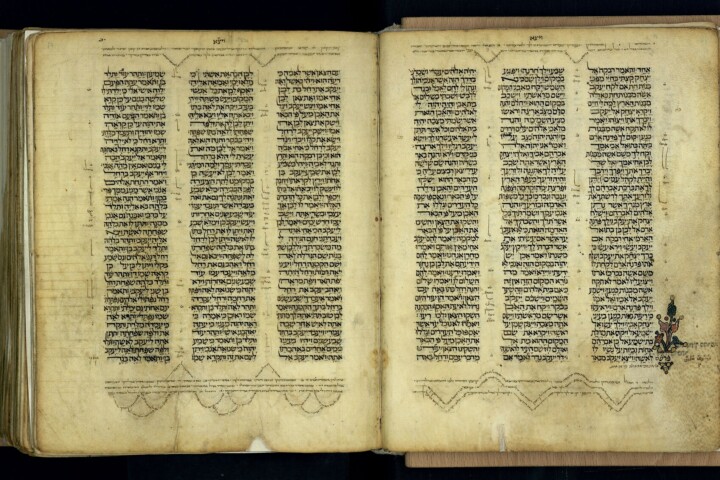
An Ideological and Improper Translation
I noticed something odd with the psalm reading at Mass the other day. Our bishops’ conference here in Canada has decreed that the Mass in English – Novus Ordo – use the ‘NRSV’, the ‘New Revised Standard Version’, an ‘updated’ translation of the original RSV, first published in 1952. This ‘new translation’ has the tendency[…]Continue reading→
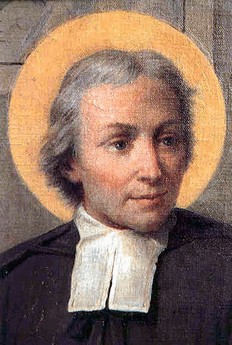
Saint Jean-Baptiste de la Salle: A Teacher for Teachers
Jean-Baptiste de la Salle (1651 – 1719), a French nobleman, ordained a priest, founded the first order in the Church’s history entirely without priests, and this came about almost by accident. I say ‘almost’, for, of course, there are no accidents with God. Destined for ordination from an early age, Jean-Baptiste never looked back, even[…]Continue reading→