
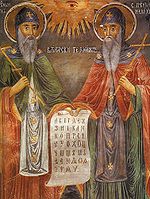
Cyril and Methodius: Brothers and Missionaries of the Slavs
The 14th of February of every year marks the great feast of the two brothers which history dubs as the “Apostles of the Slavs”, Saints Cyril and Methodius. It is right and just to honour these two brothers with such an eminent title since their life stories are an extraordinary witness of their incredible work, conducted in the ninth century, precisely in the Eastern part of the European continent, in order that the Good News of Salvation is spread.
To highlight their outstanding contribution to the evangelisation of the Old Continent, a work which surely left an indelible mark in Church history, St Pope John Paul II named these famed brothers as patron saints of Europe together with the fifth century St Benedict of Nursia, the founder of Western Monasticism. In his apostolic letter thanks to which Sts Cyril and Methodius were proclaimed as co-patrons of Europe, Egregiae Virtutis, St Pope John Paul II writes:
“Hundred years ago Pope Leo XIII with the encyclical ‘Grande Munus’ reminded the whole Church of the extraordinary merits of Saints Cyril and Methodius for their work of evangelization of the Slavs. However, given that this year the Church solemnly remembers the 1500th anniversary of the birth of Saint Benedict, proclaimed in 1964 by my venerable predecessor, Paul VI, patron saint of Europe, it seemed that this protection for all of Europe is better emphasized, if we add to the great work of the holy patriarch of the West the particular merits of the two holy brothers, Cyril and Methodius. In favour of this there are many reasons of a historical nature, both past and contemporary, which have their theological and ecclesial guarantees, as well as cultural ones in the history of our European continent. And therefore, even before this year dedicated to the particular remembrance of Saint Benedict closes, I wish that for the centenary of the Leonean encyclical, all these reasons be exploited, through the present proclamation of Saints Cyril and Methodius as co-patrons of Europe” (no.2).
Cyril and Methodius were both born into a highly esteemed senatorial family which resided in Thessalonica, in 815 and 826. Both of them made their own what St Paul writes in his letter to the Philippians: Indeed I count everything as loss because of the surpassing worth of knowing Christ Jesus my Lord. For his sake I have suffered the loss of all things, and count them as refuse, in order that I may gain Christ (Phil 3:8). Their ardent love for Christ Jesus boldly empowered them to renounce and put aside all their wealth, social status and prestige in order to lovingly and generously embrace a life of committed service to the Lord in the holy priesthood and consecrated life. In fact, when the two brothers were joyfully serving the Lord in the monastic life in a monastery on the Bosphorus, which demarcates Europe from Asia, a request came from the Khazar Empire to Costantinople asking for a Christian missionary to be sent. The choice fell on Cyril, while his younger brother, Methodius, set out for the journey to accompany him. The two brothers managed to learn the Khazar language and, like St Paul, the grace of God worked through them so much that they converted numerous souls to Christ.
As soon as they finished from their mission another request came in for them, this time from officials in Moravia, the present day region in the Czech Republic, because that region needed missionaries who could preach as well as celebrate the liturgical services in the local dialect. Contrary to the work undertaken by German missionaries before them, the sterling work done by Saints Cyril and Methodius left abundant good fruit indeed. The Godly genius of these two brothers stood in the fact that they tried to enculture the Gospel, precisely by adapting the Greek alphabet into a script for the Slavonic language. Thus, in this way, they gave birth to the “Cyrillic” alphabet. It was this which initially was employed to translate both the Bible and the liturgical books. Furthermore, by time the “Cyrillic” became the main instrument of written communication for huge portions of the world, first and foremost the present day Russia.
The two great brothers, full of apostolic zeal, worked diligently in Moravia for four years, till 868, hence attaining a far wider and greater success than the German missionaries who ventured in these areas before them. Their innovative approach to missionary activity, particularly their use of the language of the people, as well as even their Byzantine background presented itself as a problem to certain German church officials, who began to regard them with suspicion. Nevertheless, the two brothers, called together by Pope Adrian II after he saw how the great fruit of their work, confirmed their modes and greatly encouraged them. Both Cyril and Methodius were supported by the Pope for their missionary endeavours, and also received the episcopal ordination accordingly. Nevertheless, Cyril was not to return to Moravia, since he died in the Eternal City in 869.
To advance Methodius’ apostolate in Moravia, Pope Adrian II installed him archbishop of a new archdiocese within a territory that was outside the German church. Sadly, this fact fueled the antagonism of his German adversaries who managed to remove him from his episcopal office and put him in prison for a three-year period. The successor of Pope Adrian, Pope John VIII not only liberated Methodius and reinstalled him as archbishop but also broadened his work to include the region of present day Poland. The new Pontiff kept reinforcing Methodius’ method of the Slavic languages both in worship, as well as his translations of the Bible, even though the controversy with some aspects of the German church kept raging on.
Ultimately, with the help of many Greek priests, he translated the entire Bible into the language which nowadays is widely known as Church Slavonic. Methodius selected his successor from the native Moravian Slavs whom he lovingly evangelized. He died on April 6, 885.
Saints Cyril and Methodius’ missionary activity among the Slavs paved the way for the eventual evangelization of Ukraine and Russia in 988, when the Russian Prince Vladimir willingly received Baptism.
As Saint Pope John Paul II said in his encyclical on the Apostles of the Slavs, Slavorum Apostoli, of 2 June 1985: “Cyril and Methodius are as it were the connecting links or spiritual bridge between the Eastern and Western traditions, which both come together in the one great Tradition of the universal Church. For us they are the champions and also the patrons of the ecumenical endeavor of the sister Churches of East and West, for the rediscovery through prayer and dialogue of visible Unity in perfect and total communion … Unity is a meeting in truth and love, granted to us by the Spirit. Cyril and Methodius, in their personality and their work, are figures that awaken in all Christians a great ‘longing for union’ and for unity between the two sister Churches of East and West. For full catholicity, every nation, every culture has its own part to play in the universal plan of salvation. Every particular tradition, every local Church must remain open and alert to the other Churches and traditions and, at the same time, to universal and catholic communion …” (no.27).
Saints Cyril and Methodius, orate pro nobis!

Saint Kateri , Canada’s Protectress
This was the title given to Saint Kateri Tekakwitha, by Pope Benedict XVI, when he canonized her on October 28th, 2012, along with six others, in Saint Peter’ Square (she had been beatified by Pope John Paul II back in 1980). With Saint Joseph as our protector, along with the Canadian martyrs, we seem to[…]Continue reading→

Remembering Father Alphonse de Valk
(Today marks the sixth anniversary of the death of Father Alphonse de Valk, C.S.B., a faithful, courageous and indefatigable Basilian priest, pro-life-and-family apostle, and the founder of Catholic Insight magazine. Here is what we wrote those on his entering into eternity five years ago, as we continue to remember him in our prayers and thoughts)[…]Continue reading→
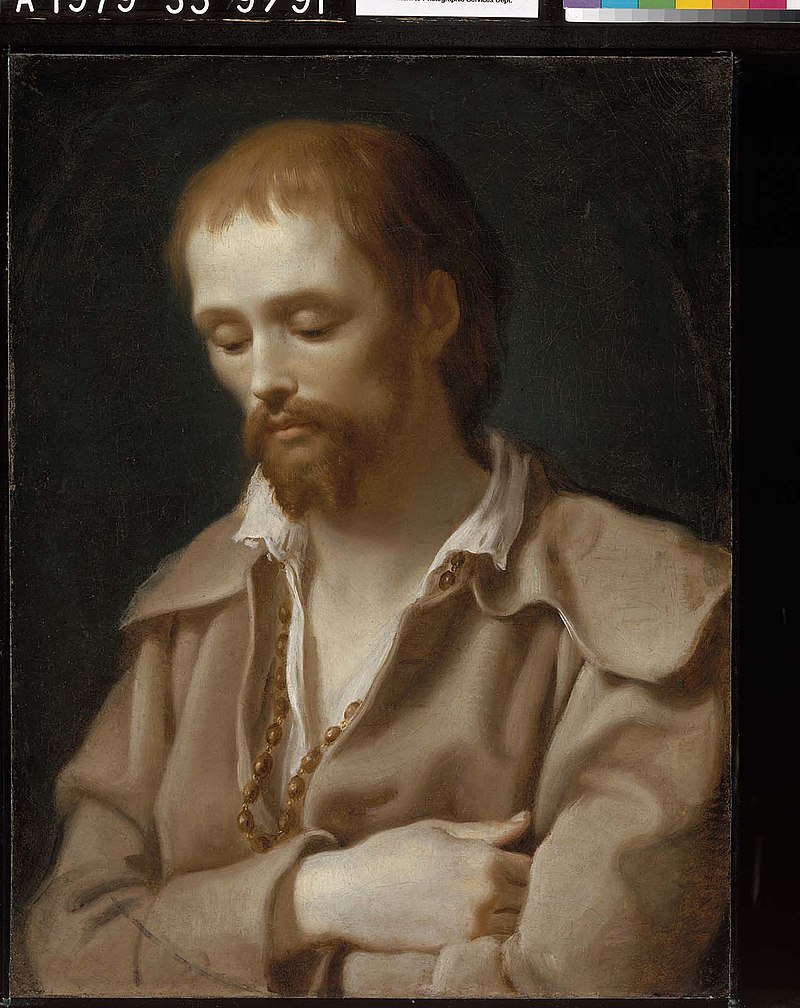
A Tale of Two Benedicts
A grace-filled Holy Week to all our readers! As we await and prepare for the Resurrection about to dawn upon us, we might keep in mind two Benedicts: Pope Emeritus Benedict XVI, requiescat in pace, elected on this day in 2005; and today’s commemoration of the mystic pilgrim, Benedict Joseph Labre, who died on this[…]Continue reading→

My Name is Bernadette
April 16th is a propitious day, for besides the anniversary of Father de Valk’s death, who founded Catholic Insight in its print form decades ago, and the commemoration of the ‘two Benedicts’, mentioned in accompanying posts, today we also recall Saint Bernadette Soubirous, the young visionary to whom the Virgin Mary appeared numerous times at[…]Continue reading→
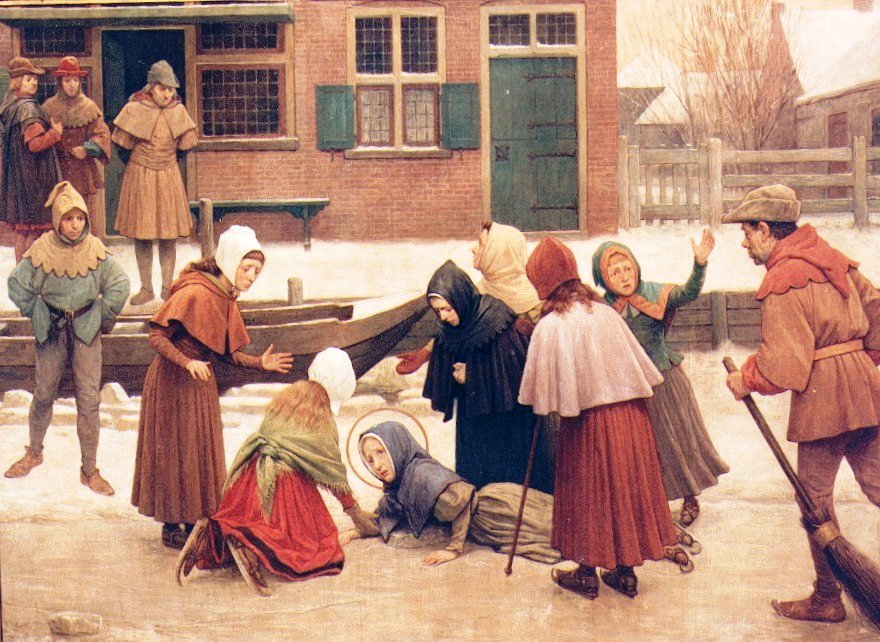
Saint Lydwina of Schiedam and Suffering Joyfully
Saint Lydwina of Schiedam (1380 – 1433) was one of the countless and glorious ‘victim souls’ in the history of the Church, those whose lives are filled with suffering, often of an unimaginable intensity, but who suffer joyfully. She was a fifteen-year old Dutch girl, out skating one day, when she fell and broke one[…]Continue reading→
The Glorious Martyrdoms of Martin and Maximus
As we enter into Eastertide, we recall on this 13th of April Pope Saint Martin I (+655), one of the noblest, if most tragic, of the successors of Saint Peter. Born in Umbria, Italy, he was of noble lineage, with great intelligence combined with charity and love of the poor and the Church. While still[…]Continue reading→

Canonizing Sister Faustina and Divine Mercy
HOMILY OF THE HOLY FATHER MASS IN ST PETER’S SQUARE FOR THE CANONIZATION OF SR MARY FAUSTINA KOWALSKA Sunday, 30 April 2000 1. “Confitemini Domino quoniam bonus, quoniam in saeculum misericordia eius”; “Give thanks to the Lord for he is good; his steadfast love endures for ever” (Ps 118: 1). So the Church sings on the Octave of[…]Continue reading→

Divine Mercy Sunday – An Echo of Every Mass
Reach out your hand and put it in my side. Do not doubt but believe’… ‘My Lord and my God!’ (Jn. 20:18)). Today is Divine Mercy Sunday, and as we celebrate the end of the Easter Octave, we contemplate the wounded side of our Saviour, the Church’s source of life. On Good Friday in the[…]Continue reading→
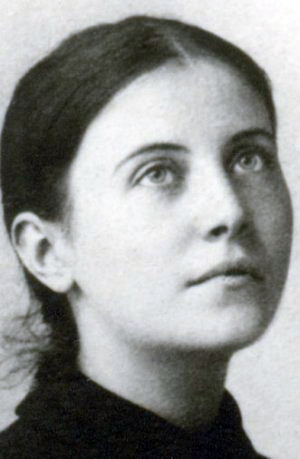
Saint Gemma Galgani
On this April 11th, in 1903 – the same year that the Italian Guiseppe Sarto was elected Pope later that summer as Pius X – a lovely, young Italian woman died, by the name of Gemma Galgani. She lived a brief life of 24 years, as did a number of other young saints, including Pier[…]Continue reading→
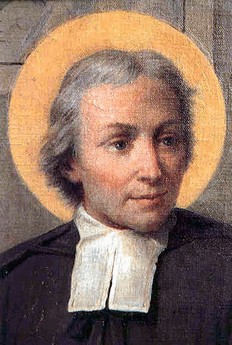
Saint Jean-Baptiste de la Salle: A Teacher for Teachers
Jean-Baptiste de la Salle (1651 – 1719), a French nobleman, ordained a priest, founded the first order in the Church’s history entirely without priests, and this came about almost by accident. I say ‘almost’, for, of course, there are no accidents with God. Destined for ordination from an early age, Jean-Baptiste never looked back, even[…]Continue reading→