
Saint Josaphat’s Legacy, East and West
On Friday 12 November, we celebrate the feast of St Josaphat. This saint represents the eastern lung united with the Church of Rome.
John Kuncevic was born around 1580 in Vladimir, which is a village of the Lithuanian Province of Volhynia (in those days part of the Polish Kingdom which was under the Jagellonian Dynasty). His parents came from the Eastern Rite Church of Kyiv (Ukraine) which at the time was separated from the Church of Rome.
In his childhood his mother explained to him the icons in church. Later on in life he confided with his friend that he experienced at that time a spark of fire which came directly from the wounded side of the Crucified and entered his own heart, an experience which filled his heart with joy, and had a great bearing in his life. John soon started to memorize the Church rituals and psalms, and his love for the Lord make him entertain the desire of suffering poverty and even death.
Even if his father sent him to Vilno in Lithuania to train him in the family’s business, John’s interest was elsewhere, spending his time reading the lives of the Saints and following the religious zeal in the local church. The Ruthenians (which was the ethnic origin of his family) had been historically evangelized from Constantinople. As such they followed the Byzantine Church. However, due to the absorption of the Ruthenians into the Polish Kingdom, who were diehard Roman Catholics, the question of reunion with Rome was argued intensely.
The bishops of the Ukrainian and Byelorussian Churches who lived within the Polish-Lithuanian Commonwealth had a Ruthenian Synod in 1595 and voted to unite with Rome which had Clement VIII as Pope. John Kuncevic was fifteen years old. In 1598 seven bishops signed the Union of Brest, which permitted them to retain their Eastern Rites while in full communion with the Pope. Although most of Vilno rejected the union, John made his profession of faith, then entered the Basilian Monastery of the Holy Trinity in Vilno, and was given the name of Josaphat.
His spiritual journey was difficult. The lax priests of his Order could not offer him spiritual direction. Therefore, Josaphat had to struggle on his own to grow in holiness. He opted for severe mortifications of reparation both for them as well as for those who were completely against reunion with Rome. By God’s grace ultimately John was able to receive some spiritual guidance through a convert from Calvinism, John Rutsky, who later on became Bishop of Kiev. It was the year 1609 when Josaphat was ordained a priest and commenced his career of preaching as well as spiritual direction. He provided for the needy and the homeless. His holy example led some sixty men to embrace the Basilian Order as their vocation.
Josaphat was chosen as superior of a daughter monastery at Byten. It was here that he revitalized the Mother of God devotion at Zirovica. When he returned back to Vilno as archimandrite of the monastery. he began to reform the monks, and it was here that he collected the texts from the Eastern Fathers and Doctors under the title A Defense of Church Unity. This initiatives hastened his appointment as Coadjutor to the elderly, ailing Bishop of Plock (Plotsk). Consequently Josaphat became the Bishop of Plock with the title of Archeparch (Archbishop).
Upon entering his new office Josaphat immediately called a diocesan synod to revive his diocese. Josaphat was wise enough to separate his priests from their ties with the reckless nobility. This he did by composing for them A Rule for Priests. He was determined to keep seeking reunion with Rome. Josaphat had to face a terrible test from the Orthodox Bishop Meletius Smotrytsky, who disseminated calumnies against Josaphat, agitating for Josaphat’s removal from Plock. When Josaphat wrote that St Vladimir preached the Catholic not Orthodox faith, hatred against him grew so much that when he was visiting (Belarus) he was killed. It was November 12, 1623, aged forty-five.
Just before his martyrdom Josaphat said: I rejoice to offer my life for my holy Catholic faith. He had prayed: Grant that I be found worthy, Lord, to shed my blood for the union and obedience to the Apostolic See. He had never revoked his childhood experience of the Crucified.
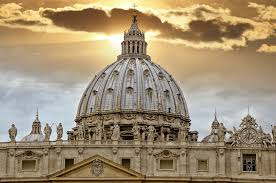
In May 1643, twenty years later, Pope Urban VIII declared him “Blessed.” On June 29, 1867, Blessed Pope Pius IX canonized him a saint. On November 12, 1923, the tercentenary of Josaphat’s martyrdom, Pope Pius XI declared him the heavenly Patron of Reunion between Orthodox and Catholics. During the Second Vatican Council, at the express wish of Pope John XXIII, who himself was most interested in reunion, the body of St. Josaphat was finally laid to rest at the magnificent altar of St. Basil in St. Peter’s Basilica, on November 25, 1963.
Pope Pius XI, in his encyclical Letter on Saint Josaphat, Ecclesiam Dei, recalls this great saint who gave his life for the unity between Catholics and Orthodox with these words:
In designing his Church God worked with such skill that in the fullness of time it would resemble a single great family embracing all men. It can be identified, as we know, by certain distinctive characteristics, notably its universality and unity.
Christ the Lord passed on to his apostles the task he had received from the Father: I have been given all authority in heaven and on earth. Go, therefore, and make disciples of all nations. He wanted the apostles as a body to be intimately bound together, first by the inner tie of the same faith and love which flows into our hearts through the Holy Spirit, and, second, by the external tie of authority exercised by one apostle over the others. For this he assigned the primacy to Peter, the source and visible basis of their unity for all time. So that the unity and agreement among them would endure, God wisely stamped them, one might say, with the mark of holiness and martyrdom.
Both these distinctions fell to Josaphat, archbishop of Polock of the Slavonic rite of the Eastern Church. He is rightly looked upon as the great glory and strength of the Eastern Rite Slavs. Few have brought them greater honour or contributed more to their spiritual welfare than Josaphat, their pastor and apostle, especially when he gave his life as a martyr for the unity of the Church. He felt, in fact, that God had inspired him to restore world-wide unity to the Church and he realised that his greatest chance of success lay in preserving the Slavonic rite and Saint Basil’s rule of monastic life within the one universal Church.
Concerned mainly with seeing his own people reunited to the See of Peter, he sought out every available argument which would foster and maintain Church unity. His best arguments were drawn from liturgical books, sanctioned by the Fathers of the Church, which were in common use among Eastern Christians, including the dissidents. Thus thoroughly prepared, he set out to restore the unity of the Church. A forceful man of fine sensibilities, he met with such success that his opponents dubbed him “the thief of souls.”
Stir up in your Church, we pray, O Lord, the Spirit that filled Saint Josaphat as he laid down his life for the sheep, so that through his intercession we, too, may be strengthened by the same Spirit and not be afraid to lay down our life for others. Through our Lord Jesus Christ, your Son, who lives and reigns with you in the unity of the Holy Spirit, God, for ever and ever. Amen.

Saint Kateri , Canada’s Protectress
This was the title given to Saint Kateri Tekakwitha, by Pope Benedict XVI, when he canonized her on October 28th, 2012, along with six others, in Saint Peter’ Square (she had been beatified by Pope John Paul II back in 1980). With Saint Joseph as our protector, along with the Canadian martyrs, we seem to[…]Continue reading→

Remembering Father Alphonse de Valk
(Today marks the sixth anniversary of the death of Father Alphonse de Valk, C.S.B., a faithful, courageous and indefatigable Basilian priest, pro-life-and-family apostle, and the founder of Catholic Insight magazine. Here is what we wrote those on his entering into eternity five years ago, as we continue to remember him in our prayers and thoughts)[…]Continue reading→
A Tale of Two Benedicts
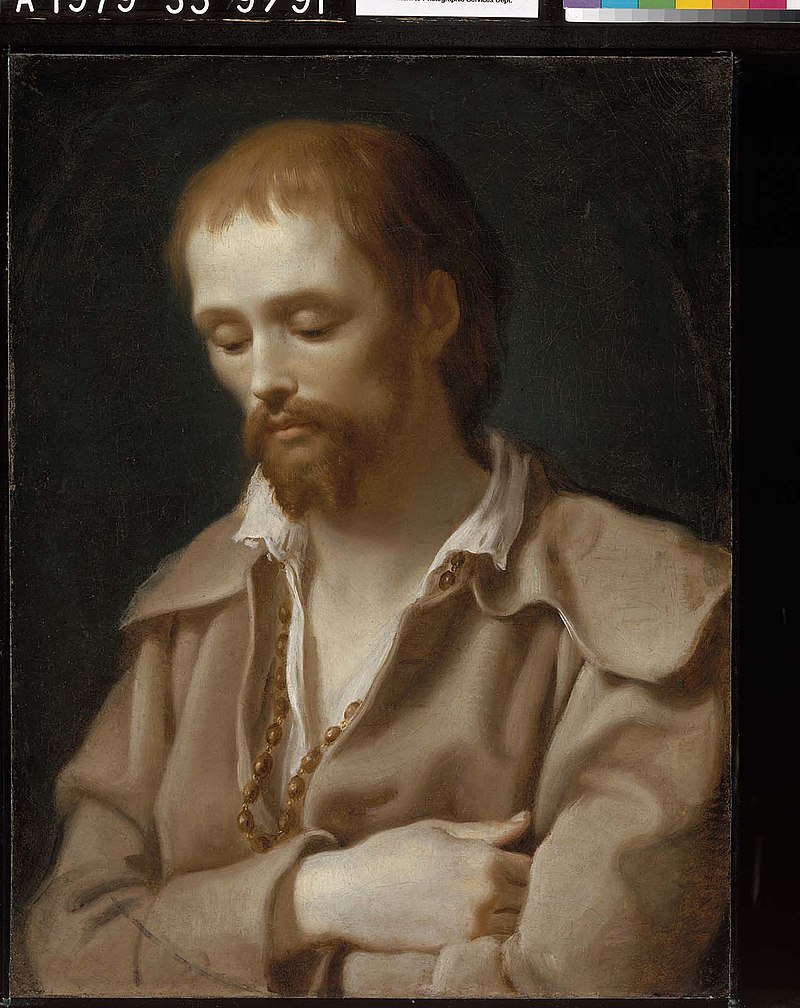
A grace-filled Holy Week to all our readers! As we await and prepare for the Resurrection about to dawn upon us, we might keep in mind two Benedicts: Pope Emeritus Benedict XVI, requiescat in pace, elected on this day in 2005; and today’s commemoration of the mystic pilgrim, Benedict Joseph Labre, who died on this[…]Continue reading→

My Name is Bernadette
April 16th is a propitious day, for besides the anniversary of Father de Valk’s death, who founded Catholic Insight in its print form decades ago, and the commemoration of the ‘two Benedicts’, mentioned in accompanying posts, today we also recall Saint Bernadette Soubirous, the young visionary to whom the Virgin Mary appeared numerous times at[…]Continue reading→
Saint Lydwina of Schiedam and Suffering Joyfully
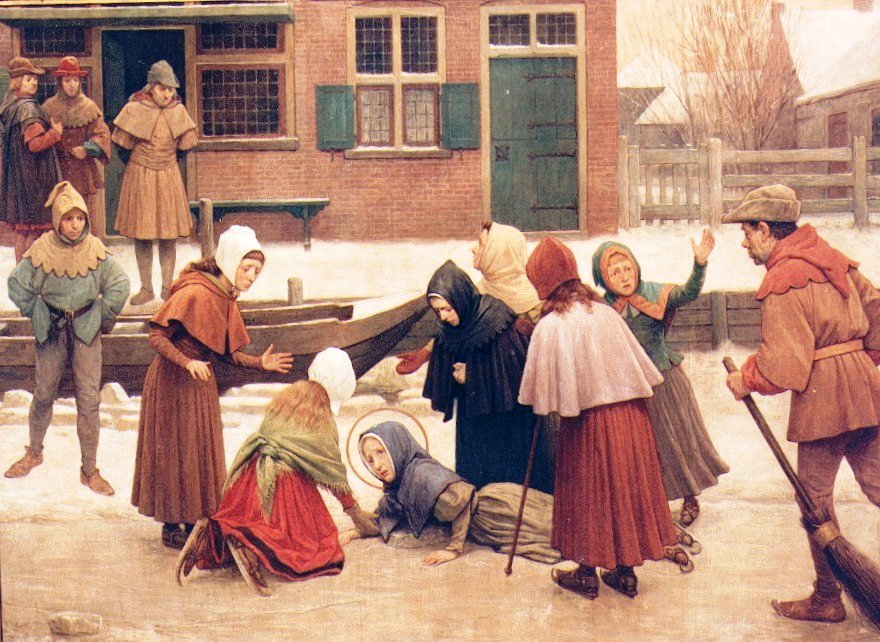
Saint Lydwina of Schiedam (1380 – 1433) was one of the countless and glorious ‘victim souls’ in the history of the Church, those whose lives are filled with suffering, often of an unimaginable intensity, but who suffer joyfully. She was a fifteen-year old Dutch girl, out skating one day, when she fell and broke one[…]Continue reading→
The Glorious Martyrdoms of Martin and Maximus
As we enter into Eastertide, we recall on this 13th of April Pope Saint Martin I (+655), one of the noblest, if most tragic, of the successors of Saint Peter. Born in Umbria, Italy, he was of noble lineage, with great intelligence combined with charity and love of the poor and the Church. While still[…]Continue reading→
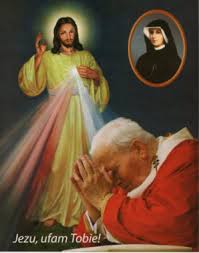
Canonizing Sister Faustina and Divine Mercy
HOMILY OF THE HOLY FATHER MASS IN ST PETER’S SQUARE FOR THE CANONIZATION OF SR MARY FAUSTINA KOWALSKA Sunday, 30 April 2000 1. “Confitemini Domino quoniam bonus, quoniam in saeculum misericordia eius”; “Give thanks to the Lord for he is good; his steadfast love endures for ever” (Ps 118: 1). So the Church sings on the Octave of[…]Continue reading→

Divine Mercy Sunday – An Echo of Every Mass
Reach out your hand and put it in my side. Do not doubt but believe’… ‘My Lord and my God!’ (Jn. 20:18)). Today is Divine Mercy Sunday, and as we celebrate the end of the Easter Octave, we contemplate the wounded side of our Saviour, the Church’s source of life. On Good Friday in the[…]Continue reading→
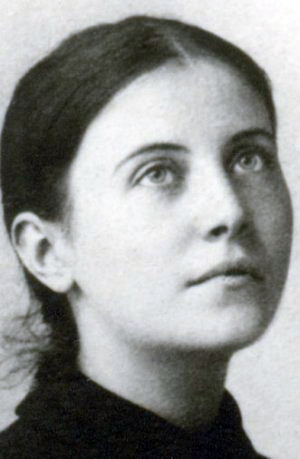
Saint Gemma Galgani
On this April 11th, in 1903 – the same year that the Italian Guiseppe Sarto was elected Pope later that summer as Pius X – a lovely, young Italian woman died, by the name of Gemma Galgani. She lived a brief life of 24 years, as did a number of other young saints, including Pier[…]Continue reading→
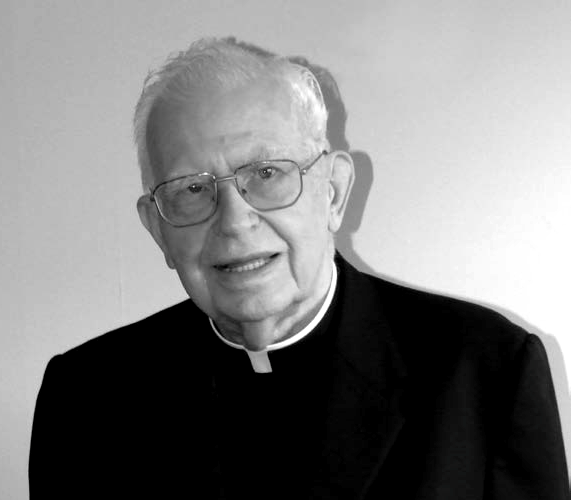
First Holy Communion: Sermon from May 16, 1943
Here is a sermon from the good old days by +Rev. Msgr. Vincent Nicholas Foy (August 14, 1915 – March 13, 2017), from 1943. Readers may recall that Pope Saint Pius X, by the decree Quam Singulari in 1910, lowered the customary age of reception of Holy Communion – after the rigours of the plague[…]Continue reading→