
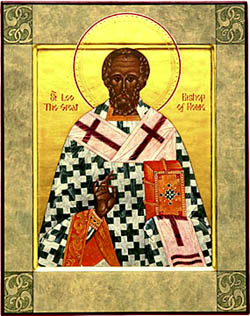
Pope Saint Leo: A Great Support in Time of Adversity
During our study and appreciation of the Church’s history of two millennia, one of the outstanding figures is that of Pope St Leo the Great.
His title already says much about him. He was born from a Roman aristocratic family, which traced its origins from Tuscany. Leo’s love for the Lord, erudition and persuasive nature, together with that singular of reconciliation he dearly nurtured, gave the Roman Church of the fifth century a great asset. How times he was sent by popes to reconcile disputing groups of Christians!
After the papacy of Celesinte as well as Pope Sixtus III, divine Providence called him to serve in the Petrine Ministry in the year 440. His immediate election showed already how much he was respected by God’s people, and Pope Leo dedicated himself completely to God’s service as pope. He always kept in mind that he was elected Pope as a servant, and in him we can affectionately attribute Jesus’ saying which he fulfilled with his utmost strength and care: For the Son of man also came not to be served but to serve, and to give his life as a ransom for many (Mark 10:45).
Pope Leo’s self-giving earned him the honour of being one of the best administrative popes of the ancient Church, diligently and tirelessly working to preserve the Church’s unity as well as its faith. On a political level he tried his very best to oust any invading army trying to destroy both the Church and her undisputed influence on contemporary culture and beyond.
On the example of the Good Shepherd he lovingly followed in his footsteps, Pope Leo fought the wolf of heresy which were weakening the Western Church, namely Pelagianism (which denied Original Sin and thus did not comprehend the necessity of God’s grace for salvation) and Manicheism which denied the goodness of the human body, creation and matter as such. Hence, by regarding matter as evil it went directly contrary to the Incarnation of Jesus Christ. His very profound sermons addressed the issue of Jesus’ humanity and his divinity which preoccupied for a long time the Eastern Church. The great Leo settled this issue thanks to a letter which, on the one hand, preserved the Church’s teaching on Jesus Christ and also opened the door for all the implications for every human being who is now baptized into Jesus Christ.
Pope Leo was also ‘great’ for his outstanding courage in defending the Eternal City against Attila the Hun who invaded Italy in 452. At this particular moment, the holy and astute Leo embraced the role of peacemaker. His greatness had another aspect too: he was so close to the people he served, inspiring and promoting charitable works in those areas of the Roman soil wherein famine, dislocation of people and poverty ran rampant. Pope Leo lived the Gospel’s message in its letter and spirit.
Before the obvious hurt, suffering and needs of the Roman Church. Pope Leo lived that beautiful phrase which can be easily attribute to the Messiah: The Spirit of the Lord God is upon me, because the Lord has anointed me to bring good tidings to the afflicted; he has sent me to bind up the brokenhearted (Isa 61:1). This he did when delivering those profound sermons. Thanks to his Spirit-anointed words, Pope Leo could reach the hearts of his afflicted flock. In that sense, St Pope Leo the Great was certainly a very powerful instrument in God’s hands to touch people’s hearts through his immense knowledge of the Word of God as well as the reading of the signs of his times both in the Church and outside of her confines.
Leo died on 10 November 461, now interceding in heaven for us to be one Church, solidified in sound teaching and open to the needs of the poor of our time.
Among other things, St Leo the Great teaches that Eucharist has the power to change us by the very Body and Blood of Christ it celebrates. He says: The effect of our sharing in the body and blood of Christ is to change us into what we receive.
Pope Leo makes us aware of the precious dignity we, as baptized, obtained at the day of our baptism. He notes: Christian, recognize your dignity and, now that you share in God’s own nature, do not return to your former base condition by sinning. Remember who is your head and of whose body you are a member. Never forget that you have been rescued from the power of darkness and brought into the light of the Kingdom of God.
Thirdly, we achieve virtue through facing temptations and winning them. He reminds us: Virtue is nothing without the trial of temptation, for there is no conflict without an enemy, no victory without strife.
Fourth, the world’s pleasures are ephemeral and the heavenly promises are eternal. He tells us: Short and fleeting are the joys of this world’s pleasures which endeavors to turn aside from the path of life those who are called to eternity. The faithful and religious spirit, therefore, must desire the things which are heavenly, and being eager for the Divine promises, lift itself to the love of the incorruptible Good and the hope of the true Light.
St Leo the Great teaches us to love the Church and support her in her unity. In one of his sermons he said: Although the universal Church of God is constituted of distinct orders of members, still, in spite of the many parts of its holy body, the Church subsists as an integral whole, just as the Apostle says: we are all one in Christ. . . For all, regenerated in Christ, are made kings by the sign of the cross; they are consecrated priests by the oil of the Holy Spirit, so that beyond the special service of our ministry as priests, all spiritual and mature Christians know that they are a royal race and are sharers in the office of the priesthood. For what is more king-like that to find yourself ruler over your body after having surrendered your soul to God? And what is more priestly than to promise the Lord a pure conscience and to offer him in love unblemished victims on the altar of one’s heart?
St Leo the Great: A great support in times of adversity, pray for us!

Saint Kateri , Canada’s Protectress
This was the title given to Saint Kateri Tekakwitha, by Pope Benedict XVI, when he canonized her on October 28th, 2012, along with six others, in Saint Peter’ Square (she had been beatified by Pope John Paul II back in 1980). With Saint Joseph as our protector, along with the Canadian martyrs, we seem to[…]Continue reading→

Remembering Father Alphonse de Valk
(Today marks the sixth anniversary of the death of Father Alphonse de Valk, C.S.B., a faithful, courageous and indefatigable Basilian priest, pro-life-and-family apostle, and the founder of Catholic Insight magazine. Here is what we wrote those on his entering into eternity five years ago, as we continue to remember him in our prayers and thoughts)[…]Continue reading→

A Tale of Two Benedicts
A grace-filled Holy Week to all our readers! As we await and prepare for the Resurrection about to dawn upon us, we might keep in mind two Benedicts: Pope Emeritus Benedict XVI, requiescat in pace, elected on this day in 2005; and today’s commemoration of the mystic pilgrim, Benedict Joseph Labre, who died on this[…]Continue reading→

My Name is Bernadette
April 16th is a propitious day, for besides the anniversary of Father de Valk’s death, who founded Catholic Insight in its print form decades ago, and the commemoration of the ‘two Benedicts’, mentioned in accompanying posts, today we also recall Saint Bernadette Soubirous, the young visionary to whom the Virgin Mary appeared numerous times at[…]Continue reading→

Saint Lydwina of Schiedam and Suffering Joyfully
Saint Lydwina of Schiedam (1380 – 1433) was one of the countless and glorious ‘victim souls’ in the history of the Church, those whose lives are filled with suffering, often of an unimaginable intensity, but who suffer joyfully. She was a fifteen-year old Dutch girl, out skating one day, when she fell and broke one[…]Continue reading→

The Glorious Martyrdoms of Martin and Maximus
As we enter into Eastertide, we recall on this 13th of April Pope Saint Martin I (+655), one of the noblest, if most tragic, of the successors of Saint Peter. Born in Umbria, Italy, he was of noble lineage, with great intelligence combined with charity and love of the poor and the Church. While still[…]Continue reading→

Canonizing Sister Faustina and Divine Mercy
HOMILY OF THE HOLY FATHER MASS IN ST PETER’S SQUARE FOR THE CANONIZATION OF SR MARY FAUSTINA KOWALSKA Sunday, 30 April 2000 1. “Confitemini Domino quoniam bonus, quoniam in saeculum misericordia eius”; “Give thanks to the Lord for he is good; his steadfast love endures for ever” (Ps 118: 1). So the Church sings on the Octave of[…]Continue reading→

Divine Mercy Sunday – An Echo of Every Mass
Reach out your hand and put it in my side. Do not doubt but believe’… ‘My Lord and my God!’ (Jn. 20:18)). Today is Divine Mercy Sunday, and as we celebrate the end of the Easter Octave, we contemplate the wounded side of our Saviour, the Church’s source of life. On Good Friday in the[…]Continue reading→

Saint Gemma Galgani
On this April 11th, in 1903 – the same year that the Italian Guiseppe Sarto was elected Pope later that summer as Pius X – a lovely, young Italian woman died, by the name of Gemma Galgani. She lived a brief life of 24 years, as did a number of other young saints, including Pier[…]Continue reading→

First Holy Communion: Sermon from May 16, 1943
Here is a sermon from the good old days by +Rev. Msgr. Vincent Nicholas Foy (August 14, 1915 – March 13, 2017), from 1943. Readers may recall that Pope Saint Pius X, by the decree Quam Singulari in 1910, lowered the customary age of reception of Holy Communion – after the rigours of the plague[…]Continue reading→