
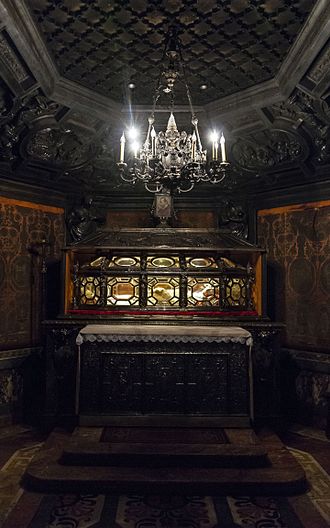
Saint Charles Borromeo’s Model Example
Today, Thursday 4 November 2021, is the feast of the great North Italian saint, St Charles Borromeo. One biographer aptly described him as always clear and precise in his views, firm in his demeanor, and constant in the execution of his projects.
If the saints are God’s reply for His Church and world at a particular time in history, then Charles Borromeo surely was a case in point. In a time where the Catholic Church in Western Europe was practically shaken from its foundations due to the Protestant Reform, he was the man to respond. Empowered by the decrees of the Council of Trent, Borromeo supervised the writing of a clear catechism, rewrote liturgical texts and music, and started enforcing clerical reform in Rome. Although Pope Pius IV named Borromeo archbishop of Milan he kept him in Rome to accomplish several official functions.
About him, Pope Benedict XVI, at the conclusion of his weekly audience of November 4, 2009, described him as an outstanding Bishop of the Diocese of Milan, who, inspired by ardent love of Christ, was a tireless teacher and guide for people.
The second lesson from the Office of Readings for Saint Charles Borromeo, declares in hiw own words: practice what you preach! I simply want to let Cardinal Charles’ most powerful and Spirit anointed words enter into our being and put us on an examination of conscience mode.
I admit that we are all weak, but if we want help, the Lord God has given us the means to find it easily. One priest may wish to lead a good, holy life, as he knows he should. He may wish to be chaste and to reflect heavenly virtues in the way he lives. Yet he does not resolve to use suitable means, such as penance, prayer, the avoidance of evil discussions and harmful and dangerous friendships. Another priest complains that as soon as he comes into church to pray the office or to celebrate Mass, a thousand thoughts fill his mind and distract him from God. But what was he doing in the sacristy before he came out for the office or for Mass? How did he prepare? What means did he use to collect his thoughts and to remain recollected?
Would you like me to teach you how to grow from virtue to virtue and how, if you are already recollected at prayer, you can be even more attentive next time, and so give God more pleasing worship? Listen, and I will tell you. If a tiny spark of God’s love already burns within you, do not expose it to the wind, for it may get blown out. Keep the stove tightly shut so that it will not lose its heat and grow cold. In other words, avoid distractions as well as you can. Stay quiet with God. Do not spend your time in useless chatter.
If teaching and preaching is your job, then study diligently and apply yourself to whatever is necessary for doing the job well. Be sure that you first preach by the way you live. If you do not, people will notice that you say one thing, but live otherwise, and your words will bring only cynical laughter and a derisive shake of the head.
Are you in charge of a parish? If so, do not neglect the parish of your own soul, do not give yourself to others so completely that you have nothing left for yourself. You have to be mindful of your people without becoming forgetful of yourself.
My brothers, you must realise that for us churchmen nothing is more necessary than meditation. We must meditate before, during and after everything we do. The prophet says: “I will pray, and then I will understand.” When you administer the sacraments, meditate on what you are doing. When you celebrate Mass, reflect on the sacrifice you are offering. When you pray the office, think about the words you are saying and the Lord to whom you are speaking. When you take care of your people, meditate on how the Lord’s blood that has washed them clean so that “all that you do becomes a work of love.”
This is the way we can easily overcome the countless difficulties we have to face day after day, which, after all, are part of our work: in meditation we find the strength to bring Christ to birth in ourselves and in other men.
Reading these Godly words I cannot not refer to what Popes Francis and Benedict said on the importance of prayer and the overt poison of senseless activism which destroys rather than bears abundant good fruit in the life of a Bishop and priest.
When speaking to the parish priests of the Diocese of Rome on Thursday, 6 March 2014, Pope Francis challenged them with this direct question: Another question I ask: in the evening, how do you conclude your day? With the Lord or in front of the television? Conscious of the essential role of prayer in a priest’s life, Pope Francis once said: It took the disciples time to really ‘become Christ’ to others so this is not a given at ordination. For this to happen, the priest needs to continue to grow in union with Christ through prayer and intimacy.
Prayer helps the priest from falling into the temptation of senseless activism. On this very crucial point Pope Benedict XVI tells us priests in his first encyclical on Christian love , Deus Caritas Est:
Prayer, as a means of drawing ever new strength from Christ, is concretely and urgently needed. People who pray are not wasting their time, even though the situation appears desperate and seems to call for action alone. Piety does not undermine the struggle against the poverty of our neighbors, however extreme. … It is time to reaffirm the importance of prayer in the face of the activism and the growing secularism of many Christians engaged in charitable work. Clearly, the Christian who prays does not claim to be able to change God’s plans or correct what he has foreseen. Rather, he seeks an encounter with the Father of Jesus Christ, asking God to be present with the consolation of the Spirit to him and his work. … Our crying out [to the Father] is, as it was for Jesus on the Cross, the deepest and most radical way of affirming our faith in his sovereign power (nos.36-38).
Finally, the great St Charles Borromeo teaches us, priests and bishops, to be guided by a continual discernment. After all this should be the existential attitude of every Christian as Pope Francis rightly teaches us in his apostolic exhortation on the call to holiness in today’s world, Gaudete et Exsultate:
Discernment is necessary not only at extraordinary times, when we need to resolve grave problems and make crucial decisions. It is a means of spiritual combat for helping us to follow the Lord more faithfully. We need it at all times, to help us recognize God’s timetable, lest we fail to heed the promptings of his grace and disregard his invitation to grow. Often discernment is exercised in small and apparently irrelevant things, since greatness of spirit is manifested in simple everyday realities. It involves striving untrammelled for all that is great, better and more beautiful, while at the same time being concerned for the little things, for each day’s responsibilities and commitments. For this reason, I ask all Christians not to omit, in dialogue with the Lord, a sincere daily “examination of conscience”. Discernment also enables us to recognize the concrete means that the Lord provides in his mysterious and loving plan, to make us move beyond mere good intentions (no. 169).
Preserve in the midst of your people, we ask, O Lord, the spirit with which you filled the Bishop Saint Charles Borromeo, that your Church may be constantly renewed and, by conforming herself to the likeness of Christ, may show his face to the world. Who lives and reigns with you in the unity of the Holy Spirit, God, for ever and ever. Amen.
St Charles Borromeo, a great Reformer of the Church, pray for us!

Saint Kateri , Canada’s Protectress
This was the title given to Saint Kateri Tekakwitha, by Pope Benedict XVI, when he canonized her on October 28th, 2012, along with six others, in Saint Peter’ Square (she had been beatified by Pope John Paul II back in 1980). With Saint Joseph as our protector, along with the Canadian martyrs, we seem to[…]Continue reading→

Remembering Father Alphonse de Valk
(Today marks the sixth anniversary of the death of Father Alphonse de Valk, C.S.B., a faithful, courageous and indefatigable Basilian priest, pro-life-and-family apostle, and the founder of Catholic Insight magazine. Here is what we wrote those on his entering into eternity five years ago, as we continue to remember him in our prayers and thoughts)[…]Continue reading→

A Tale of Two Benedicts
A grace-filled Holy Week to all our readers! As we await and prepare for the Resurrection about to dawn upon us, we might keep in mind two Benedicts: Pope Emeritus Benedict XVI, requiescat in pace, elected on this day in 2005; and today’s commemoration of the mystic pilgrim, Benedict Joseph Labre, who died on this[…]Continue reading→

My Name is Bernadette
April 16th is a propitious day, for besides the anniversary of Father de Valk’s death, who founded Catholic Insight in its print form decades ago, and the commemoration of the ‘two Benedicts’, mentioned in accompanying posts, today we also recall Saint Bernadette Soubirous, the young visionary to whom the Virgin Mary appeared numerous times at[…]Continue reading→

Saint Lydwina of Schiedam and Suffering Joyfully
Saint Lydwina of Schiedam (1380 – 1433) was one of the countless and glorious ‘victim souls’ in the history of the Church, those whose lives are filled with suffering, often of an unimaginable intensity, but who suffer joyfully. She was a fifteen-year old Dutch girl, out skating one day, when she fell and broke one[…]Continue reading→

The Glorious Martyrdoms of Martin and Maximus
As we enter into Eastertide, we recall on this 13th of April Pope Saint Martin I (+655), one of the noblest, if most tragic, of the successors of Saint Peter. Born in Umbria, Italy, he was of noble lineage, with great intelligence combined with charity and love of the poor and the Church. While still[…]Continue reading→

Canonizing Sister Faustina and Divine Mercy
HOMILY OF THE HOLY FATHER MASS IN ST PETER’S SQUARE FOR THE CANONIZATION OF SR MARY FAUSTINA KOWALSKA Sunday, 30 April 2000 1. “Confitemini Domino quoniam bonus, quoniam in saeculum misericordia eius”; “Give thanks to the Lord for he is good; his steadfast love endures for ever” (Ps 118: 1). So the Church sings on the Octave of[…]Continue reading→

Divine Mercy Sunday – An Echo of Every Mass
Reach out your hand and put it in my side. Do not doubt but believe’… ‘My Lord and my God!’ (Jn. 20:18)). Today is Divine Mercy Sunday, and as we celebrate the end of the Easter Octave, we contemplate the wounded side of our Saviour, the Church’s source of life. On Good Friday in the[…]Continue reading→
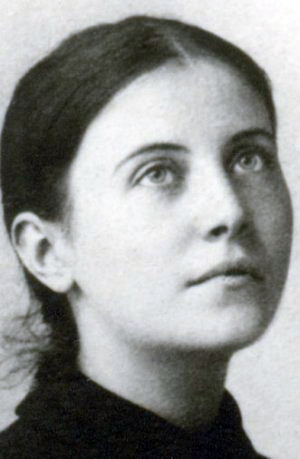
Saint Gemma Galgani
On this April 11th, in 1903 – the same year that the Italian Guiseppe Sarto was elected Pope later that summer as Pius X – a lovely, young Italian woman died, by the name of Gemma Galgani. She lived a brief life of 24 years, as did a number of other young saints, including Pier[…]Continue reading→

First Holy Communion: Sermon from May 16, 1943
Here is a sermon from the good old days by +Rev. Msgr. Vincent Nicholas Foy (August 14, 1915 – March 13, 2017), from 1943. Readers may recall that Pope Saint Pius X, by the decree Quam Singulari in 1910, lowered the customary age of reception of Holy Communion – after the rigours of the plague[…]Continue reading→