
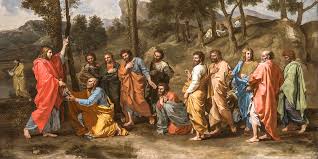
Naming the Apostles
We encounter the name of Jude in the Book of Acts. The evangelists Matthew and Mark name him as Thaddeus. In his catechesis on Simon and Jude, of Wednesday 11 October 2006, Pope Benedict XVI tells us that with regard to Jude Thaddaeus, this is what tradition has called him, combining two different names: in fact, whereas Matthew and Mark call him simply “Thaddaeus” (Mt 10: 3; Mk 3: 18), Luke calls him “Judas, the son of James” (Lk 6: 16; Acts 1: 13). The nickname “Thaddaeus” is of uncertain origin and is explained either as coming from the Aramaic, taddà’, which means “breast” and would therefore suggest “magnanimous”, or as an abbreviation of a Greek name, such as “Teodòro, Teòdoto”.
Connected with the apostle Thaddaeus is the question he makes to Jesus: “Lord, how is it that you will manifest yourself to us, and not to the world?” (John 14:22). A question to which Jesus mysteriously replied: If a man loves me, he will keep my word, and my Father will love him, and we will come to him and make our home with him. (John 14:23). But does Jesus’ answer actually mean?
Pope Benedict gives us a very interesting explanation when he tells us in the catechesis we have just referred to: This means that the Risen One must be seen, must be perceived also by the heart, in a way so that God may take up his abode within us. The Lord does not appear as a thing. He desires to enter our lives, and therefore his manifestation is a manifestation that implies and presupposes an open heart. Only in this way do we see the Risen One. In simple words, Jesus wants to reveal to the world through you and me, provided that we open our heart to Him.
The name of Jude reminds us of the author of the Letter of Jude. As we know this letter is addressed to a wider circle and not simply confined to a specifically particular local Church. On this letter Pope Benedict comments:
A major concern of this writing is to put Christians on guard against those who make a pretext of God’s grace to excuse their own licentiousness and corrupt their brethren with unacceptable teachings, introducing division within the Church “in their dreamings” (v. 8). This is how Jude defines their doctrine and particular ideas. He even compares them to fallen angels and, mincing no words, says that “they walk in the way of Cain” (v. 11).
Furthermore, he brands them mercilessly as “waterless clouds, carried along by winds; fruitless trees in late autumn, twice dead, uprooted; wild waves of the sea, casting up the foam of their own shame; wandering stars for whom the nether gloom of darkness has been reserved for ever” (vv. 12-13).
Today, perhaps, we are no longer accustomed to using language that is so polemic, yet that tells us something important. In the midst of all the temptations that exist, with all the currents of modern life, we must preserve our faith’s identity. Of course, the way of indulgence and dialogue, on which the Second Vatican Counsel happily set out, should certainly be followed firmly and consistently.
But this path of dialogue, while so necessary, must not make us forget our duty to rethink and to highlight just as forcefully the main and indispensable aspects of our Christian identity. Moreover, it is essential to keep clearly in mind that our identity requires strength, clarity and courage in light of the contradictions of the world in which we live.
Cardinal Ratzinger was right when, in the Declaration Dominus Iesus, on the unicity and salvific universality of Jesus Christ and the Church, wrote: Inter-religious dialogue, which is part of the Church’s evangelizing mission, requires an attitude of understanding and a relationship of mutual knowledge and reciprocal enrichment, in obedience to the truth and with respect for freedom (no. 2).
Further in the document Dominus Iesus gives us the criteria of fruitful inter-religious dialogue.
In inter-religious dialogue as well, the mission ad gentes “today as always retains its full force and necessity”. “Indeed, God -desires all men to be saved and come to the knowledge of the truth’ (1 Tim 2:4); that is, God wills the salvation of everyone through the knowledge of the truth. Salvation is found in the truth. Those who obey the promptings of the Spirit of truth are already on the way of salvation. But the Church, to whom this truth has been entrusted, must go out to meet their desire, so as to bring them the truth. Because she believes in God’s universal plan of salvation, the Church must be missionary”. Inter-religious dialogue, therefore, as part of her evangelizing mission, is just one of the actions of the Church in her mission ad gentes. Equality, which is a presupposition of inter-religious dialogue, refers to the equal personal dignity of the parties in dialogue, not to doctrinal content, nor even less to the position of Jesus Christ – who is God himself made man – in relation to the founders of the other religions. Indeed, the Church, guided by charity and respect for freedom, must be primarily committed to proclaiming to all people the truth definitively revealed by the Lord, and to announcing the necessity of conversion to Jesus Christ and of adherence to the Church through Baptism and the other sacraments, in order to participate fully in communion with God, the Father, Son and Holy Spirit. Thus, the certainty of the universal salvific will of God does not diminish, but rather increases the duty and urgency of the proclamation of salvation and of conversion to the Lord Jesus Christ (no.22).
We encounter Simon in each and every list of the apostles. In Matthew and Mark Simon is represented as a “Cananaean” whereas Luke merely refers to him as “Zealot”. Pope Benedict remarks: In Hebrew the verb qanà’ means “to be jealous, ardent” and can be said both of God, since he is jealous with regard to his Chosen People (cf. Ex 20: 5), and of men who burn with zeal in serving the one God with unreserved devotion, such as Elijah (cf. I Kgs 19: 10). Thus, it is highly likely that even if this Simon was not exactly a member of the nationalist movement of Zealots, he was at least marked by passionate attachment to his Jewish identity, hence, for God, his People and divine Law.
Simon, who was passionate about his Jewish identity, was so different from Matthew which regarded as impure since he was a tax collector. However, Jesus purposely chose his close collaborators from different and contrasting backgrounds. For Him, what highly mattered was themselves and not their social status and labels! Jesus was the one who held them together.
On this very important point Pope Benedict says: This is clearly a lesson for us who are often inclined to accentuate differences and even contrasts, forgetting that in Jesus Christ we are given the strength to get the better of our continual conflicts. Let us also bear in mind that the group of the Twelve is the prefiguration of the Church, where there must be room for all charisms, peoples and races, all human qualities that find their composition and unity in communion with Jesus.
O God, who by the blessed Apostles have brought us to acknowledge your name, graciously grant, through the intercession of Saints Simon and Jude, that the Church may constantly grow by increase of the peoples who believe in you. Through our Lord Jesus Christ, your Son, who lives and reigns with you in the unity of the Holy Spirit, God, for ever and ever. Amen.

Saint Kateri , Canada’s Protectress
This was the title given to Saint Kateri Tekakwitha, by Pope Benedict XVI, when he canonized her on October 28th, 2012, along with six others, in Saint Peter’ Square (she had been beatified by Pope John Paul II back in 1980). With Saint Joseph as our protector, along with the Canadian martyrs, we seem to[…]Continue reading→

Remembering Father Alphonse de Valk
(Today marks the sixth anniversary of the death of Father Alphonse de Valk, C.S.B., a faithful, courageous and indefatigable Basilian priest, pro-life-and-family apostle, and the founder of Catholic Insight magazine. Here is what we wrote those on his entering into eternity five years ago, as we continue to remember him in our prayers and thoughts)[…]Continue reading→

A Tale of Two Benedicts
A grace-filled Holy Week to all our readers! As we await and prepare for the Resurrection about to dawn upon us, we might keep in mind two Benedicts: Pope Emeritus Benedict XVI, requiescat in pace, elected on this day in 2005; and today’s commemoration of the mystic pilgrim, Benedict Joseph Labre, who died on this[…]Continue reading→

My Name is Bernadette
April 16th is a propitious day, for besides the anniversary of Father de Valk’s death, who founded Catholic Insight in its print form decades ago, and the commemoration of the ‘two Benedicts’, mentioned in accompanying posts, today we also recall Saint Bernadette Soubirous, the young visionary to whom the Virgin Mary appeared numerous times at[…]Continue reading→

Saint Lydwina of Schiedam and Suffering Joyfully
Saint Lydwina of Schiedam (1380 – 1433) was one of the countless and glorious ‘victim souls’ in the history of the Church, those whose lives are filled with suffering, often of an unimaginable intensity, but who suffer joyfully. She was a fifteen-year old Dutch girl, out skating one day, when she fell and broke one[…]Continue reading→

The Glorious Martyrdoms of Martin and Maximus
As we enter into Eastertide, we recall on this 13th of April Pope Saint Martin I (+655), one of the noblest, if most tragic, of the successors of Saint Peter. Born in Umbria, Italy, he was of noble lineage, with great intelligence combined with charity and love of the poor and the Church. While still[…]Continue reading→
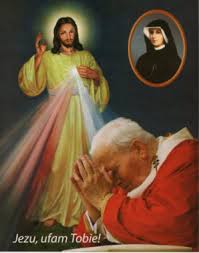
Canonizing Sister Faustina and Divine Mercy
HOMILY OF THE HOLY FATHER MASS IN ST PETER’S SQUARE FOR THE CANONIZATION OF SR MARY FAUSTINA KOWALSKA Sunday, 30 April 2000 1. “Confitemini Domino quoniam bonus, quoniam in saeculum misericordia eius”; “Give thanks to the Lord for he is good; his steadfast love endures for ever” (Ps 118: 1). So the Church sings on the Octave of[…]Continue reading→

Divine Mercy Sunday – An Echo of Every Mass
Reach out your hand and put it in my side. Do not doubt but believe’… ‘My Lord and my God!’ (Jn. 20:18)). Today is Divine Mercy Sunday, and as we celebrate the end of the Easter Octave, we contemplate the wounded side of our Saviour, the Church’s source of life. On Good Friday in the[…]Continue reading→
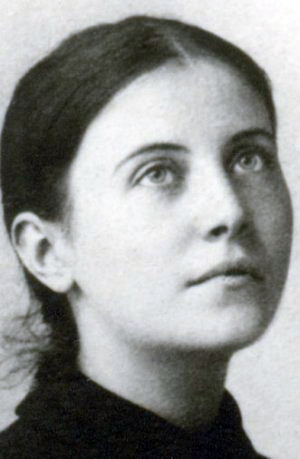
Saint Gemma Galgani
On this April 11th, in 1903 – the same year that the Italian Guiseppe Sarto was elected Pope later that summer as Pius X – a lovely, young Italian woman died, by the name of Gemma Galgani. She lived a brief life of 24 years, as did a number of other young saints, including Pier[…]Continue reading→
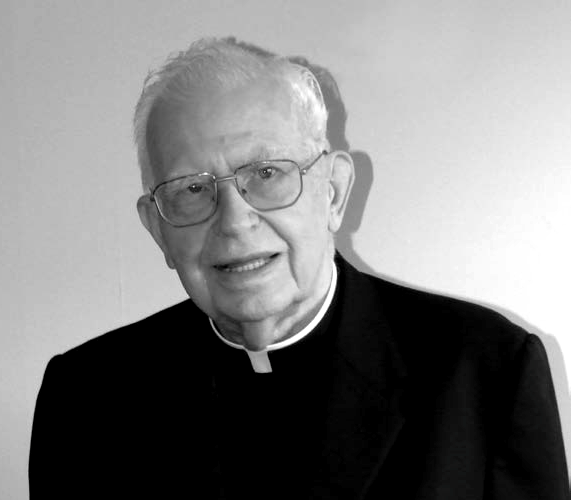
First Holy Communion: Sermon from May 16, 1943
Here is a sermon from the good old days by +Rev. Msgr. Vincent Nicholas Foy (August 14, 1915 – March 13, 2017), from 1943. Readers may recall that Pope Saint Pius X, by the decree Quam Singulari in 1910, lowered the customary age of reception of Holy Communion – after the rigours of the plague[…]Continue reading→