
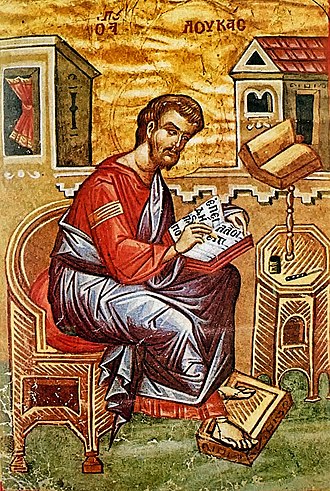
Saint Luke: Passionate Narrator of God’s Infinite Mercy
Today, Monday October 18, 2021, is the feast day of St Luke, the Evangelist and the author of the Book of Acts.
It is interesting that if one were to look closely at the Gospel he left us, one notices the merciful tone of it. To begin with, we notice that the word mercy is used some ten times whereas the adjective merciful is used three times. More than that, and as Biblical scholars rightly pointed out, Luke’s Gospel has an entire chapter – fifteen – dedicated to God’s merciful love for those who leave his mercy, wherein we find the parable of the merciful father. and the prodigal son. The Father’s loving kindness who does not stop from loving and forgiving us all way through in our lives.
In Luke’s Gospel there is also the theme of forgiveness, the exemplar of such is Jesus himself, Who, when nailed on the Cross, prayed to His Father and Our Father: Father, forgive them; for they know not what they do (Luke 23:34). This powerful word, forgiveness, is so important in this Gospel that Luke uses it some twenty times! In simple words, this third evangelist is telling us that if we do not forgive, as our Father in Heaven forgives us, we are not living our dignity as the sons and daughters of our One Merciful Father. Moreover, we shall be in direct opposition to Jesus who, on the Cross, plainly and unconditionally forgave those who crucified Him.
Luke’s Gospel reminds us of the relevance of joy. The Christian is the son and daughter of Christian joy! The word joy is found some thirteen times in the entire Gospel text, and should be the distinctive mark of the followers of Jesus. In Luke’s chapter 15, joy is the response in Heaven for every person who turns back to the Father’s Heart! Let us taste this joy in the subsequent text taken from Luke chapter 15, the chapter entirely dedicated to God’s mercy!
“What man of you, having a hundred sheep, if he has lost one of them, does not leave the ninety-nine in the wilderness, and go after the one which is lost, until he finds it? And when he has found it, he lays it on his shoulders, rejoicing. And when he comes home, he calls together his friends and his neighbors, saying to them, `Rejoice with me, for I have found my sheep which was lost.’ Just so, I tell you, there will be more joy in heaven over one sinner who repents than over ninety-nine righteous persons who need no repentance. “Or what woman, having ten silver coins, if she loses one coin, does not light a lamp and sweep the house and seek diligently until she finds it? And when she has found it, she calls together her friends and neighbors, saying, `Rejoice with me, for I have found the coin which I had lost.’ Just so, I tell you, there is joy before the angels of God over one sinner who repents” (Luke 15:4-10).
Christ’s catechetical discourse narrated by Luke boldly affirms the importance of women and outcasts in the birth, infancy, life, passion, death and resurrection of Jesus. Back from my theology days, our New Testament lecturers kept harping on the fact that Luke’s Gospel is the Gospel of women. With how much power did Luke portray Mary, the Mother of Jesus the Son of God; Elizabeth; the widow of the parable; the widow who gave all she had as a gift to the temple treasury; Anna the prophetess; the widow of Nain; the women of Jerusalem; the women who sponsored Jesus in his ministry such as Joanna, the wife of Chuza, Herod’s steward, and Susanna, and many others (Luke 8:3), and women who were healed by Jesus himself, as the Gospel text openly tells us: also some women who had been healed of evil spirits and infirmities: Mary, called Mag’dalene, from whom seven demons had gone out (Luke 8:2).
The third Gospel is filled with the theme that God’s most merciful and joyous salvation is for everyone! How beautiful and eloquent is the conclusion of this Gospel when Jesus says to his disciples before he ascended into heaven: Thus it is written, that the Christ should suffer and on the third day rise from the dead, and that repentance and forgiveness of sins should be preached in his name to all nations, beginning from Jerusalem. You are witnesses of these things. And behold, I send the promise of my Father upon you; but stay in the city, until you are clothed with power from on high.” (Luke 24:46-49).
It is precisely on this note with which the Book of Acts starts. And while staying with them he charged them not to depart from Jerusalem, but to wait for the promise of the Father, which, he said, “you heard from me, for John baptized with water, but before many days you shall be baptized with the Holy Spirit” (Acts 1:4-5). But things took a definite turn when the Holy Spirit descended upon them in chapter 2. Let us appreciate Luke’s special and most exquisite rendering of this pivotal event in the life of the Church.
When the day of Pentecost had come, they were all together in one place. And suddenly a sound came from heaven like the rush of a mighty wind, and it filled all the house where they were sitting. And there appeared to them tongues as of fire, distributed and resting on each one of them. And they were all filled with the Holy Spirit and began to speak in other tongues, as the Spirit gave them utterance. Now there were dwelling in Jerusalem Jews, devout men from every nation under heaven. And at this sound the multitude came together, and they were bewildered, because each one heard them speaking in his own language. And they were amazed and wondered, saying, “Are not all these who are speaking Galileans? And how is it that we hear, each of us in his own native language? Par’thians and Medes and E’lamites and residents of Mesopota’mia, Judea and Cappado’cia, Pontus and Asia, Phryg’ia and Pamphyl’ia, Egypt and the parts of Libya belonging to Cyre’ne, and visitors from Rome, both Jews and proselytes, Cretans and Arabians, we hear them telling in our own tongues the mighty works of God.” And all were amazed and perplexed, saying to one another, “What does this mean?” (Luke 2:1-12).
The Book tells us, in the most wonderful way, how God’s mercy, as shown in one’s repentance and forgiveness of sins by God, is really preached to all nations (see Luke 24:46-49), under the guidance of the Holy Spirit. Luke uses the word Holy Spirit and Spirit some 57 times in the whole Book of Acts! Thus, the Church, although heavily persecuted, can expand and do all Jesus’ work thanks to and solely by his Holy Spirit!
Holy Spirit, transform me and us as a Church, in and through you, through the intercession of Mary, Our Mother, and St Luke, the third evangelist and the passionate writer of God’s mercy. Amen.

Saint Kateri , Canada’s Protectress
This was the title given to Saint Kateri Tekakwitha, by Pope Benedict XVI, when he canonized her on October 28th, 2012, along with six others, in Saint Peter’ Square (she had been beatified by Pope John Paul II back in 1980). With Saint Joseph as our protector, along with the Canadian martyrs, we seem to[…]Continue reading→

Remembering Father Alphonse de Valk
(Today marks the sixth anniversary of the death of Father Alphonse de Valk, C.S.B., a faithful, courageous and indefatigable Basilian priest, pro-life-and-family apostle, and the founder of Catholic Insight magazine. Here is what we wrote those on his entering into eternity five years ago, as we continue to remember him in our prayers and thoughts)[…]Continue reading→
A Tale of Two Benedicts
A grace-filled Holy Week to all our readers! As we await and prepare for the Resurrection about to dawn upon us, we might keep in mind two Benedicts: Pope Emeritus Benedict XVI, requiescat in pace, elected on this day in 2005; and today’s commemoration of the mystic pilgrim, Benedict Joseph Labre, who died on this[…]Continue reading→

My Name is Bernadette
April 16th is a propitious day, for besides the anniversary of Father de Valk’s death, who founded Catholic Insight in its print form decades ago, and the commemoration of the ‘two Benedicts’, mentioned in accompanying posts, today we also recall Saint Bernadette Soubirous, the young visionary to whom the Virgin Mary appeared numerous times at[…]Continue reading→
Saint Lydwina of Schiedam and Suffering Joyfully
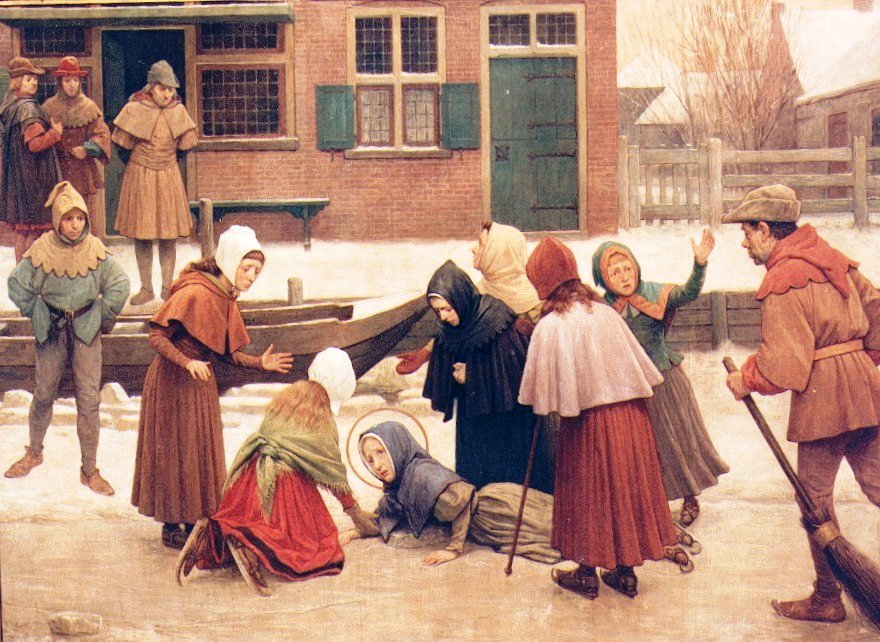
Saint Lydwina of Schiedam (1380 – 1433) was one of the countless and glorious ‘victim souls’ in the history of the Church, those whose lives are filled with suffering, often of an unimaginable intensity, but who suffer joyfully. She was a fifteen-year old Dutch girl, out skating one day, when she fell and broke one[…]Continue reading→
The Glorious Martyrdoms of Martin and Maximus
As we enter into Eastertide, we recall on this 13th of April Pope Saint Martin I (+655), one of the noblest, if most tragic, of the successors of Saint Peter. Born in Umbria, Italy, he was of noble lineage, with great intelligence combined with charity and love of the poor and the Church. While still[…]Continue reading→

Canonizing Sister Faustina and Divine Mercy
HOMILY OF THE HOLY FATHER MASS IN ST PETER’S SQUARE FOR THE CANONIZATION OF SR MARY FAUSTINA KOWALSKA Sunday, 30 April 2000 1. “Confitemini Domino quoniam bonus, quoniam in saeculum misericordia eius”; “Give thanks to the Lord for he is good; his steadfast love endures for ever” (Ps 118: 1). So the Church sings on the Octave of[…]Continue reading→

Divine Mercy Sunday – An Echo of Every Mass
Reach out your hand and put it in my side. Do not doubt but believe’… ‘My Lord and my God!’ (Jn. 20:18)). Today is Divine Mercy Sunday, and as we celebrate the end of the Easter Octave, we contemplate the wounded side of our Saviour, the Church’s source of life. On Good Friday in the[…]Continue reading→
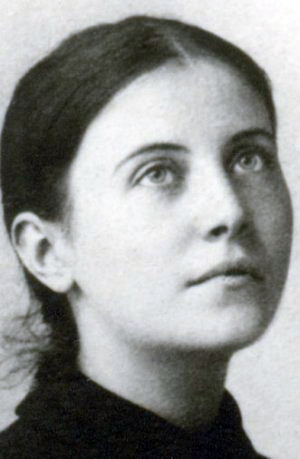
Saint Gemma Galgani
On this April 11th, in 1903 – the same year that the Italian Guiseppe Sarto was elected Pope later that summer as Pius X – a lovely, young Italian woman died, by the name of Gemma Galgani. She lived a brief life of 24 years, as did a number of other young saints, including Pier[…]Continue reading→
First Holy Communion: Sermon from May 16, 1943
Here is a sermon from the good old days by +Rev. Msgr. Vincent Nicholas Foy (August 14, 1915 – March 13, 2017), from 1943. Readers may recall that Pope Saint Pius X, by the decree Quam Singulari in 1910, lowered the customary age of reception of Holy Communion – after the rigours of the plague[…]Continue reading→