
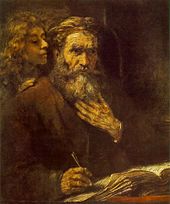
Matthew’s Marvelous Metanoia
Saint Matthew, also known as Levi, presents Christ as the new Moses, leading His people from the darkness and slavery of sin into the light and freedom of salvation. Yet, Matthew also likely saw himself in Moses, perhaps, of the same tribe – Levi – and whose priestly lineage he likely shared, representing all those drawn out from the stagnant mud of sin. His recounting of Christ’s life follows in many ways the first five books of the Bible, the Mosaic Pentateuch.
We know little of Levi’s prior life, nor of his subsequent life as ‘Matthew’ – whose Hebraic origins mean ‘gift of the Lord’ – only that he was a tax collector, a loathed profession, a betrayer of his own people, squeezing out the hard-earned coins from his fellow Jews to enrich the already rich, such as Herod, which may sound sort of familiar and au courant.
We know not how sinful Matthew’s life was otherwise, only that as soon as he was called, he, without hesitation, arose and followed Him. The first verb is the same one used for Christ’s future resurrection, but here it is a rising from spiritual death. The Venerable Bede in today’s Office of Readings teaches that Matthew was already interiorly prepared to accept the grace of conversion that Christ offered – that mystical evangelical metanoia, the ‘turning around of one’s mind and soul’; conversion to the fullness of life, the mission of Apostleship and eventually, according to our tradition, martyrdom.
‘And he rose and followed him’. There is no reason for surprise that the tax collector abandoned earthly wealth as soon as the Lord commanded him. Nor should one be amazed that neglecting his wealth, he joined a band of men whose leader had, on Matthew’s assessment, no riches at all. Our Lord summoned Matthew by speaking to him in words. By an invisible, interior impulse flooding his mind with the light of grace, he instructed him to walk in his footsteps. In this way Matthew could understand that Christ, who was summoning him away from earthly possessions, had incorruptible treasures of heaven in his gift..
The sinners and tax collectors who gathered with Matthew – now full of an exuberant joy, and why not? – for a celebratory meal with Christ were those seeking the truth, and forgiveness thereby. They were not the recalcitrant, wallowing in their sin, and justifying evil by the measure of their own behaviour and inclinations, as do many of our own age, who resemble more the hard-hearted and embittered Pharisees: ‘Whatever I think is good, is good, indeed must be good’, a self-justification condemned not just by Christ, but by Pope John Paul in Veritatis Splendor, words which are worth quoting, as our Church divides over the proper interpretation of ‘mercy’:
In this context, appropriate allowance is made both for God’s mercy towards the sin of the man who experiences conversion and for the understanding of human weakness. Such understanding never means compromising and falsifying the standard of good and evil in order to adapt it to particular circumstances. It is quite human for the sinner to acknowledge his weakness and to ask mercy for his failings;
So far, so good, and those were the ones gathered in Matthew’s home, amongst whom we should count ourselves. But the Holy Father goes on to sternly warn:
what is unacceptable is the attitude of one who makes his own weakness the criterion of the truth about the good, so that he can feel self-justified, without even the need to have recourse to God and his mercy. An attitude of this sort corrupts the morality of society as a whole, since it encourages doubt about the objectivity of the moral law in general and a rejection of the absoluteness of moral prohibitions regarding specific human acts, and it ends up by confusing all judgments about values. (#104)
This week, the House of Congress in the United States will vote on a bill forcing abortion on all the states, and many of those pushing this legislation are self-proclaimed ‘Catholics’. There seems no end to our capacity to rationalize, and reduce God’s law to fit our own shriveled hearts.
The encyclical of Pope John Paul was not quoted once in Amoris Laetitia, which should give one pause. Should not the ‘Splendour of Truth’ rather be shouted from the rooftops, that we all, like Matthew, may repent, before it be too late? Whatever one’s interpretation of that problematical ‘chapter 8’, we should realize that ‘welcoming sinners’ into the Church, and to Communion, will not help them much, unless they are, with Matthew the disciple, willing to repent of their sins. Only such will we experience that peace of the Lord that ‘surpasseth understanding’, like the other tax collector, Zaccheus, and countless other souls throughout history, when salvation enters our home, hearth and heart.
We will leave you, dear reader, with the words of Saint Bede, which may warm our own hearts on this last day of summer:
To see a deeper understanding of the great celebration Matthew held at his house, we must realise that he not only gave a banquet for the Lord at his earthly residence, but far more pleasing was the banquet set in his own heart which he provided through faith and love. Our Saviour attests to this: ‘Behold I stand at the door and knock; if anyone hears my voice and opens the door, I will come in to him and eat with him, and he with me’.
Saint Matthew, ora pro nobis!

Carney’s Amoral Majority
After five defections – euphemistically described as ‘crossing the floor’ – and three by-elections, Mark Carney and his Liberals how have their coveted majority. One wonders what bowls of pottage were offered in back-room deals. In the archaic monarchical system that is the Dominion of Canada, this majority allows the newly-minted Prime Minister to rule[…]Continue reading→

Saint Kateri , Canada’s Protectress
This was the title given to Saint Kateri Tekakwitha, by Pope Benedict XVI, when he canonized her on October 28th, 2012, along with six others, in Saint Peter’ Square (she had been beatified by Pope John Paul II back in 1980). With Saint Joseph as our protector, along with the Canadian martyrs, we seem to[…]Continue reading→

Remembering Father Alphonse de Valk
(Today marks the sixth anniversary of the death of Father Alphonse de Valk, C.S.B., a faithful, courageous and indefatigable Basilian priest, pro-life-and-family apostle, and the founder of Catholic Insight magazine. Here is what we wrote those on his entering into eternity five years ago, as we continue to remember him in our prayers and thoughts)[…]Continue reading→

A Tale of Two Benedicts
A grace-filled Holy Week to all our readers! As we await and prepare for the Resurrection about to dawn upon us, we might keep in mind two Benedicts: Pope Emeritus Benedict XVI, requiescat in pace, elected on this day in 2005; and today’s commemoration of the mystic pilgrim, Benedict Joseph Labre, who died on this[…]Continue reading→

My Name is Bernadette
April 16th is a propitious day, for besides the anniversary of Father de Valk’s death, who founded Catholic Insight in its print form decades ago, and the commemoration of the ‘two Benedicts’, mentioned in accompanying posts, today we also recall Saint Bernadette Soubirous, the young visionary to whom the Virgin Mary appeared numerous times at[…]Continue reading→

Saint Lydwina of Schiedam and Suffering Joyfully
Saint Lydwina of Schiedam (1380 – 1433) was one of the countless and glorious ‘victim souls’ in the history of the Church, those whose lives are filled with suffering, often of an unimaginable intensity, but who suffer joyfully. She was a fifteen-year old Dutch girl, out skating one day, when she fell and broke one[…]Continue reading→

The Glorious Martyrdoms of Martin and Maximus
As we enter into Eastertide, we recall on this 13th of April Pope Saint Martin I (+655), one of the noblest, if most tragic, of the successors of Saint Peter. Born in Umbria, Italy, he was of noble lineage, with great intelligence combined with charity and love of the poor and the Church. While still[…]Continue reading→

Canonizing Sister Faustina and Divine Mercy
HOMILY OF THE HOLY FATHER MASS IN ST PETER’S SQUARE FOR THE CANONIZATION OF SR MARY FAUSTINA KOWALSKA Sunday, 30 April 2000 1. “Confitemini Domino quoniam bonus, quoniam in saeculum misericordia eius”; “Give thanks to the Lord for he is good; his steadfast love endures for ever” (Ps 118: 1). So the Church sings on the Octave of[…]Continue reading→

Divine Mercy Sunday – An Echo of Every Mass
Reach out your hand and put it in my side. Do not doubt but believe’… ‘My Lord and my God!’ (Jn. 20:18)). Today is Divine Mercy Sunday, and as we celebrate the end of the Easter Octave, we contemplate the wounded side of our Saviour, the Church’s source of life. On Good Friday in the[…]Continue reading→

Saint Gemma Galgani
On this April 11th, in 1903 – the same year that the Italian Guiseppe Sarto was elected Pope later that summer as Pius X – a lovely, young Italian woman died, by the name of Gemma Galgani. She lived a brief life of 24 years, as did a number of other young saints, including Pier[…]Continue reading→