
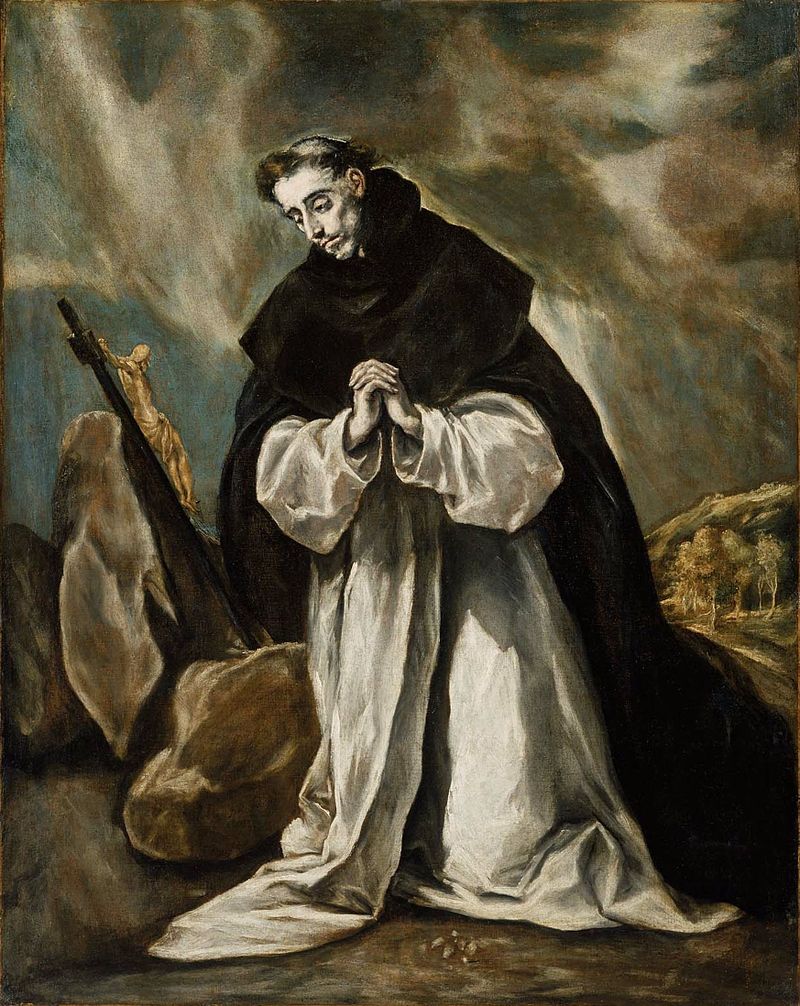
Dominic and the Dogs of (Spiritual) War
(As Father Attard reminds us, this is the 8th centenary of the death of the great Saint Dominic, entering heaven on August 6th, 1221, four years before the birth of one of his greatest disciples, Thomas Aquinas. Although this year his feast falls on a Sunday, we though it a propos to publish a couple of articles on the great founder, signifying what one holy soul ‘giving all to God’ can do, to change the world and all history. For Pope Francis’ letter to Brother Gerard Timoner, Master General, of last May, commemorating this anniversary, please see here).
Saint Dominic (+1221) was one of those souls destined from birth to do great things – as, we may suppose, all saints are in some way. But all the contemporary accounts attest to his burning desire for God from the earliest age: His mother, Jane of Aza (eventually canonized by Pope Leo XII in 1828) had a prophecy during her pregnancy: of a dog with a flaming torch in its mouth setting the world ablaze – some say the story was made up, afte a play on the name of the Dominicans – Domini canes, the ‘dogs of the Lord’. But like all legends, there is at least some truth to it: After all, her son did set the world on fire, and would a saint ever fib?
Dominic, destined for the religious life, first joined the Augustinians, and was sent on a mission to convert the Cathars in southern France, a heretical sect that denied the goodness of God’s creation, including marriage and children, a mediaeval version of the early Manichees, who thought the noblest thing one could do was commit slow suicide by starvation. At the very least, do not procreate. What is old is new again.
It was a demonic doctrine, and the State tried to crush them by force, while the Church tried by eloquent preaching. But Dominic realized that the best way to convert them was to imitate their own lives of poverty and austerity, but not out of fear or loathing, but joy and love: To be cheerful paupers for Christ, loving all creation, yet at the same time highly educated and persuasive. Dominic had already spent ten years in university studies, and had adopted an ascetical life, with long hours in prayer and meditation.
So he founded an Order to do the work, calling them the Ordo Praedicatorum, the ‘Order of Preachers’, but commonly called the Dominicans, whose primary task is to contemplate, study and hand on the fruits of this work to those who ‘know not the truth’. I heard somewhere that in their Rule, Dominicans are supposed to study four hours a day; I hope that is still true, both in theory and in practice, for God’s people still perish for lack of truth, as the prophet Hosea lamented – now perhaps more than ever. Yet prayer is their primary weapon, not least the Rosary of Our Lady, devotion to which, and to whom, Dominic helped to propagate – the Virgin Mary, whom no heretic, nor even less demon, can withstand.
Dominic was more clear in his purpose and vision than his contemporary Francis, who was always ambivalent about beginning an Order. For how does one build an organization on the principles of a man whose very mission was to own nothing? Hence, the persistent fissiparity of the followers of Francis; they would be the largest Order in the Church, if there not so many branches and types of them, all seeking to return to that ideal of their founder. Much to the good, and there have been countless saints, missionaries and martyrs amongst the Franciscans.
Yet, from the beginning, Dominic was clear that he wanted an Order of scholarly priests, firm and resolved in their work and purpose, first, against the Cathars, but, seeing their value, the Church soon used the Dominicans as agents against all heresies, and as preachers and teachers of the full, unbounded clarity of orthodoxy. It is a war, but a joyful one, whose mission is not to destroy the enemy, but lead him to paradise.
Dominic taught the goodness of good the things of this world, and he attested to this goodness, ironically, by giving them up for God, going barefoot, never using a bed, abstaining from meat, an ascetical life, combined with strict chastity and purity, but always praising the Almighty for all He had given, as his spiritual son, Thomas Aquinas, born four years after the death of the founder, would do even more clearly and systematically, and his writings – not least the synthesis of his quasi-miraculous Summa – stand as a testament to what Dominic began.
So pray to Dominic and Thomas today for a return to that clarity of vision, the truth of all creation in all its depth and wonder.
Praise God, for we are fearfully and wonderfully made.
Saint Dominic, ora pro nobis!
, four years before his most famous spiritual son, Thomas of Aquinas was born, was, like the famed ‘Dumb Ox’, to fulfil much in a relatively short life: They both died at around the half-century mark, when some are just getting going. After all, Aristotle, whom Thomas did much to make a household name, claimed a man was not mature enough to study metaphysics until the tender age of 40, which was the age the Jews thought requisite to have developed a similar maturity to have a spiritual opinion; hence, their reply to the Christ, that He – yes, the Eternal One – was yet still but a relative youth in his early thirties.
But to God, all time, all ages, are relative, and from our human perspective, our main purpose is, by the grace of God, to save our souls, and help save those around us. Everything else, to paraphrase Einstein in a different context, is detail. Love the Lord thy God with all thy heart, soul, mind and strength, and thy neighbour as thyself.
The first and foremost way to love the other is to offer them the truth, which is a task to which Dominic dedicated his life, founding the ‘Order of Preachers’, Ordo Praedicatorum,
Carney’s Amoral Majority
After five defections – euphemistically described as ‘crossing the floor’ – and three by-elections, Mark Carney and his Liberals how have their coveted majority. One wonders what bowls of pottage were offered in back-room deals. In the archaic monarchical system that is the Dominion of Canada, this majority allows the newly-minted Prime Minister to rule[…]Continue reading→

Saint Kateri , Canada’s Protectress
This was the title given to Saint Kateri Tekakwitha, by Pope Benedict XVI, when he canonized her on October 28th, 2012, along with six others, in Saint Peter’ Square (she had been beatified by Pope John Paul II back in 1980). With Saint Joseph as our protector, along with the Canadian martyrs, we seem to[…]Continue reading→

A Tale of Two Benedicts
A grace-filled Holy Week to all our readers! As we await and prepare for the Resurrection about to dawn upon us, we might keep in mind two Benedicts: Pope Emeritus Benedict XVI, requiescat in pace, elected on this day in 2005; and today’s commemoration of the mystic pilgrim, Benedict Joseph Labre, who died on this[…]Continue reading→

My Name is Bernadette
April 16th is a propitious day, for besides the anniversary of Father de Valk’s death, who founded Catholic Insight in its print form decades ago, and the commemoration of the ‘two Benedicts’, mentioned in accompanying posts, today we also recall Saint Bernadette Soubirous, the young visionary to whom the Virgin Mary appeared numerous times at[…]Continue reading→

Saint Lydwina of Schiedam and Suffering Joyfully
Saint Lydwina of Schiedam (1380 – 1433) was one of the countless and glorious ‘victim souls’ in the history of the Church, those whose lives are filled with suffering, often of an unimaginable intensity, but who suffer joyfully. She was a fifteen-year old Dutch girl, out skating one day, when she fell and broke one[…]Continue reading→

The Glorious Martyrdoms of Martin and Maximus
As we enter into Eastertide, we recall on this 13th of April Pope Saint Martin I (+655), one of the noblest, if most tragic, of the successors of Saint Peter. Born in Umbria, Italy, he was of noble lineage, with great intelligence combined with charity and love of the poor and the Church. While still[…]Continue reading→

Canonizing Sister Faustina and Divine Mercy
HOMILY OF THE HOLY FATHER MASS IN ST PETER’S SQUARE FOR THE CANONIZATION OF SR MARY FAUSTINA KOWALSKA Sunday, 30 April 2000 1. “Confitemini Domino quoniam bonus, quoniam in saeculum misericordia eius”; “Give thanks to the Lord for he is good; his steadfast love endures for ever” (Ps 118: 1). So the Church sings on the Octave of[…]Continue reading→

Saint Stanislaus of Szczepanów
We celebrate Saint Stanislaus today (+ April 11, 1079), in light of this Easter Octave, a bishop and martyr who accepted the episcopacy only at the direct order of Pope Alexander II. He proved a wise and courageous leader of his flock, put to death by his own king, Boleslaus, for rebuking the monarch’s ‘immoral[…]Continue reading→
Saint Gemma Galgani
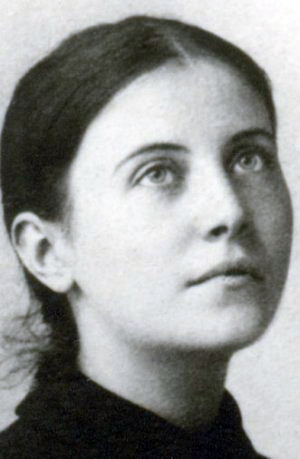
On this April 11th, in 1903 – the same year that the Italian Guiseppe Sarto was elected Pope later that summer as Pius X – a lovely, young Italian woman died, by the name of Gemma Galgani. She lived a brief life of 24 years, as did a number of other young saints, including Pier[…]Continue reading→
An Ideological and Improper Translation
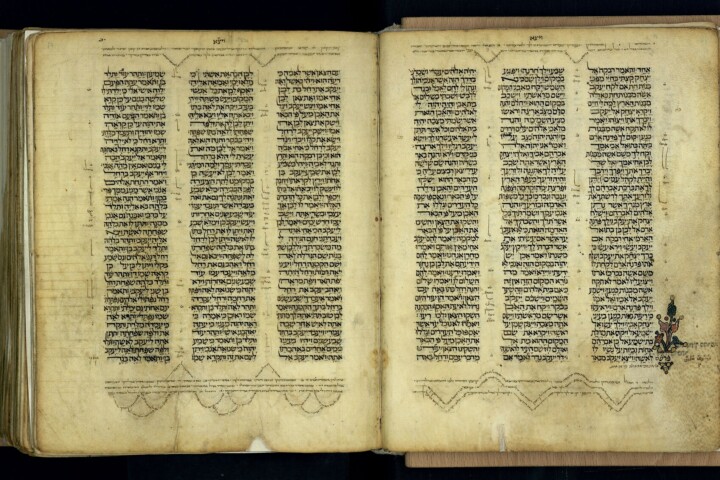
I noticed something odd with the psalm reading at Mass the other day. Our bishops’ conference here in Canada has decreed that the Mass in English – Novus Ordo – use the ‘NRSV’, the ‘New Revised Standard Version’, an ‘updated’ translation of the original RSV, first published in 1952. This ‘new translation’ has the tendency[…]Continue reading→