
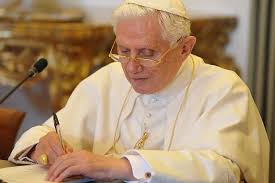
Pope Benedict and Saint Thomas – Part I
BENEDICT XVI
GENERAL AUDIENCE
Saint Peter’s Square
Wednesday, 2 June 2010
Saint Thomas Aquinas
Dear Brothers and Sisters,
After several Catecheses on the priesthood and on my latest Journeys, today we return to our main theme: meditation on some of the great thinkers of the Middle Ages. We recently looked at the great figure of St Bonaventure, a Franciscan, and today I wish to speak of the one whom the Church calls the Doctor communis namely, St Thomas Aquinas. in his Encyclical Fides et Ratio my venerable Predecessor, Pope John Paul II, recalled that “the Church has been justified in consistently proposing St Thomas as a master of thought and a model of the right way to do theology” (n. 43). It is not surprising that, after St Augustine, among the ecclesiastical writers mentioned in the Catechism of the Catholic Church St Thomas is cited more than any other, at least 61 times! He was also called the Doctor Angelicus, perhaps because of his virtues and, in particular, the sublimity of his thought and the purity of his life.
Thomas was born between 1224 and 1225 in the castle that his wealthy noble family owned at Roccasecca near Aquino, not far from the famous Abbey of Montecassino where his parents sent him to receive the first elements of his education. A few years later he moved to Naples, the capital of the Kingdom of Sicily, where Frederick II had founded a prestigious university. Here the thinking of the Greek philosopher Aristotle was taught without the limitations imposed elsewhere. The young Thomas was introduced to it and immediately perceived its great value. However, it was above all in those years that he spent in Naples that his Dominican vocation was born. Thomas was in fact attracted by the ideal of the Order recently founded by St Dominic. However, when he was clothed in the Dominican habit his family opposed this decision and he was obliged to leave the convent and spend some time at home.
In 1245, by which time he had come of age, he was able to continue on the path of his response to God’s call. He was sent to Paris to study theology under the guidance of another Saint, Albert the Great, of whom I spoke not long ago. A true and deep friendship developed between Albert and Thomas. They learned to esteem and love each other to the point that Albert even wanted his disciple to follow him to Cologne, where he had been sent by the Superiors of the Order to found a theological studium. Thomas then once again came into contact with all Aristotle’s works and his Arab commentators that Albert described and explained.
In this period the culture of the Latin world was profoundly stimulated by the encounter with Aristotle’s works that had long remained unknown. They were writings on the nature of knowledge, on the natural sciences, on metaphysics, on the soul and on ethics and were full of information and intuitions that appeared valid and convincing. All this formed an overall vision of the world that had been developed without and before Christ, and with pure reason, and seemed to impose itself on reason as “the” vision itself; accordingly seeing and knowing this philosophy had an incredible fascination for the young. Many accepted enthusiastically, indeed with a-critical enthusiasm, this enormous baggage of ancient knowledge that seemed to be able to renew culture advantageously and to open totally new horizons. Others, however, feared that Aristotle’s pagan thought might be in opposition to the Christian faith and refused to study it. Two cultures converged: the pre-Christian culture of Aristotle with its radical rationality and the classical Christian culture. Certain circles, moreover, were led to reject Aristotle by the presentation of this philosopher which had been made by the Arab commentators. Avicenna and Averroës. Indeed, it was they who had transmitted the Aristotelian philosophy to the Latin world. For example, these commentators had taught that human beings have no personal intelligence but that there is a single universal intelligence, a spiritual substance common to all, that works in all as “one”: hence, a depersonalization of man. Another disputable point passed on by the Arab commentators was that the world was eternal like God. This understandably unleashed never-ending disputes in the university and clerical worlds. Aristotelian philosophy was continuing to spread even among the populace.
(To continue reading, please see here).

Saint Kateri , Canada’s Protectress
This was the title given to Saint Kateri Tekakwitha, by Pope Benedict XVI, when he canonized her on October 28th, 2012, along with six others, in Saint Peter’ Square (she had been beatified by Pope John Paul II back in 1980). With Saint Joseph as our protector, along with the Canadian martyrs, we seem to[…]Continue reading→

Remembering Father Alphonse de Valk
(Today marks the sixth anniversary of the death of Father Alphonse de Valk, C.S.B., a faithful, courageous and indefatigable Basilian priest, pro-life-and-family apostle, and the founder of Catholic Insight magazine. Here is what we wrote those on his entering into eternity five years ago, as we continue to remember him in our prayers and thoughts)[…]Continue reading→

My Name is Bernadette
April 16th is a propitious day, for besides the anniversary of Father de Valk’s death, who founded Catholic Insight in its print form decades ago, and the commemoration of the ‘two Benedicts’, mentioned in accompanying posts, today we also recall Saint Bernadette Soubirous, the young visionary to whom the Virgin Mary appeared numerous times at[…]Continue reading→

Canonizing Sister Faustina and Divine Mercy
HOMILY OF THE HOLY FATHER MASS IN ST PETER’S SQUARE FOR THE CANONIZATION OF SR MARY FAUSTINA KOWALSKA Sunday, 30 April 2000 1. “Confitemini Domino quoniam bonus, quoniam in saeculum misericordia eius”; “Give thanks to the Lord for he is good; his steadfast love endures for ever” (Ps 118: 1). So the Church sings on the Octave of[…]Continue reading→

Divine Mercy Sunday – An Echo of Every Mass
Reach out your hand and put it in my side. Do not doubt but believe’… ‘My Lord and my God!’ (Jn. 20:18)). Today is Divine Mercy Sunday, and as we celebrate the end of the Easter Octave, we contemplate the wounded side of our Saviour, the Church’s source of life. On Good Friday in the[…]Continue reading→
First Holy Communion: Sermon from May 16, 1943
Here is a sermon from the good old days by +Rev. Msgr. Vincent Nicholas Foy (August 14, 1915 – March 13, 2017), from 1943. Readers may recall that Pope Saint Pius X, by the decree Quam Singulari in 1910, lowered the customary age of reception of Holy Communion – after the rigours of the plague[…]Continue reading→
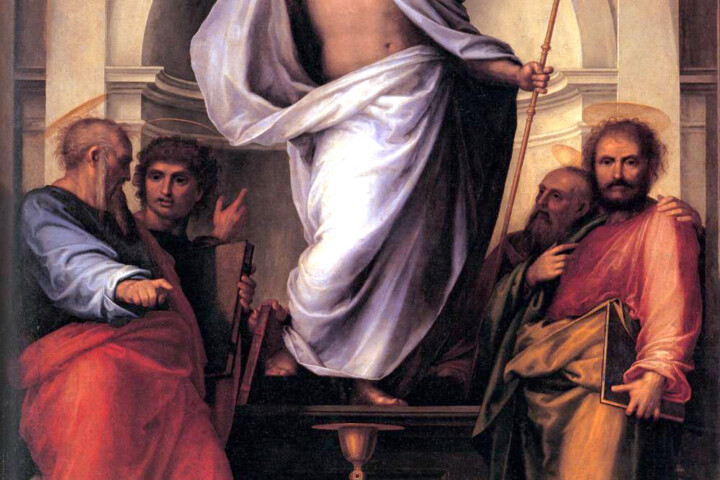
In the Glorious Light of Easter, Alleluia!
Set your minds on things that are above, not on things that are on earth, for you have died, and your life is hidden with Christ in God. When Christ who is your life is revealed, then you also will be revealed with him in glory (Col. 3:3-4). The Resurrection of Our Lord and Saviour[…]Continue reading→
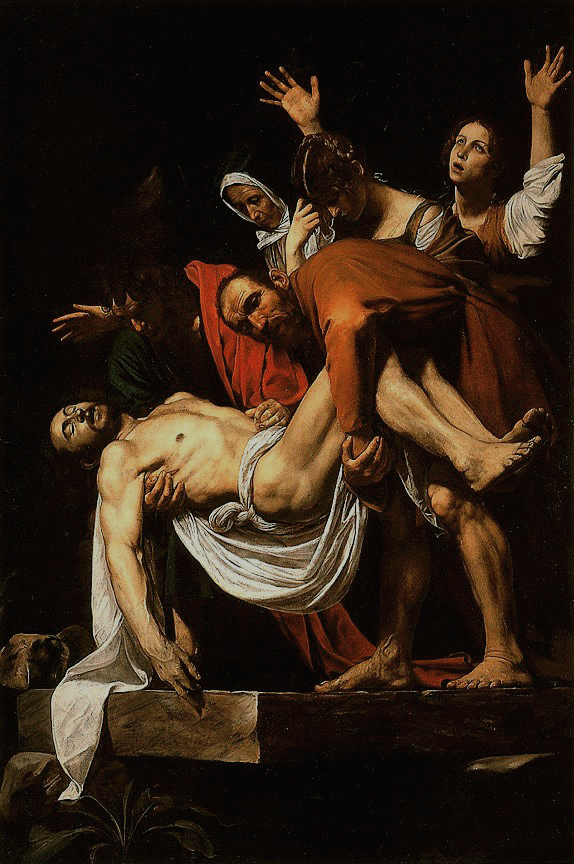
An Ancient Homily for Holy Saturday
The time between Good Friday and Easter Sunday is one of waiting, in silence, as the world wonders – anticipates – what will happen, after the death of Christ. We re-live this time each year in the anamnesis of our liturgy, and in turn look forward to the glorious re-creation of all things at the[…]Continue reading→
Europe’s Long Descent
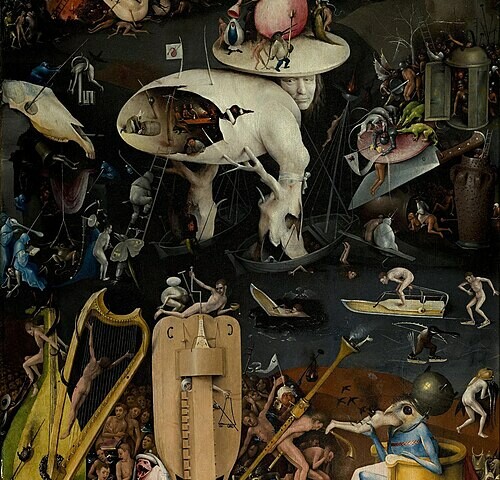
(As we meditate on this day on Christ’s burial, and His descent into hell, it is fitting to ponder here with contributor Peter Marcus how the world seems to be heading there as well. The difference is that, although God cannot ‘redeem’ hell, nor those therein, He can and did redeem the world. There is[…]Continue reading→
Pope Saint John Paul II’s First Good Friday Homily
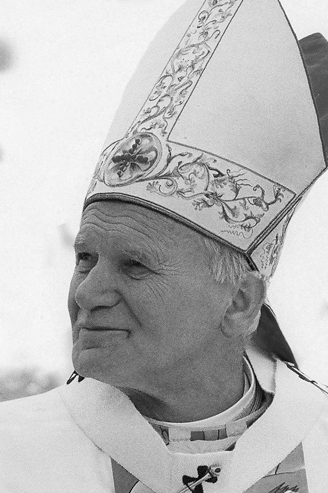
ADDRESS OF HIS HOLINESS JOHN PAUL II AT THE CONCLUSION OF THE STATIONS OF THE CROSS AT THE COLOSSEUM Good Friday, 13 April 1979 When we make the Way of the Cross from one station to the next, in spirit we are always at the spot wherethis journey had its “historical” place: where it[…]Continue reading→