
The Precipitous Prelate and the Prudential Pope
Newton’s Third Law has many applications, as does Hegel’s dialectic of thesis-antithesis-synthesis, in that eternal struggle of the World Spirit – even in the ecclesial and theological realm. For the Church, in her earthly manifestation, reels from crisis to crisis, seeming to totter, even approach collapse, but rising stronger, like a phoenix from the ashes, until the final revelation of her eternal perfection and glory.
It is in this light that we should see the unfolding controversy surrounding Archbishop Carlo Maria Vigano, who has become more intransigent seemingly with each passing day. Papal nuncio to the United States from 2011-2016, he has striven to present the truth, not least of former-cardinal McCarrick’s misdemeanours, along with whoever else aided and abetted.
The Archbishop seems to see himself as the ‘thesis’ to the ‘antithesis’ of the complacent, comfortable and compliant Church, striving as he approaches his octogenarian years to make up for lost time – a Newtonian counter-reaction to what he perceives perhaps as his own earlier concessions omissions, to take back the land he allowed to be conquered by the forces.
Which would be fine, but he seems to have gone a bridge too far of late and is in proximate danger of entering the abyss of schism, and dragging a whole lot of people with him.
The ubiquitous Taylor Marshall, about whom I know little, is not helping matters. The title of his recent podcast, ‘Is Archbishop Vigano in Schism? No!’, is not (yet) the right question to ask.
Marshall’s sub-title is more accurate, that is, whether His Grace is on the brink of schism, to which the answer, to my mind, is yes. So far, he has been careful enough not to topple over the edge, and has framed his exhortations in the form of, well, exhortations. He has not – explicitly and formally – rejected Vatican II, but has called for us – and, we may ask, who is ‘us’ – to do so.
The Code of Canon Law, which I presume the Archbishop still accepts as binding, even though it is a post-conciliar document:
schism is the refusal of submission to the Supreme Pontiff or of communion with the members of the Church subject to him (CIC, 751)
A significant part of that ‘submission’ and ‘communion’ is accepting the formal decisions of Magisterium – the Pope and the bishop in union with him – whether we like them or not.
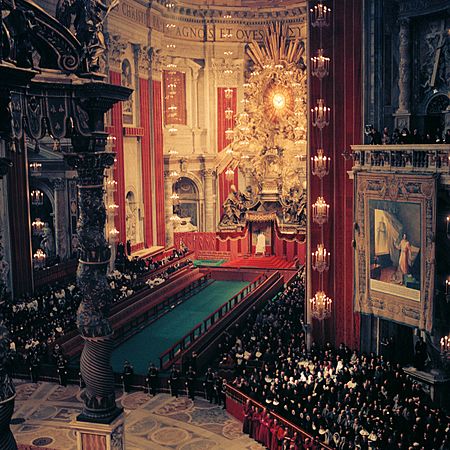
And the Pope and the bishops – almost to a man – ratified the documents of the Second Vatican Council by overwhelming majorities.
Yes, one could argue there are deficiencies and even omissions in the documents, but no heresies, and nothing contrary to Church teaching.
And we should all be aware that it is not just ‘Vatican II’ that would be rejected, but all that has happened since Vatican II, all the other documents, decrees, encyclicals, decisions, the whole modus docendi et vivendi of the Church, the entire papacies of John Paul II and Benedict XVI.
We should be clear that there is no ‘reset’ button in the Church, which must absorb what has happened, what has been decided, always striving to be more perfect. Things move on, doctrine and praxis develops, and, as mentioned in my previous article, corrections are ‘built in’ to the system, without the need to undermine or even blow up that very system.
I can’t help but wonder, however, to what pristine time would the Archbishop have us reset to? Were the liturgical and other reforms of Pius XII too much? The loss of the claim to the papal states under Pius XI? What of the daily Communion advocated by Pius X? Or of Leo XIII’s advocacy of democratic regimes?
One’s mind reels at the cascading and catastrophic if the principle underlying Archbishop Vigano’s stance were to be accepted.
Extrema se tangunt, the Latin proverb says: ‘Extremes touch each other.’ We would end up adopting the very modernist and protestant mindset that we all want to avoid: We will decide what is orthodoxy and orthopraxy, what to accept and not accept – and what crudescent excess or deviations must be removed.
I will only say a couple of things for now concerning the Archbishop’s recent interview with Phil Lawler, and that it he seems to misunderstand the role of the sensus fidelium (or the sensus fidei, as he puts it). This is a complex topic, but there is no precedent, and no theological principle, by which the faithful can rejected a promulgated and ratified Ecumenical Council in toto. That is simply not how the Church operates. The ‘faithful’ may help the Magisterium discern a doctrine or devotion before it is defined, or to sharpen and clarify doctrines once defined (in a general way).
This was Archbishop Vigano’s position until recently, when he developed a more intransigent stance.
The ‘sense of the faithful’ simply cannot reverse officially proclaimed ecumenical Councils. There is no, and never will be, precedent for such.
The Archbishop further polarizes this situation, with an ‘either you’re with me, or against me’ tone. I, for one, along with many others, are not defending the conciliar documents, such as Nostra Aetate, as he claims ‘with knives drawn’. We all realize the Vatican documents – or any issuance of the Magisterium – have the authority nor the infallibility of Scripture, or that the bishops at the Council were divinely inspired in the same way. But Council are kept from teaching erroneous doctrine, and was an event moved by the Holy Spirit, and is part of the perennial Magisterium of the Church. The Archbishop’s claim that all the errors of the modern era are contained in nuce (in a nutshell) in the conciliar documents is a rather poisonous red herring.
Are we to conclude that those who in any way support the Council – and the Church since, – are now in the category of schismatics, members of that parallel ‘apostate’ Church that Vigano describes? Alas, and alas again. Think twice, and a third time, before you make that leap. If schism is to come, let us not be the ones to precipitate it.
Reflect upon the sober words of Pope Benedict XVI from his 2005 Christmas address, and his call for a hermeneutic of continuity, as opposed to one of rupture (a distinction that Archbishop rejects, claiming the whole thing was just rupture). Benedict’s words – that the Council, in line with Pope John XXIII’s purpose, to present the ancient truths of the Church in a new mode and key – deserve to be read in their entirety, and in context, as do the conciliar documents.
The tragic thing is that many of use may well have been with the Archbishop in his call for such ongoing reform, for correction, for clarification, of the conciliar documents and many other aspects of our beleaguered Church. He has more than a point. The Church is in a perilous state. But we cannot be with him in his call for a rejection of the Council, which would undo the very principles that holds the Church as a Church. (The reflections by di Sandro Magister are also helpful).
Christ is protecting His Church, which He promised He would be with unto the end of time. We must trust, hope, and bide our time, allow Christ and His Holy Spirit to act, all the while doing what we called to, within the historical continuity of that same Church, outside of which, really, all is lost.

Carney’s Amoral Majority
After five defections – euphemistically described as ‘crossing the floor’ – and three by-elections, Mark Carney and his Liberals how have their coveted majority. One wonders what bowls of pottage were offered in back-room deals. In the archaic monarchical system that is the Dominion of Canada, this majority allows the newly-minted Prime Minister to rule[…]Continue reading→

Saint Kateri , Canada’s Protectress
This was the title given to Saint Kateri Tekakwitha, by Pope Benedict XVI, when he canonized her on October 28th, 2012, along with six others, in Saint Peter’ Square (she had been beatified by Pope John Paul II back in 1980). With Saint Joseph as our protector, along with the Canadian martyrs, we seem to[…]Continue reading→

Remembering Father Alphonse de Valk
(Today marks the sixth anniversary of the death of Father Alphonse de Valk, C.S.B., a faithful, courageous and indefatigable Basilian priest, pro-life-and-family apostle, and the founder of Catholic Insight magazine. Here is what we wrote those on his entering into eternity five years ago, as we continue to remember him in our prayers and thoughts)[…]Continue reading→

A Tale of Two Benedicts
A grace-filled Holy Week to all our readers! As we await and prepare for the Resurrection about to dawn upon us, we might keep in mind two Benedicts: Pope Emeritus Benedict XVI, requiescat in pace, elected on this day in 2005; and today’s commemoration of the mystic pilgrim, Benedict Joseph Labre, who died on this[…]Continue reading→

My Name is Bernadette
April 16th is a propitious day, for besides the anniversary of Father de Valk’s death, who founded Catholic Insight in its print form decades ago, and the commemoration of the ‘two Benedicts’, mentioned in accompanying posts, today we also recall Saint Bernadette Soubirous, the young visionary to whom the Virgin Mary appeared numerous times at[…]Continue reading→

Saint Lydwina of Schiedam and Suffering Joyfully
Saint Lydwina of Schiedam (1380 – 1433) was one of the countless and glorious ‘victim souls’ in the history of the Church, those whose lives are filled with suffering, often of an unimaginable intensity, but who suffer joyfully. She was a fifteen-year old Dutch girl, out skating one day, when she fell and broke one[…]Continue reading→

The Glorious Martyrdoms of Martin and Maximus
As we enter into Eastertide, we recall on this 13th of April Pope Saint Martin I (+655), one of the noblest, if most tragic, of the successors of Saint Peter. Born in Umbria, Italy, he was of noble lineage, with great intelligence combined with charity and love of the poor and the Church. While still[…]Continue reading→

Divine Mercy Sunday – An Echo of Every Mass
Reach out your hand and put it in my side. Do not doubt but believe’… ‘My Lord and my God!’ (Jn. 20:18)). Today is Divine Mercy Sunday, and as we celebrate the end of the Easter Octave, we contemplate the wounded side of our Saviour, the Church’s source of life. On Good Friday in the[…]Continue reading→

Saint Stanislaus of Szczepanów
We celebrate Saint Stanislaus today (+ April 11, 1079), in light of this Easter Octave, a bishop and martyr who accepted the episcopacy only at the direct order of Pope Alexander II. He proved a wise and courageous leader of his flock, put to death by his own king, Boleslaus, for rebuking the monarch’s ‘immoral[…]Continue reading→

Saint Gemma Galgani
On this April 11th, in 1903 – the same year that the Italian Guiseppe Sarto was elected Pope later that summer as Pius X – a lovely, young Italian woman died, by the name of Gemma Galgani. She lived a brief life of 24 years, as did a number of other young saints, including Pier[…]Continue reading→