
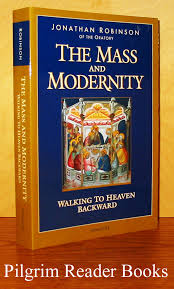
A Review of Father Jonathan Robinson’s “The Mass and Modernity”
Jonathan Robinson, The Mass and Modernity: Walking to Heaven Backwards. San Francisco: Ignatius Press, 2005. (First published in the Chesterton Review)
When I mentioned Father Robinson’s latest book to a learned friend, he said, “Robinson . . . he wrote a good book on Hegel.” I can believe it. Although I haven’t read that book, the presentation of philosophy in The Mass and Modernity accomplishes the seemingly impossible task of making Hegel comprehensible. Doing so is important for the success of the book, as it is nothing less than a purposeful summary of the intellectual history of Europe from the time of Enlightenment to the present day. The “purpose” is to show that Catholics, in their post-Vatican-II willingness to dialogue with the world, have incorporated into the liturgy principles which are at fist sight antipathetic to Catholicism and to religion itself. Even as the danger of the dialogue is noted, however, its necessity is also underlined, for the alternative is to shrink into the narrow confines of biblical fundamentalism or to be caught the religious cold storage of sects such as the Lefebvrists. Towards the end of the book, in the chapter “From Communal Divinity to Holy Community,” Robinson addresses the limitations of such sectarianism, which he contrasts both with the London Carthusians martyred by Henry VIII in 1535 and with the Birmingham Oratory as described by John Henry Newman.
The subtitle comes from Newman’s well-known sermon “The State of Innocence”: “We walk to heaven backward.”[1] Newman’s point, that we advance by trial and error, summarizes the thesis of the book, both in its openness to the achievements of the Second Vatican Council but also in its recognition that its implementation has been halting, partial and all too frequently retrograde. Part one opens with this statement: “Something has gone drastically wrong with the worship of the Church” (p.31), which, Robinson notes, has led to “apathy, bitterness and triviality” (p. 15). How could this result have come about? How could the solemn liturgy which once attracted converts by its majesty and confirmed the faithful in their devotion have become a disagreeable chore for a not-inconsiderable number who, as often as not, attend Sunday Mass with their eyes shut, their ears closed, and their teeth clenched. Robinson has a ready and convincing answer to this question, one which traces the course of philosophy in Europe and America from the Enlightenment of the eighteenth-century to post-modernism of our day. “Ideas matter; but the ideas that matter most are taken for granted” (p. 40). The formative idea of today, the one which most threatens authentic worship, is that the ultimate reality is community, not God. The philosophers leading up to this aberration— Kant, Hume, Hegel, Comte—make their appearance in the narrative, like milestones on the way to the Slough of Despond, which has inscribed on its portal, “Post-modernism: Blowing It All Up.”
I wish I could convey in a review the richness of Father Robinson’s text. It is magisterial in its treatment of the philosophical systems that stand behind contemporary assumptions about what is real and what is important, but there is more. Numerous sources, effortlessly invoked, exhibit a familiarity with our culture that makes reading the book an education in itself. Flipping through the pages, one encounters Plato, of course, Augustine and Newman but also many others, from John Stuart Mill to John Updike and from Evelyn Waugh to Casanova (José, that is, not Giovanni). Nevertheless, the line of argumentation remains perfectly clear. It can be summarized by noting Robinson’s use of John Rist’s Real Ethics, in which he establishes that a natural-law ethics is impossible without a belief in Plato’s transcendent good, which Christianity recognized as the good God. Natural law describes what man makes of his moral universe. By rejecting God, man must place himself as the ultimate arbiter of what is right and seemly, and the way lies open to the relativism in thought and behaviour that has afflicted the western world. In this section, Robinson invokes Iris Murdoch, of all people, who fought for principles and ideals in morality, although she did so only in an attempt to re-establish Plato’s “good” as opposed to the Christian Platonists’ good God.
In analyzing the Enlightenment, Robinson invokes Bishop Berkeley, of all people. “The Bishop was no fool,” he notes, for “one of the driving forces behind his work was the effort to vindicate Christianity against the materialism of his age” (p. 60). But when the arbitration of truth had been awarded to reason alone, past religious controversies seemed trivial or, worse, in bad taste. The scandal of Christianity, viz., the absolute significance of one man, Jesus Christ, for human and even natural history, became intolerable, and all religious schemes were recognized as equally good, if equally limited. Revelation, reduced to a sentiment, lost its content, and theism of any sort ultimately became irrelevant. It was left to Kant, therefore, to make religion and morality subsections of his philosophy, to Hume to dispense altogether with religion, to Hegel to locate the transcendent in (European) society, and to Comte—the first sociologist—to institutionalize the “religion of humanity” (p. 156). Small wonder that the current situation among academics is a complete surrender of traditional aim of philosophy: the search for objective truth; Robinson notes, however, “that postmodernism as it is usually presented is a metaphysics, that is, it is a statement about what things are really like” (p. 182).
Far more important than these analyses of the origins and current situation of Western society is Robinson’s suggestion of how to respond to it as Christians. His plan of action is found in Part Three, “The Lamb’s High Feast.” The very title tells the reader in brief that the Eucharist will be the origin for Catholics of the “ideas that matter.” But “[m]odernity has left little room for a Catholicism that revolves around the transcendence of God the Father, of the particularity of the revelation of God the Son, and the community as, in itself, a sort of eighth sacrament of the abiding presence of God the Holy Spirit working among us” (p. 235). Robinson is persuasive in his demonstration of the transformation of the Mass from the sacrament that re-presents Christ’s sacrifice on Calvary to a rite that “builds the community as the definitive Church” (p. 241; German Martinez, Signs of Freedom). Restoration, therefore, must arise out of a renewed familiarity with our Tradition, and Robinson, as I have noted, draws effectively upon it here as in an earlier work, On the Lord’s Appearing.[2] I particularly appreciated his recognition of the importance of Dionysius the pseudo-Areopagite in his great scheme of exitus-reditus that later served as the framework for the Summa theologiae of Saint Thomas Aquinas. One could actually describe The Mass and Modernity as tracing another sort of exitus-reditus: a moving away from the transcendent and a return to it through the solemn celebration of the Christian mysteries. Iterated and reiterated throughout these telling chapters is the obvious truth that religion is centred on the worship of God, not man. Traditional Christianity raised man Godwards by a sacramental spirituality that has its origins in the Incarnation itself, for matter can be, and has definitively been, the locus of God’s action in the world. What liturgical reformers overlooked was what should have been axiomatic, that the closer one approaches God the greater should be the reverence. Moses at the burning bush was awestruck, and rightly so, in hearing the voice of the angel of God, but at each Eucharist Catholics encounter the incarnate Word of God.
The Mass and Modernity was published before the appearance of Summorum pontificum, the motu proprio of Benedict XVI which in July 2007 lifted the restrictions on the use the pre-conciliar Mass. Robinson’s observations about the celebration of the novus ordo, therefore, presumed that it would continue as the only form of the Mass available to the vast majority of Catholics. Consequently, he recommended that it be infused with the reverence that one associates with the Tridentine liturgy: “The role of the Old Rite . . . will be to provide a standard of worship, of mystery, and of catechesis toward which the celebration of the Novus Ordo must be moved.” Having attended Mass and Solemn Vespers at the Oratory Church in Toronto, I can affirm that this standard was attained. In particular, I should call attention to the celebrant’s facing ad orientem during the canon, a change, or rather restoration, that Robinson identifies as the single most effective way of exhibiting the essence of the Mass as a religious act. Not surprisingly, after July the Oratory has made Mass according to the old rite readily available to parishioners. Somewhat coyly, it is not referred to as “the Tridentine Mass”—which is not quite accurate—or as “the Mass of John XXIII”—which can be off putting—but as Usus Antiquior, i.e., “celebrated according to the more ancient usage, that is to say, in accordance with the 1962 Missal.”
In his next book, I hope Father Robinson addresses a difficulty occasioned by the motu proprio that is most acute for the priest who celebrates according to the usus antiquior on Mondays and Fridays, say, and the novus ordo the rest of the week. To judge from my own experience, he subjects himself to a sort of spiritual schizophrenia. On two days of the week, he observes complicated and numerous rubrics with the utmost scrupulosity, approaching the altar with greater caution and reverence than Moses had before the burning bush or atop of Mount Sinai. But on the other days, there is no fast from midnight, there are lay men and women in the sanctuary, even administering Holy Communion, and there is an easiness about the rubrics in even the most careful celebration. Can anyone, especially the priest, work in two such radically different modes? Forced to answer my own question, I would echo Father Robinson by saying that with the passage of time the novus ordo will inevitably become more and more solemn, as it must if the Church is to survive. In the meantime, one is unsure of what to do with one’s fingers after the consecration.
[1] “The State of Innocence,” Parochial and Plain Sermons, 8 vols. (London: Rivingtons, 1868), vol. 5, p. 108.
[2] My review was published in the Chesterton Review 25 (1999), 144-47.

Saint Kateri , Canada’s Protectress
This was the title given to Saint Kateri Tekakwitha, by Pope Benedict XVI, when he canonized her on October 28th, 2012, along with six others, in Saint Peter’ Square (she had been beatified by Pope John Paul II back in 1980). With Saint Joseph as our protector, along with the Canadian martyrs, we seem to[…]Continue reading→

Remembering Father Alphonse de Valk
(Today marks the sixth anniversary of the death of Father Alphonse de Valk, C.S.B., a faithful, courageous and indefatigable Basilian priest, pro-life-and-family apostle, and the founder of Catholic Insight magazine. Here is what we wrote those on his entering into eternity five years ago, as we continue to remember him in our prayers and thoughts)[…]Continue reading→

My Name is Bernadette
April 16th is a propitious day, for besides the anniversary of Father de Valk’s death, who founded Catholic Insight in its print form decades ago, and the commemoration of the ‘two Benedicts’, mentioned in accompanying posts, today we also recall Saint Bernadette Soubirous, the young visionary to whom the Virgin Mary appeared numerous times at[…]Continue reading→

Canonizing Sister Faustina and Divine Mercy
HOMILY OF THE HOLY FATHER MASS IN ST PETER’S SQUARE FOR THE CANONIZATION OF SR MARY FAUSTINA KOWALSKA Sunday, 30 April 2000 1. “Confitemini Domino quoniam bonus, quoniam in saeculum misericordia eius”; “Give thanks to the Lord for he is good; his steadfast love endures for ever” (Ps 118: 1). So the Church sings on the Octave of[…]Continue reading→

Divine Mercy Sunday – An Echo of Every Mass
Reach out your hand and put it in my side. Do not doubt but believe’… ‘My Lord and my God!’ (Jn. 20:18)). Today is Divine Mercy Sunday, and as we celebrate the end of the Easter Octave, we contemplate the wounded side of our Saviour, the Church’s source of life. On Good Friday in the[…]Continue reading→

First Holy Communion: Sermon from May 16, 1943
Here is a sermon from the good old days by +Rev. Msgr. Vincent Nicholas Foy (August 14, 1915 – March 13, 2017), from 1943. Readers may recall that Pope Saint Pius X, by the decree Quam Singulari in 1910, lowered the customary age of reception of Holy Communion – after the rigours of the plague[…]Continue reading→

In the Glorious Light of Easter, Alleluia!
Set your minds on things that are above, not on things that are on earth, for you have died, and your life is hidden with Christ in God. When Christ who is your life is revealed, then you also will be revealed with him in glory (Col. 3:3-4). The Resurrection of Our Lord and Saviour[…]Continue reading→

An Ancient Homily for Holy Saturday
The time between Good Friday and Easter Sunday is one of waiting, in silence, as the world wonders – anticipates – what will happen, after the death of Christ. We re-live this time each year in the anamnesis of our liturgy, and in turn look forward to the glorious re-creation of all things at the[…]Continue reading→

Europe’s Long Descent
(As we meditate on this day on Christ’s burial, and His descent into hell, it is fitting to ponder here with contributor Peter Marcus how the world seems to be heading there as well. The difference is that, although God cannot ‘redeem’ hell, nor those therein, He can and did redeem the world. There is[…]Continue reading→
Pope Saint John Paul II’s First Good Friday Homily
ADDRESS OF HIS HOLINESS JOHN PAUL II AT THE CONCLUSION OF THE STATIONS OF THE CROSS AT THE COLOSSEUM Good Friday, 13 April 1979 When we make the Way of the Cross from one station to the next, in spirit we are always at the spot wherethis journey had its “historical” place: where it[…]Continue reading→