
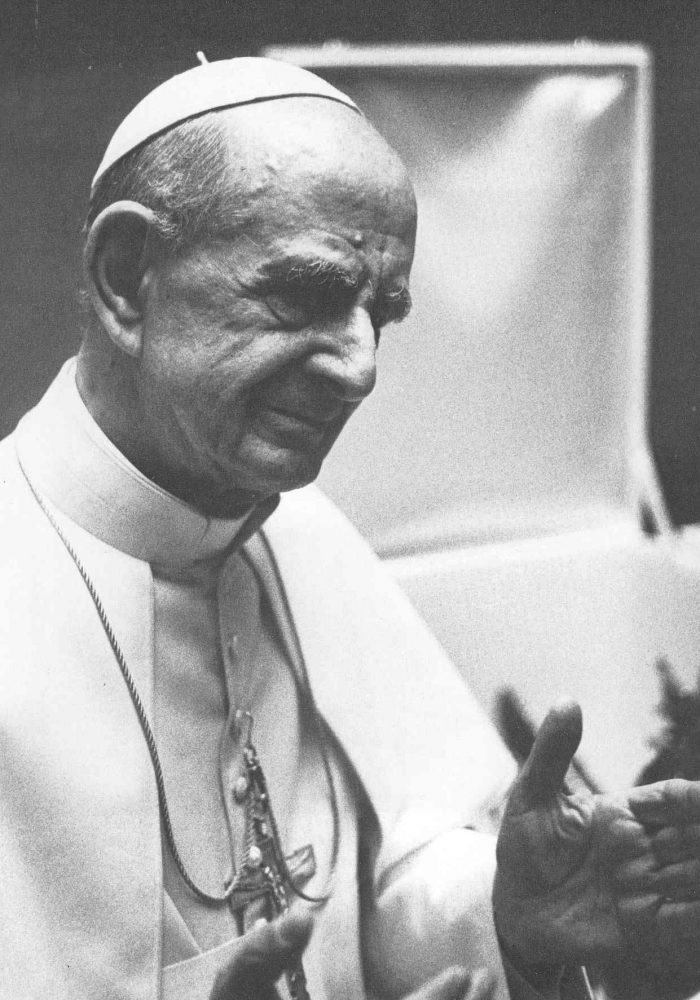
The Legacy of Paul VI
The controversial Pope Saint Paul VI is commemorated on May 29th, the day of his ordination to the priesthood in 1920 – this marking the hundredth anniversary. He was the second-last Italian Pope, a run of pontiffs from the nation that had last 455 years, which may seem odd for a Church that claims universality. But such are the ways of providence, and after the brief 33-day reign of John Paul I, Pope Saint John Paul II began what seems to be a run of non-Italians – even though Francis – Jorge Bergoglio – is an Italian by blood.
Paul VI, like almost the Popes before him in the modern era, was of the ‘nobility’, and destined for some high office or other in the Church, trained in diplomacy and, as they say, Romanitas. We may wonder at some of his decisions in striving to maintain peace, and evangelize an ever-more secular world. His decision to continue the Council called by Pope – also saint – John XXIII was momentous, but more so was his reform of the ancient liturgy, especially the Holy Mass, giving Annibale Cardinal Bugnini a lot of free reign to construct the Novus Ordo, promulgated in its editio typica Latin version in 1969 – one almost never said – and the English and other vernaculars beginning in 1974 – always said, and often not with what reverence one might expect from the most sacred of sacrifices.
As his addresses of that fateful year of 1969 attest, Paul VI had high and optimistic hopes for the ‘new Mass’ – more strictly, the new use (usus) of celebrating Mass – and his decrees more or less forbade the celebration of the usus antiquior, as decreed by the Council of Trent (even if that use was never legally proscribed, and, Deo gratias, is now permitted universally by Pope Benedict’s 2007 Apostolic Letter Summorum Pontificum). hopes that seem to have hit the hard wall of reality. Lex orandi, lex credendi, lex agendi – the law of praying is the law of believing is the law of acting. Or we act and believe as we pray. One has to wonder about Paul VI, who seems to have been a good and pious man, dedicated to his religion, who loved the Mass and beauty and liturgy, and especially to the Blessed Mother, on whom he wrote three letters. How much did he see what was going on around him, and the liturgical and moral chaos that was a hallmark of the seventies?
He seems to have seen something of this, for the last encyclical he wrote, after much prayer and reflection – some say dithering and hesitancy – on the feast of Saint James the greater, July 25th, 1968, was one of the most prophetic of the 20th century, dividing the Church ever since: Humane Vitae, which taught the beauty, integrity and harmony of the marital union, that there was a nexus indissolubilis, an indissoluble bond, between the unitive and procreative significations of this most intimate of human acts. To try to divide this union by any means – that is, any sort of ‘contraceptive’ act – was gravely sinful, and would lead to all sorts of deleterious consequences, which we now all around us.
The world by and large rejected Paul VI’s message, and perhaps it was because of the barrage of unrelenting criticism that he did not write another encyclical, although he reigned for a full decade more, before his death, broken and worn out, on August 6th, the feast of the Transfiguration, 1978. Maybe he thought that Humanae Vitae said what he had to say, and that its teaching was really the linchpin that held everything else together. As marriage and family go, so go society: To hell, or to heaven.
The Church canonizes her members not because they are perfect, or because they make all the right decisions, but because, in the end, they held to the truth, suffered for its sake, and witnessed thereto. Could Paul VI have done more, or done things differently? Yes, and we could say the same for all the saints – and the saints would say it even more of themselves. Who knows? Maybe it was his intercession that helped get the usus antiquior back into our churches, and we may pray that we return ever-more to liturgical and moral sanity – for you can’t have one, without the other.

Carney’s Amoral Majority
After five defections – euphemistically described as ‘crossing the floor’ – and three by-elections, Mark Carney and his Liberals how have their coveted majority. One wonders what bowls of pottage were offered in back-room deals. In the archaic monarchical system that is the Dominion of Canada, this majority allows the newly-minted Prime Minister to rule[…]Continue reading→

Saint Kateri , Canada’s Protectress
This was the title given to Saint Kateri Tekakwitha, by Pope Benedict XVI, when he canonized her on October 28th, 2012, along with six others, in Saint Peter’ Square (she had been beatified by Pope John Paul II back in 1980). With Saint Joseph as our protector, along with the Canadian martyrs, we seem to[…]Continue reading→

A Tale of Two Benedicts
A grace-filled Holy Week to all our readers! As we await and prepare for the Resurrection about to dawn upon us, we might keep in mind two Benedicts: Pope Emeritus Benedict XVI, requiescat in pace, elected on this day in 2005; and today’s commemoration of the mystic pilgrim, Benedict Joseph Labre, who died on this[…]Continue reading→

My Name is Bernadette
April 16th is a propitious day, for besides the anniversary of Father de Valk’s death, who founded Catholic Insight in its print form decades ago, and the commemoration of the ‘two Benedicts’, mentioned in accompanying posts, today we also recall Saint Bernadette Soubirous, the young visionary to whom the Virgin Mary appeared numerous times at[…]Continue reading→

Saint Lydwina of Schiedam and Suffering Joyfully
Saint Lydwina of Schiedam (1380 – 1433) was one of the countless and glorious ‘victim souls’ in the history of the Church, those whose lives are filled with suffering, often of an unimaginable intensity, but who suffer joyfully. She was a fifteen-year old Dutch girl, out skating one day, when she fell and broke one[…]Continue reading→

The Glorious Martyrdoms of Martin and Maximus
As we enter into Eastertide, we recall on this 13th of April Pope Saint Martin I (+655), one of the noblest, if most tragic, of the successors of Saint Peter. Born in Umbria, Italy, he was of noble lineage, with great intelligence combined with charity and love of the poor and the Church. While still[…]Continue reading→

Saint Stanislaus of Szczepanów
We celebrate Saint Stanislaus today (+ April 11, 1079), in light of this Easter Octave, a bishop and martyr who accepted the episcopacy only at the direct order of Pope Alexander II. He proved a wise and courageous leader of his flock, put to death by his own king, Boleslaus, for rebuking the monarch’s ‘immoral[…]Continue reading→
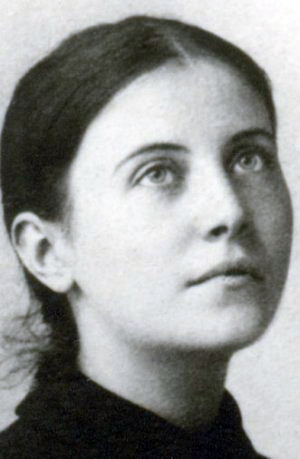
Saint Gemma Galgani
On this April 11th, in 1903 – the same year that the Italian Guiseppe Sarto was elected Pope later that summer as Pius X – a lovely, young Italian woman died, by the name of Gemma Galgani. She lived a brief life of 24 years, as did a number of other young saints, including Pier[…]Continue reading→
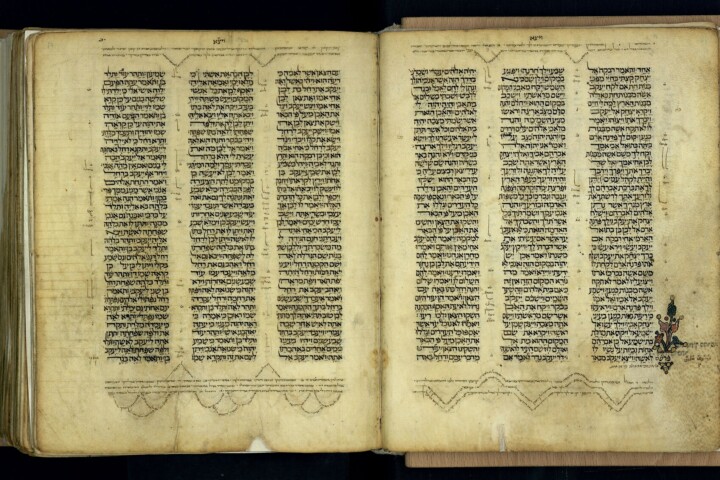
An Ideological and Improper Translation
I noticed something odd with the psalm reading at Mass the other day. Our bishops’ conference here in Canada has decreed that the Mass in English – Novus Ordo – use the ‘NRSV’, the ‘New Revised Standard Version’, an ‘updated’ translation of the original RSV, first published in 1952. This ‘new translation’ has the tendency[…]Continue reading→
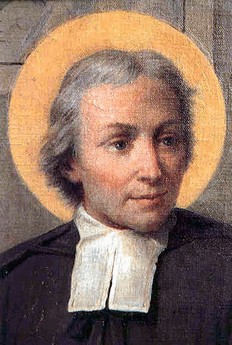
Saint Jean-Baptiste de la Salle: A Teacher for Teachers
Jean-Baptiste de la Salle (1651 – 1719), a French nobleman, ordained a priest, founded the first order in the Church’s history entirely without priests, and this came about almost by accident. I say ‘almost’, for, of course, there are no accidents with God. Destined for ordination from an early age, Jean-Baptiste never looked back, even[…]Continue reading→