
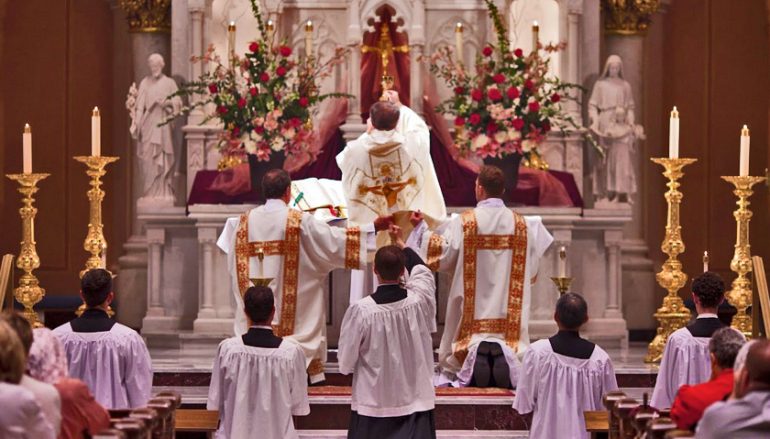
Evelyn Waugh and the Mass of the Ages
I was struck as I finished up reading over a small volume of letters by the great English writer Evelyn Waugh, author of such treasures as Brideshead Revisited, Love Among the Ruins, A Handful of Dust and numerous others, that this was the day he died, on April 10th, 1966, which was, fittingly, Easter Sunday.
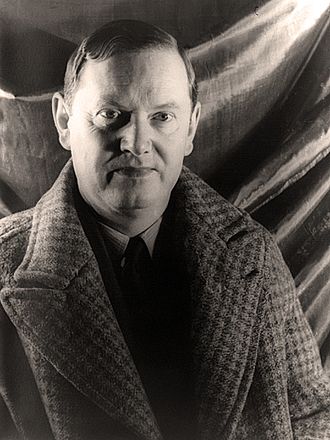
Evelyn Waugh, a convert who entered the Catholic Church on September 29th, 1930 as a 26 year old, always loved the Mass, and his novels evince a deep immersion in his Faith. He is, in the truest sense of the word, a Catholic novelist, with an uncanny ability to show and not tell, to leave you with a sense that the Faith, even if it be hidden and submerged, is not only true, but holds everything together, without which, the centre truly cannot hold.
The slim book, published by Ignatius Press, is a series of letters, given and received, on Waugh’s thoughts on the changes in the Mass after Vatican II, implemented in his final years. Needless to say, perhaps, Mr. Waugh, was not, and we may repeat not, a fan of the ‘changes’ made in the wake of the Council – and that is putting things mildly
We should be clear that this was not about the Novus Ordo, which Waugh did not live to see, as it was not promulgated until 1969 (and then only in its editio typica Latin version, rarely ever said, with the English vernacular in 1974).
No, what he was writing, complaining and griping about, with his unmatched command of precise English, were the various ‘experiments’ with the Mass, flowing from disordered and disturbed elements in the ‘liturgical movement’, ‘experts’ armed with the nebulous and nefarious ‘spirit of Vatican II’, who took a metaphorical, and sometimes all-too-real, wrecking ball to the Mass of the Ages and its splendid accoutrements: high altars, vestments, chant, Latin, polyphony, litanies, stained glass, reverence. Iconoclasm it was, writ large, all the while adding much that was, shall we say, not so splendid, almost all of it of their own making, whatever their hearkening back to mythical ‘ancient liturgies’. We need not list the abuses, for we have all lived, and still live, through them, and the reader’s imagination may be even more vivid than mine.
In his own inimitable, acerbic way, Waugh criticized what was being done to the Liturgy, the outlandish, scandalous and bizarre. As he puts it in one passage:
In the Church of Christ the King, Oklahoma, the people instead of kneeling at the consecration and elevation of the host, crowd round the priest strumming guitars. All the tongues of Babel are to be employed save only Latin
And this was not the worst of it, for the worst was yet to come. We have pilgrimaged now as a people through the experiment now for fifty years – ten more years than the Israelites in the desert of Sinai – as this is the half-century anniversary of the official implementation of the Novus Ordo in 1970. Whatever one says about licit, reverent, beautiful chanted Masses in what is now called the ‘ordinary form’ – and I have seen any number of them, Deo gratias – most of us have suffered for years in ad hoc, clappy hands, extemporized, emotionalized, sentimental liturgies, flouting laws left, right and centre of the sanctuary, the bitter fruits of which, to this writer’s mind, are all around us, not least in our collective response to this crisis.
Evelyn Waugh saw back then where the radical change, one might say without much exaggeration the mutilation, of the Liturgy would lead. And he was not alone, including many non-Catholics, who saw the need, indeed the duty, of the Church to preserve the traditional Liturgy, as we would Notre Dame cathedral or Saint Peter’s itself – but even more so. A group of these elites, including Agatha Christine, penned this heartfelt 1971 petition to Pope Paul VI, claiming what a tragedy it would be to lose what we now call the ‘old Mass’. Well worth a read, signifying, like a testament frozen in amber to what we have lost.
Of course, all is not lost, for this crisis may bring many to their senses, and not, we hope, to lose their faith. As the saying goes, lex orandi, lex credendi, lex agendi. We believe as we pray, and we live as we pray and believe. This crisis is revealing things, not all of them pleasant, about how we ourselves, from the lowest of the laity to the most exalted of the episcopacy, have prayed and lived.
May we all learn what lesson God is teaching us, whatever betides afterward.
Carney’s Amoral Majority
After five defections – euphemistically described as ‘crossing the floor’ – and three by-elections, Mark Carney and his Liberals how have their coveted majority. One wonders what bowls of pottage were offered in back-room deals. In the archaic monarchical system that is the Dominion of Canada, this majority allows the newly-minted Prime Minister to rule[…]Continue reading→

Saint Kateri , Canada’s Protectress
This was the title given to Saint Kateri Tekakwitha, by Pope Benedict XVI, when he canonized her on October 28th, 2012, along with six others, in Saint Peter’ Square (she had been beatified by Pope John Paul II back in 1980). With Saint Joseph as our protector, along with the Canadian martyrs, we seem to[…]Continue reading→

Remembering Father Alphonse de Valk
(Today marks the sixth anniversary of the death of Father Alphonse de Valk, C.S.B., a faithful, courageous and indefatigable Basilian priest, pro-life-and-family apostle, and the founder of Catholic Insight magazine. Here is what we wrote those on his entering into eternity five years ago, as we continue to remember him in our prayers and thoughts)[…]Continue reading→

A Tale of Two Benedicts
A grace-filled Holy Week to all our readers! As we await and prepare for the Resurrection about to dawn upon us, we might keep in mind two Benedicts: Pope Emeritus Benedict XVI, requiescat in pace, elected on this day in 2005; and today’s commemoration of the mystic pilgrim, Benedict Joseph Labre, who died on this[…]Continue reading→

My Name is Bernadette
April 16th is a propitious day, for besides the anniversary of Father de Valk’s death, who founded Catholic Insight in its print form decades ago, and the commemoration of the ‘two Benedicts’, mentioned in accompanying posts, today we also recall Saint Bernadette Soubirous, the young visionary to whom the Virgin Mary appeared numerous times at[…]Continue reading→

Saint Lydwina of Schiedam and Suffering Joyfully
Saint Lydwina of Schiedam (1380 – 1433) was one of the countless and glorious ‘victim souls’ in the history of the Church, those whose lives are filled with suffering, often of an unimaginable intensity, but who suffer joyfully. She was a fifteen-year old Dutch girl, out skating one day, when she fell and broke one[…]Continue reading→

The Glorious Martyrdoms of Martin and Maximus
As we enter into Eastertide, we recall on this 13th of April Pope Saint Martin I (+655), one of the noblest, if most tragic, of the successors of Saint Peter. Born in Umbria, Italy, he was of noble lineage, with great intelligence combined with charity and love of the poor and the Church. While still[…]Continue reading→

Canonizing Sister Faustina and Divine Mercy
HOMILY OF THE HOLY FATHER MASS IN ST PETER’S SQUARE FOR THE CANONIZATION OF SR MARY FAUSTINA KOWALSKA Sunday, 30 April 2000 1. “Confitemini Domino quoniam bonus, quoniam in saeculum misericordia eius”; “Give thanks to the Lord for he is good; his steadfast love endures for ever” (Ps 118: 1). So the Church sings on the Octave of[…]Continue reading→

Divine Mercy Sunday – An Echo of Every Mass
Reach out your hand and put it in my side. Do not doubt but believe’… ‘My Lord and my God!’ (Jn. 20:18)). Today is Divine Mercy Sunday, and as we celebrate the end of the Easter Octave, we contemplate the wounded side of our Saviour, the Church’s source of life. On Good Friday in the[…]Continue reading→

Saint Stanislaus of Szczepanów
We celebrate Saint Stanislaus today (+ April 11, 1079), in light of this Easter Octave, a bishop and martyr who accepted the episcopacy only at the direct order of Pope Alexander II. He proved a wise and courageous leader of his flock, put to death by his own king, Boleslaus, for rebuking the monarch’s ‘immoral[…]Continue reading→