
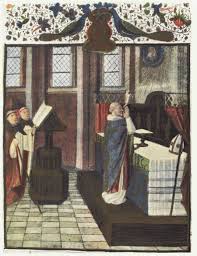
Ad Orientem, et Pro Populo
The Bishop of Boise, Idaho, Peter F. Christensen, has specifically forbidden his priests, even in their ultra-private Masses now mandated, from celebrating ‘ad orientem’. We’ve got to stop all those young rebels, it seems, reverting back to retrograde eras of yesteryear.
His Excellency states that this is mandated by the new (2011) General Introduction to the Roman Missal (GIRM), and has been of great spiritual value to the people. And speaking of yesteryear, Here are his own words, which signify he seems liturgically stuck in an era when Stayin’ Alive was just a disco song, and not a motto for a pandemic:
There are priests who prefer ad orientem. I am convinced that they mean well and find it a devout way to pray. But the overwhelming experience worldwide after Vatican II is that the priest faces the people for Mass and this has contributed to the sanctification of the people
One has to wonder what His Excellency might mean, and what evidence may be adduced. Sanctification, as churches empty, belief in the Real Presence is vanishing, and who’s left becomes ever-more grey.
Whatever happens to the Novus Ordo – whether it should (I will leave aside for now whether it could) be reformed and brought more into line with the usus antiquior, which seems to be the mind of the Council, and of Josef Ratzinger, but not so much of Bishop Christensen – we may wonder whether this marks the beginning of the end of the new Mass as we know it, that is, as it has been celebrated up to now, with few vestigial marks of the Eternal Sacrifice of all time.
Providentially, I have an article on this topic soon to be published in Crisis magazine. For now, here is a response on whether ‘facing the people’ is in fact mandated by the new GIRM (with a couple of typos corrected). A portion of the thread follows:
The English copy of the GIRM has a mistranslation on 299
Altare maius exstruatur a pariete seiunctum, ut facile circumiri et in eo celebratio versus populum peragi possit, quod expedit ubicumque possibile sit.
The correct translation would be more along the lines of:
The main altar should be built separated from the wall, which is useful wherever it is possible, so that it can be easily walked around and a celebration toward the people can be carried out
The qualifier ‘quod’ refers to the main clause, in that the altar should be separate from the wall whenever possible, NOT that the priest should face the people whenever possible.
The CDWDS has since issued a clarification.
adoremus.org/12-0101cdw-adorient.html
In summary, as you may read, there is not, and never was, any command or prescription to say Mass ‘facing the people’, even if this has become the custom, and is suggested in the GIRM. In fact, the first edition of the GIRM in 1974 assumed the priest said Mass, as ancient tradition has it back to the earlies days of the Church, ‘cum populo’ and ‘ad orientem’, with instructions to face the people at certain points (as is still the case in the usus antiquior).
The new custom – and it is new, as Louis Bouyer meticulously proved – of facing the people obscures what the Mass really is, in its deepest reality, the Sacrifice of Christ, offered to God the Father, on behalf of the people. And the priest facing the people leads, imperceptibly, even unwittingly, to all sorts of liturgical abnormalities, as well as distracting him from his primary task of acting as the one offering this sacrifice.
We can only hope that all the priests now saying the most private of private Masses may realize this, and turn themselves around to lead us in prayer, when the populi return again.

Carney’s Amoral Majority
After five defections – euphemistically described as ‘crossing the floor’ – and three by-elections, Mark Carney and his Liberals how have their coveted majority. One wonders what bowls of pottage were offered in back-room deals. In the archaic monarchical system that is the Dominion of Canada, this majority allows the newly-minted Prime Minister to rule[…]Continue reading→

Saint Kateri , Canada’s Protectress
This was the title given to Saint Kateri Tekakwitha, by Pope Benedict XVI, when he canonized her on October 28th, 2012, along with six others, in Saint Peter’ Square (she had been beatified by Pope John Paul II back in 1980). With Saint Joseph as our protector, along with the Canadian martyrs, we seem to[…]Continue reading→
A Closed, Unsustainable, Descending Loop
As a follow-up to my thoughts on Payette’s payout, here be a stark image of where are here in Canada. As the graph shows in, well, graphic terms, since 2025, the public sector has contributed to 95.5% of economic growth. The private sector – which funds the public sector, or is supposed to – has[…]Continue reading→

A Tale of Two Benedicts
A grace-filled Holy Week to all our readers! As we await and prepare for the Resurrection about to dawn upon us, we might keep in mind two Benedicts: Pope Emeritus Benedict XVI, requiescat in pace, elected on this day in 2005; and today’s commemoration of the mystic pilgrim, Benedict Joseph Labre, who died on this[…]Continue reading→

My Name is Bernadette
April 16th is a propitious day, for besides the anniversary of Father de Valk’s death, who founded Catholic Insight in its print form decades ago, and the commemoration of the ‘two Benedicts’, mentioned in accompanying posts, today we also recall Saint Bernadette Soubirous, the young visionary to whom the Virgin Mary appeared numerous times at[…]Continue reading→
Presidential Pardon of Weronika Krawczyk
As a good news, follow-up to our story from Poland, of the persecution of Weronika Krawczyk for her pro-life views, we heard that she has been granted a presidential pardon. One might still wonder why one needs a presidential pardon for simply holding the long-held belief that the child within the womb is a child,[…]Continue reading→

Saint Lydwina of Schiedam and Suffering Joyfully
Saint Lydwina of Schiedam (1380 – 1433) was one of the countless and glorious ‘victim souls’ in the history of the Church, those whose lives are filled with suffering, often of an unimaginable intensity, but who suffer joyfully. She was a fifteen-year old Dutch girl, out skating one day, when she fell and broke one[…]Continue reading→

The Glorious Martyrdoms of Martin and Maximus
As we enter into Eastertide, we recall on this 13th of April Pope Saint Martin I (+655), one of the noblest, if most tragic, of the successors of Saint Peter. Born in Umbria, Italy, he was of noble lineage, with great intelligence combined with charity and love of the poor and the Church. While still[…]Continue reading→
Pope Leo and a Rosary for Peace
Pope Leo XIV has asked Catholics across the world to join him in a Rosary for peace today, at 18:00 Rome time (6 pm), which would be noon from where I write (EST). If you are able, whether at that time or another, and in whatever way you pray, to join in intercession with the[…]Continue reading→
Payette’s Payout
I was glancing through some headlines, and noticed a mention of Julie Payette – engineer and astronaut and sometime the Queen’s representative in Canada – which brought back vague memories. She was appointed Governor-General by Justin Trudeau in 2017. Ms. Payette resigned in 2021, amidst claims that she created a ‘toxic work environment’, with allegations[…]Continue reading→