
King David’s Take on Covid
Back in biology class, we debated whether viruses were ‘alive’. They’re certainly the lowest form of living thing, if living at all. They cannot move themselves, but must be moved around by others – as we have discovered.
But they can replicate, but only by using the replicative processes of other organisms. They burrow deep into the cell, taking over its DNA, using the cell’s machinery to produce its own genetic material, and copies of itself, the protein sheaths that contain the genetic material of the virus. After producing thousands or millions of copies, the cell bursts. When this happens to enough cells, we, the host of the virus, get sick. How sick, depends on the level, depth and type of infiltration of the virus. But many of you may already know this, as we sit around the house Wikipedia-ing virology.
In the end, however, it is difficult to predict what viruses can or cannot do, even by experts – a point to which I shall return in a moment. More or less, we learn what a virus can do when a virus has done what it can do. Also, they can mutate, season by season, region by region.
All in all, nasty little critters.
One might view this current pandemic from a scientific lens, fighting it based on what we know of the coronavirus family, their history, their physiognomy and so on. So the search is on for a vaccine.
There is also the epidemiological lens, how the virus spreads through populations. In part, this goes back to the scientific – how it hangs in the air, on surfaces, its mode of transmission. But this also includes the behavioural, the aspect which most affects all of us.
To stop the spread of the virus – recall, they themselves cannot move, and if this thing had been left in Wuhan, in Wuhan it would have remained – we change we live and move, often in what seem strange ways: Masks, coughing and sneezing into one’s sleeve, watching what we touch, not putting our hands to our noses, eyes and mouth (nearly impossible), and, the word of the day, even of our age, ‘social distancing’, the most controversial and most difficult of all.
Which brings us to the legal lens. Initially, the social distancing was voluntary, but now, not least with the recent declaration of the ‘Emergency Measures Act’ (formerly, the War Time), the government – that is, the police and even the military – have been given ‘emergency’ powers, which in normal times would be immoral (and I might argue, still are, even in extraordinary times). Hence, the laws now against gatherings of more than ten people, and, most recently, enforced quarantine for those likely affected.
Our own resident tin-pot would-be dictator, Trudeau, is getting all butch, beard and all, after poo-pooing any need for extreme measures just a few weeks ago, shipping off now-much-needed medical supplies off to China; not limiting travel from and to China; and keeping the porous border with the United States, including the illegal crossings that are tacitly tolerated.
As he warns Canadians in his attempt to invoke an interior authority he does not have, ‘Stay home!’, and, ominously, ‘no measures are off the table’, in this all-out war against this virus. One Italian mayor threatened flame-throwers against those who violated quarantine, one hopes jokingly; but, as I am wont to say, in joco veritas.
I prefer to see things through a theological lens, which, if done prudently and with reason, is the truest of them all. Pope John Paul II, in his 1984 meditation on suffering, Salvifici Doloris, taught with every punishment sent to us, there is always a ‘complex involvement with sin’. It may not be our sin, but sin it be, from the original sin of Adam which resulted in our fallen nature, all the way to the sins of our own nation, soaked in the blood of the unborn, and now the elderly and sick, the mutilation even of children in the name of ‘transgenderism’, for which Trudeau, pere et fils carry a grave responsibility, whatever their own culpability in at least Justin’s apparent vacuous muddledness – one can only hope that they know not what they do. And that goes for all of us, to some extent, along with them, for not doing what we should, for going along to get along, for not praying and sacrificing enough, for just being too soft and complacent.
We need what in Scotland we call a ‘tobering up’, a kick in the pants, a wake-up call, for we have all taken things too easily and for granted.
Yes, we must do what we can – within reason, along with divine, natural and ecclesiastical law – to limit the spread and damage done by this virus.
But we should also keep in mind the broader theological and eternal perspective, that this is all sent for our good, from which we must draw what good we can, and the virus will last as long as God wills that it last.
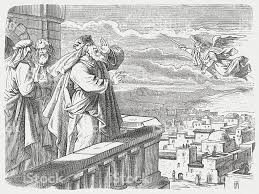
Ponder the story of King David, after taking his illicit census of the people, demonstrating his lack of faith and trust in God, for which God offered him three choices as punishment (2 Samuel 24: 1-25): Famine, fleeing from his enemies or a pestilence. David chose the last one, since, rather than be under the power of men, he would “fall into the hand of the Lord, for his mercy is great”. And, indeed, the “Lord repented of the evil, and said to the angel who was working destruction among the people, ‘It is enough, now stay your hand’.
But for that mercy to be granted, we, from the highest to the lowest, as in Nineveh, must beseech God, repent of our sins, that He may spare as many as He might. Even, perhaps especially, without the sacraments – and I will have more to say on that shortly – we must keep up our prayer life, our examination of conscience, our own conversation with God, His Mother, the angels and saints, as best we might.
If we do not, and we continue in our sin, even if this virus burns itself out, as they all do eventually, another evil little critter, or another calamity, will befall, and, as Christ warns the cured blind man, may well be worse than the first.

Carney’s Amoral Majority
After five defections – euphemistically described as ‘crossing the floor’ – and three by-elections, Mark Carney and his Liberals how have their coveted majority. One wonders what bowls of pottage were offered in back-room deals. In the archaic monarchical system that is the Dominion of Canada, this majority allows the newly-minted Prime Minister to rule[…]Continue reading→

Saint Kateri , Canada’s Protectress
This was the title given to Saint Kateri Tekakwitha, by Pope Benedict XVI, when he canonized her on October 28th, 2012, along with six others, in Saint Peter’ Square (she had been beatified by Pope John Paul II back in 1980). With Saint Joseph as our protector, along with the Canadian martyrs, we seem to[…]Continue reading→

A Tale of Two Benedicts
A grace-filled Holy Week to all our readers! As we await and prepare for the Resurrection about to dawn upon us, we might keep in mind two Benedicts: Pope Emeritus Benedict XVI, requiescat in pace, elected on this day in 2005; and today’s commemoration of the mystic pilgrim, Benedict Joseph Labre, who died on this[…]Continue reading→

My Name is Bernadette
April 16th is a propitious day, for besides the anniversary of Father de Valk’s death, who founded Catholic Insight in its print form decades ago, and the commemoration of the ‘two Benedicts’, mentioned in accompanying posts, today we also recall Saint Bernadette Soubirous, the young visionary to whom the Virgin Mary appeared numerous times at[…]Continue reading→

Saint Lydwina of Schiedam and Suffering Joyfully
Saint Lydwina of Schiedam (1380 – 1433) was one of the countless and glorious ‘victim souls’ in the history of the Church, those whose lives are filled with suffering, often of an unimaginable intensity, but who suffer joyfully. She was a fifteen-year old Dutch girl, out skating one day, when she fell and broke one[…]Continue reading→

The Glorious Martyrdoms of Martin and Maximus
As we enter into Eastertide, we recall on this 13th of April Pope Saint Martin I (+655), one of the noblest, if most tragic, of the successors of Saint Peter. Born in Umbria, Italy, he was of noble lineage, with great intelligence combined with charity and love of the poor and the Church. While still[…]Continue reading→

Saint Stanislaus of Szczepanów
We celebrate Saint Stanislaus today (+ April 11, 1079), in light of this Easter Octave, a bishop and martyr who accepted the episcopacy only at the direct order of Pope Alexander II. He proved a wise and courageous leader of his flock, put to death by his own king, Boleslaus, for rebuking the monarch’s ‘immoral[…]Continue reading→
Saint Gemma Galgani
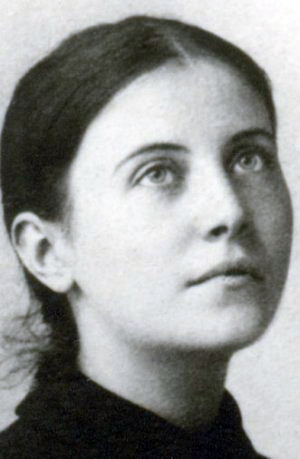
On this April 11th, in 1903 – the same year that the Italian Guiseppe Sarto was elected Pope later that summer as Pius X – a lovely, young Italian woman died, by the name of Gemma Galgani. She lived a brief life of 24 years, as did a number of other young saints, including Pier[…]Continue reading→
An Ideological and Improper Translation
I noticed something odd with the psalm reading at Mass the other day. Our bishops’ conference here in Canada has decreed that the Mass in English – Novus Ordo – use the ‘NRSV’, the ‘New Revised Standard Version’, an ‘updated’ translation of the original RSV, first published in 1952. This ‘new translation’ has the tendency[…]Continue reading→
Saint Jean-Baptiste de la Salle: A Teacher for Teachers
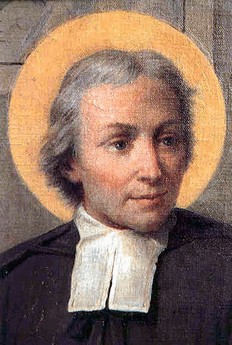
Jean-Baptiste de la Salle (1651 – 1719), a French nobleman, ordained a priest, founded the first order in the Church’s history entirely without priests, and this came about almost by accident. I say ‘almost’, for, of course, there are no accidents with God. Destined for ordination from an early age, Jean-Baptiste never looked back, even[…]Continue reading→