
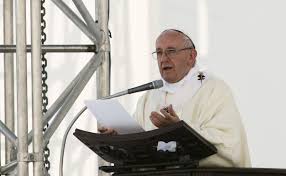
Pope Francis’ Troubling Terminology
There is a principle in theology – which applies to other sciences as well – that we interpret the less authoritative, the less precise and the less clear, in light of what is more authoritative, the more precise, and what is more clearly stated. Humanae Vitae trumps the Winnipeg Statement of the Canadian episcopacy, any day of the conjugal week, and the precise proscriptions of John Paul II’s 1981 Apostolic Exhortation Familiaris Consortio are the key to interpreting whatever is vaguely meant by ‘accompaniment’ in Chapter 8 of Amoris Laetitia.
It is in this light that we should read Pope Francis’ words of late. He says much that is good, pious and orthodox, but, alas, then he drops some theological grenades. As with all of his more controversial statements, there is truth in them, but also aspects, ambiguities and asservations that don’t seem to jibe with what we may consider orthodox. I’m striving to be subtle here. If you are up for it, here is my attempt to clarify his words, and we may leave whatever Francis himself intends by them, between himself and God.
So here goes with what my rather simple, linear mind might offer on the three topic the Pope has chosen to lend his words in the last month of 2019:
His homily on December 12th, where he described Our Lady of Guadalupe making Christ a ‘mestizo’, a term that refers to one of ‘blended’ race. True enough, Christ did ‘unite’ two natures, human and divine, but the notion of ‘blending’, as others have noted, could lead one to the heresy of monophysitism, Christ ‘molding’ the two natures into one super-nature. Rather, we take the words of Pope Leo the Great from his great Tome, adopted at the Council of Chalcedon in 451: The two natures remain quite distinct, while being united in one hypostasis, without ‘confusion, change, division or separation’.
What of Our Lady herself? The Pope claims she was never presented as a ‘co-redemptrix’, but always as a ‘disciple’. Hmm. True, during her earthly life, she was a simple maiden, going about her daily tasks, unremarked by the wider world. But that hidden life, filled often with sorrow and the cross, had a unique role in the redemption of the world, as Lumen Gentium makes clear.
Embracing God’s salvific will with a full heart and impeded by no sin, she devoted herself totally as a handmaid of the Lord to the person and work of her Son, under Him and with Him, by the grace of almighty God, serving the mystery of redemption. Rightly therefore the holy Fathers see her as used by God not merely in a passive way, but as freely cooperating in the work of human salvation through faith and obedience (par. 57)
How much Mary knew of her future salvific role, we know not. But we do know that now, Our Lady is exalted as the greatest in all of God’s creation, the queen of angels and of men, mediatrix of grace, the surest path to Christ, Who is in turn the Way, the Truth and the Life. It is not for nothing that Pope John Paul chose as his motto the Monfortian totus tuus, which goes on to state, et omnia mea tua sunt. I am all yours, my Mother, and everything I have is yours.
The Holy Father’s impromptu question and answer to high school students, in Rome on December 20th, in response to a query about speaking to others about the Faith. He said, in part:
With a non-believer the last thing I have to do is try to convince him. Never. The last thing I have to do is talk. I have to live in accordance with my faith
True, we want to lead by example, and we don’t want to come across as insufferable self-righteous prigs, our gimlet eye on the peccadillos of others, or railing on the erroneous beliefs of others. But I don’t think overzealousness in preaching the faith is a rampant problem in our complaisant and complacent ecclesia moderna. And never talk? Should we not exhort to greater witness, for how are people to hear, unless one preaches – that is, teaches – them what we believe? Woe is me, said Saint Paul, if I do not speak of Christ and His truth. The Pope goes on:
But listen, never, ever advance the Gospel through proselytism. If someone says he is a disciple of Jesus and comes to you with proselytism, he is not a disciple of Jesus. We shouldn’t proselytize, the Church does not grow from proselytizing.
What is meant by ‘proselytism’, and is it always a bad thing? The Holy Father seems to have earlier offered some sort of explanation, but without much apparent clarity to this reader. What are we to say of the uncompromising reply of the Apostles Peter and John to the command given them by the Council of Sadducees:
So they called them and charged them not to speak or teach at all in the name of Jesus. But Peter and John answered them, “Whether it is right in the sight of God to listen to you rather than to God, you must judge; for we cannot but speak of what we have seen and heard.”
A hearty debate on all that we believe, on all that is true good and beautiful, on what is requisite to be saved, is necessary in the common pursuit of that same truth, without which we are reduced – like the bereft sisters in Pirates of Penzance – to talking about the weather, or, worse yet, sports.
The Holy Father also waxes eloquent in his Christmas address, once again on one of his bêtes noires, ‘rigidity’, with the extreme claim that those who suffer from this ironically nebulous condition are mentally unhinged. Here are his own words:
Let us always remember that behind every form of rigidity lies some kind of imbalance. Rigidity and imbalance feed one another in a vicious circle. And today this temptation to rigidity has become very real.
Hmm. I’m not sure what he means by this, but a Church – like any body or organization – without a rigid sub-structure is reduced to jelly, a marshmallow, fluff and phantasmagoria, a glee club. Christ’s warning about houses build on sand, rather on solid rock, which, whatever other adjectives one may apply to such an enduring, irreformable substance – the Canadian shield on which I write is roughly 4 billion years old, and counting – itself seems rather rigid.
There are some things about which we must be inflexible, namely, the doctrinal and moral principles of our Faith. To take but one primary example, as Pope John Paul put it in Veritatis Splendor, we must avoid committing gravely evil acts even if it means shedding our blood – there would be no martyrs were it not so. The truth of the Incarnation, the hypostatic union, the reality of the Eucharist, the perpetual virginity of Our Lady, her sinlessness, the need of the Church for salvation, the efficacy of grace in the sacraments, the infallibility of the papal office, when exercised under certain conditions, the need for the proper ‘matter and form’ in the sacraments without making things up as we go along…the list could go on for a few more pages, but they are all truths about which we must be quite rigid indeed.
The Holy Father closes his address by oddly quoting Cardinal Martini, a few days before the latter’s death:
The Church is two hundred years behind the times. Why is she not shaken up? Are we afraid? Fear, instead of courage? Yet faith is the Church’s foundation. Faith, confidence, courage… Only love conquers weariness.
Who is weary, and with what? And what, pray tell, is meant by ‘the times’, behind which the Church is a full two centuries? Is not the Church always two millennia ‘behind the times’, for Christ’s truth is ever ancient, yet ever new, and as Blessed Pius IX taught quite rightly, it is not the Church’s task to adapt to modernity, but the world which must listen to the perennial and transcendent teaching of the Church.
All in all, we should pray for the Pope, for the Church, for God’s will to be manifested in the maelstrom through which we now travel, all the while maintaining a respect for his office. We are the Church militant, and in any military, we salute the rank, not the man. Pope-olatry has no place in Catholicism, whatever the personal charisma of some previous occupants of the Chair of Peter. We may, nay, must analyse and criticize what he writes and says, filtered through the lens of Tradition and our own mind, keeping in mind that no one Pope represents the Church, which not only has existed for two millennia, but with 265 Popes before Francis, on whose shoulders he himself stands, and whose own authoritative teachings cannot be dismissed.
At the same time, we should not confuse the man with the office, and beware vituperation heaped upon the Pope, which is largely misplaced and misguided, and only harms the writer more than anything else. We are the Church militant, and, like any military, we salute the office, not the man. He is Pope Francis – not Bergolio, nor Frankie, nor any other diminutive or worse – until he goes before God, Who will judge his manner and conduct, and every word he has uttered, as will be the case for us all, only more so for those in high places. Be thankful if you live a hidden and lowly life; Saint Philip Neri exhorted his followers, amare nesciri, to love to be unknown. Whether he deserves the office given him is not really up to us and, after all, what man does? There is a reason why the chamber the newly-elected Pope enters before going out on the balcony to greet the world is called the ‘crying room’.
So strive for what clarity you might in these troubles times. And while we’re on that note, I thought the Apostolic Nuncio’s warning to the American bishops that Francis’ Magisterium must be obeyed a perfect opportunity to ask precisely what it is that Magisterium teaches. Who knows? We may even have received a clarification of the dubia.
Whether we ever get a clear answer to our innumerable questions, in the meantime are guided by the perennial teaching of the Church, keeping our minds focused and founded on truths that are already there. And, remember, the more authoritative, the more clear, and the more precise, always in light of the less so.

Carney’s Amoral Majority
After five defections – euphemistically described as ‘crossing the floor’ – and three by-elections, Mark Carney and his Liberals how have their coveted majority. One wonders what bowls of pottage were offered in back-room deals. In the archaic monarchical system that is the Dominion of Canada, this majority allows the newly-minted Prime Minister to rule[…]Continue reading→

Saint Kateri , Canada’s Protectress
This was the title given to Saint Kateri Tekakwitha, by Pope Benedict XVI, when he canonized her on October 28th, 2012, along with six others, in Saint Peter’ Square (she had been beatified by Pope John Paul II back in 1980). With Saint Joseph as our protector, along with the Canadian martyrs, we seem to[…]Continue reading→

A Tale of Two Benedicts
A grace-filled Holy Week to all our readers! As we await and prepare for the Resurrection about to dawn upon us, we might keep in mind two Benedicts: Pope Emeritus Benedict XVI, requiescat in pace, elected on this day in 2005; and today’s commemoration of the mystic pilgrim, Benedict Joseph Labre, who died on this[…]Continue reading→

My Name is Bernadette
April 16th is a propitious day, for besides the anniversary of Father de Valk’s death, who founded Catholic Insight in its print form decades ago, and the commemoration of the ‘two Benedicts’, mentioned in accompanying posts, today we also recall Saint Bernadette Soubirous, the young visionary to whom the Virgin Mary appeared numerous times at[…]Continue reading→

Saint Lydwina of Schiedam and Suffering Joyfully
Saint Lydwina of Schiedam (1380 – 1433) was one of the countless and glorious ‘victim souls’ in the history of the Church, those whose lives are filled with suffering, often of an unimaginable intensity, but who suffer joyfully. She was a fifteen-year old Dutch girl, out skating one day, when she fell and broke one[…]Continue reading→

The Glorious Martyrdoms of Martin and Maximus
As we enter into Eastertide, we recall on this 13th of April Pope Saint Martin I (+655), one of the noblest, if most tragic, of the successors of Saint Peter. Born in Umbria, Italy, he was of noble lineage, with great intelligence combined with charity and love of the poor and the Church. While still[…]Continue reading→

Saint Stanislaus of Szczepanów
We celebrate Saint Stanislaus today (+ April 11, 1079), in light of this Easter Octave, a bishop and martyr who accepted the episcopacy only at the direct order of Pope Alexander II. He proved a wise and courageous leader of his flock, put to death by his own king, Boleslaus, for rebuking the monarch’s ‘immoral[…]Continue reading→

Saint Gemma Galgani
On this April 11th, in 1903 – the same year that the Italian Guiseppe Sarto was elected Pope later that summer as Pius X – a lovely, young Italian woman died, by the name of Gemma Galgani. She lived a brief life of 24 years, as did a number of other young saints, including Pier[…]Continue reading→

An Ideological and Improper Translation
I noticed something odd with the psalm reading at Mass the other day. Our bishops’ conference here in Canada has decreed that the Mass in English – Novus Ordo – use the ‘NRSV’, the ‘New Revised Standard Version’, an ‘updated’ translation of the original RSV, first published in 1952. This ‘new translation’ has the tendency[…]Continue reading→
Saint Jean-Baptiste de la Salle: A Teacher for Teachers
Jean-Baptiste de la Salle (1651 – 1719), a French nobleman, ordained a priest, founded the first order in the Church’s history entirely without priests, and this came about almost by accident. I say ‘almost’, for, of course, there are no accidents with God. Destined for ordination from an early age, Jean-Baptiste never looked back, even[…]Continue reading→