
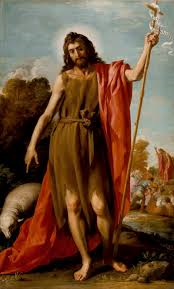
Gaudete! The Third Sunday of Advent
‘Truly I tell you, among those born of women no one has arisen greater than John the Baptist; yet the least in the kingdom of heaven is greater than he’ (Mt. 11:11). ⧾
Today is Gaudete Sunday and the sacred liturgy exhorts us to be joyful as we look forward to the coming celebration of Our Lord’s birth. Once again, we encounter John the Baptist, the last of the prophets preparing the way for the Lord through his call to repentance. As we read the ancient prophecies during Advent, we are especially mindful that the New Testament lies hidden in the Old and the Old Testament is unveiled in the New (St. Augustine: Novum Testamentum in vetere latet, Vetus in novo patet. Catechism of the Catholic Church, 128). (This truth is brought home to us especially in the Service of Lessons and Carols which we will hold this afternoon at 3:00 p.m. Nine biblical readings that recall the promise of salvation and their fulfilment in Christ.) The New Testament lies hidden in the Old and the Old Testament is unveiled in the New. Our Christian faith is not based solely on events, but on the conformity of these events to the revelation contained in the Old Testament or what are sometimes referred to as the Jewish Scriptures. Roy Schoeman, a Harvard professor who converted to Catholicism through a mystical encounter with Our Lady expresses the unity of the Scriptures in this manner: Judaism is pre- Messianic Catholicism and Catholicism is post-Messianic Judaism.
In the cycle of our Sunday reading, the Gospel reading is always an echo of the first reading taken from the Old Testament. This should help us to be mindful always that we are people of Tradition. In every Mass in the Canon we make mention of Abraham our father in faith. We are the spiritual heirs of the promise made to him. Our identity and even our worship are not of our own making. There are elements in the Mass that have their origin in the liturgy of the Temple in Jerusalem. We are not rootless and without identity. The liturgy of Advent is a yearly return to the sources of our ontology, our essential identity as the People of God. Rooted in the Mystery of Jesus the Messiah we are guided by the heralds of salvation and those who served this mystery most intimately so that we might experience, live and proclaim it with ever greater fidelity.
In our Gospel reading, Our Lord also bears witness to John whose preaching ushered in the age of the Messiah. At first hearing we might find Our Lord’s answer to John’s question somewhat evasive or puzzling: Are you the one who is to come, or are we to wait for another?’ (Mt. 11:3). Nothing could be clearer or more impressive than the answer Our Lord gives to John’s messengers: The blind receive their sight, the lame walk, the lepers are cleansed, the deaf hear, the dead are raised and the poor have the good news preached to them (Mt. 11:5). These words are a fulfillment of the prophecy of Isaiah which we heard in our first reading. The New Testament lies hidden in the Old and the Old Testament is unveiled in the New.
Just as important as the message preached by John however, is his attitude towards the message. The greatness of John the Baptist which Our Lord praises lies in his humility and self-effacement. He bears witness to the radiance of the Messiah whose coming he has preached, and so he declares: ‘He must increase, but I must decrease’ (Jn. 3:30). These words express very succinctly our own dispositions before the Mystery of God especially as we serve Him both in our worship and in our active charity. St. John the Baptist is set before us today as a model of our own Christian commitment; both individually and collectively. We too must prepare the way for the Lord and proclaim the Good News; and we must do so humbly. If we wish to be instruments of Christ, then we must make every effort to divest ourselves of all that is not of Christ. Only this way can we effectively bear witness to the light of truth with integrity. Otherwise, we stand between the light and those in need of it. The mystery of John the Baptist is still being fulfilled in the world today as we continue the work of the Lord’s precursor, showing Christ to the world as the only hope of salvation.
‘Truly I tell you, among those born of women no one has arisen greater than John the Baptist; yet the least in the kingdom of heaven is greater than he.’ In these words the mystery of John the Baptist is revealed as a present reality. Our Lord is in no way undermining John’s holiness. Rather, He affirms that even the least of us has an important part to play in the unfolding plan of salvation The Prophets looked forward to the New Covenant but did not share fully in its blessings. We however, are firmly established in it. John is greater than anyone ‘born of woman’, that is, anyone born ‘of human stock, or by fleshly desire of a human father’; but he is lesser than anyone who has been given the ‘right of becoming a child of God’, who has been ‘born of God himself’ [Jn. 1:12f] (Erasmo Leiva-Merikakis, Fire of Mercy, Heart of the World, Vol I, p. 659). Even the least aspect of the fulfillment of the promise of salvation is a greater reality than the greatest prophet or prophecy concerning it.
The significance of this truth at the practical level is that whatever is done by us to proclaim and to further the cause of God’s Kingdom is imbued with a spiritual power and significance beyond the very obvious immediate benefit precisely because it is done in Christ and in the power and presence of the Holy Spirit. We are active participants in the unfolding Mystery of Salvation in the times that have been allotted to us. John the Baptist teaches all of us that in the encounter with the living God, who comes to save us, humility and surrender enable us to be drawn into this saving Mystery just as Our Lady and St. Joseph were; and from them we learn how to serve this Mystery as the greatest good in our life. Beyond the exercise of Christian charity which is especially in evidence at this time of the year, there are realities in the order of grace that can only be perceived in the prayerful silence of our own souls; such that we ourselves like John the Baptist become a sign and source of hope.
More than the many works of active charity performed by Catholics, especially in our outreach to the poor and needy, our collective response to penance and renewal through sacramental confession is a sign to the world of how to receive and share the gift of Salvation. In the humility and self- effacement of this sacrament we make John’s words our very own: He must increase, but I must decrease. A humble confession is no less a bold proclamation of the Messiah’s mission to heal and save the human family. In the grace of this sacrament we can begin to understand that the least in the kingdom of heaven is greater than [John the Baptist]; and that all of us can become humble servants of the work of God begun in sacred mystery and wonderfully manifested in the Messiah, Our Lord and Saviour Jesus Christ. ⧾

Remembering Father Alphonse de Valk
(Today marks the sixth anniversary of the death of Father Alphonse de Valk, C.S.B., a faithful, courageous and indefatigable Basilian priest, pro-life-and-family apostle, and the founder of Catholic Insight magazine. Here is what we wrote those on his entering into eternity five years ago, as we continue to remember him in our prayers and thoughts)[…]Continue reading→

Divine Mercy Sunday – An Echo of Every Mass
Reach out your hand and put it in my side. Do not doubt but believe’… ‘My Lord and my God!’ (Jn. 20:18)). Today is Divine Mercy Sunday, and as we celebrate the end of the Easter Octave, we contemplate the wounded side of our Saviour, the Church’s source of life. On Good Friday in the[…]Continue reading→

Saint Stanislaus of Szczepanów
We celebrate Saint Stanislaus today (+ April 11, 1079), in light of this Easter Octave, a bishop and martyr who accepted the episcopacy only at the direct order of Pope Alexander II. He proved a wise and courageous leader of his flock, put to death by his own king, Boleslaus, for rebuking the monarch’s ‘immoral[…]Continue reading→

First Holy Communion: Sermon from May 16, 1943
Here is a sermon from the good old days by +Rev. Msgr. Vincent Nicholas Foy (August 14, 1915 – March 13, 2017), from 1943. Readers may recall that Pope Saint Pius X, by the decree Quam Singulari in 1910, lowered the customary age of reception of Holy Communion – after the rigours of the plague[…]Continue reading→

In the Glorious Light of Easter, Alleluia!
Set your minds on things that are above, not on things that are on earth, for you have died, and your life is hidden with Christ in God. When Christ who is your life is revealed, then you also will be revealed with him in glory (Col. 3:3-4). The Resurrection of Our Lord and Saviour[…]Continue reading→

An Ancient Homily for Holy Saturday
The time between Good Friday and Easter Sunday is one of waiting, in silence, as the world wonders – anticipates – what will happen, after the death of Christ. We re-live this time each year in the anamnesis of our liturgy, and in turn look forward to the glorious re-creation of all things at the[…]Continue reading→

Europe’s Long Descent
(As we meditate on this day on Christ’s burial, and His descent into hell, it is fitting to ponder here with contributor Peter Marcus how the world seems to be heading there as well. The difference is that, although God cannot ‘redeem’ hell, nor those therein, He can and did redeem the world. There is[…]Continue reading→
Pope Saint John Paul II’s First Good Friday Homily
ADDRESS OF HIS HOLINESS JOHN PAUL II AT THE CONCLUSION OF THE STATIONS OF THE CROSS AT THE COLOSSEUM Good Friday, 13 April 1979 When we make the Way of the Cross from one station to the next, in spirit we are always at the spot wherethis journey had its “historical” place: where it[…]Continue reading→
A Meditation for Good Friday: How To Undo the Effects of Sin?
Cardinal Newman, now Saint John Henry Newman, was a towering figure of nineteenth-century Catholicism who is almost universally admired. I say “almost” because not everyone likes him. I knew a priest once, Arthur Caulkins, who has become disenchanted with Newman. As an undergraduate Arthur had been enamoured of Newman, and this interest continued when he[…]Continue reading→
Pope Benedict’s Last Holy Thursday Homily
MASS OF THE LORD’S SUPPER HOMILY OF HIS HOLINESS BENEDICT XVI Basilica of St John Lateran Holy Thursday, 5 April 2012 Photo Gallery (Video) Dear Brothers and Sisters! Holy Thursday is not only the day of the institution of the Most Holy Eucharist, whose splendour bathes all else and in some ways draws it to[…]Continue reading→