
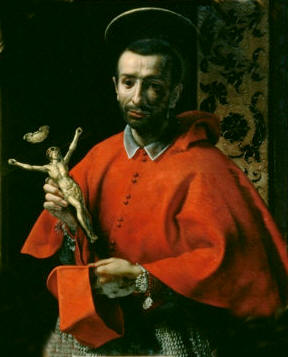
The True Reformation of Charles Borromeo
The memorial of Saint Charles Borromeo (1538-1584) commemorates one of the great pillars – along with Saint Robert Bellarmine, Philip Neri and countless others – of what is unfortunately known as the ‘Counter Reformation’, which is really nothing other than the Catholic Church’s vigorous response – lately grown complacent, complaisant and enervated in the luxury and worldliness of the renaissance – to the Protestant’s own reaction against this enervation, but which also included their throwing out much of Tradition and truth.
Charles in his relatively brief life filled more than most men in three lives. He was one of the rather rare good fruits of nepotism, being none other than the Pope’s nephew, from a noble family lineage. Said Pontiff, Pius IV, recognizing the qualities in the young Charles, then but 22 years old, appointed him a cardinal in 1560, and this back in the days when that office went along with much political power, riches, largesse, and, if one so desired, a life of ease and comfort.
Numerous other nepotistic ‘cardinal-nephews’ had chosen to immerse themselves what the world might offer, but Charles chose the precise opposite, dedicating himself to his vocation with an extraordinary zeal to the true Reformation of the Church of Christ. He promoted austerity and discipline amongst the clergy, as well as piety and learning, leading always by example. And it was Cardinal Borromeo who, almost by sheer force of his own will, intellect and holiness, brought the third session of the Council of Trent (1545 – 1563) to an admirable and glorious conclusion, which clarified and solidified the Church’s doctrine and practice.
Charles was ordained a priest in 1563 (cardinals up until quite recently could be, and sometime were, laymen), and was appointed Archbishop of Milan a year later, in 1564. His reforms there met with much resistance, even an attempt on his life, but he again led by his own saintly example, putting into practical effect the reforms called for by the recently completed Tridentine Council. By his diplomacy and numerous writings, he influenced the Church in this tumultuous time, as well as world affairs, including the troubling state of the Church in England. Edmund Campion, the great Jesuit and future martyr, stayed with Bishop Charles for eight days of prayer and conversation, before his fateful return to England.
His advice to his priests stands in good stead for us all:
Would you like me to teach you how to grow from virtue to virtue and how, if you are already recollected at prayer, you can be even more attentive next time, and so give God more pleasing worship? Listen, and I will tell you. If a tiny spark of God’s love already burns within you, do not expose it to the wind, for it may get blown out. Keep the stove tightly shut so that it will not lose its heat and grow cold. In other words, avoid distractions as well as you can. Stay quiet with God. Do not spend your time in useless chatter.
‘Stay quiet with God‘ is invaluable advice in our technological era of constant noise and distraction, counsel reiterated powerfully and providentially for our own day by another saintly cardinal, Robert Sarah, whose book on the Power of Silence comes highly recommended.
Charles Borromeo was the patron and intercessor of a future bishop who carried his name, Karol Wojtyla (who often invoked the prayers of his predecessor, and himself celebrated this day, for in Polish culture, the focus is on one’s patron saint by name, rather than one’s birthday). Their lives in many ways were parallel, both reformers of the Church in the heady days after a great Council. They lived in different eras, and their outlooks coloured by this (Charles is now criticized for his treatment of ‘heretics’, but Church-State relations were quite different in the 16th century than they are now).
Bishops Wojtyla and Borromeo were both great saints, stalwart and steadfast in their defence and safeguarding of the Church’s salvific truths, clearly, without ambiguity and compromise, who sought the lowest place (young Karol at first desired to be a Carthusian, and we may be thankful that his spiritual director convinced him otherwise). Both were brought up to the highest, by the grace and providence of God, and we should pray that all of our pastors, bishops and priests imbibe some large share of their spirit of dedication, magnanimity and holiness.
Saint Charles Borromeo, ora pro nobis!

Carney’s Amoral Majority
After five defections – euphemistically described as ‘crossing the floor’ – and three by-elections, Mark Carney and his Liberals how have their coveted majority. One wonders what bowls of pottage were offered in back-room deals. In the archaic monarchical system that is the Dominion of Canada, this majority allows the newly-minted Prime Minister to rule[…]Continue reading→

Saint Kateri , Canada’s Protectress
This was the title given to Saint Kateri Tekakwitha, by Pope Benedict XVI, when he canonized her on October 28th, 2012, along with six others, in Saint Peter’ Square (she had been beatified by Pope John Paul II back in 1980). With Saint Joseph as our protector, along with the Canadian martyrs, we seem to[…]Continue reading→

Remembering Father Alphonse de Valk
(Today marks the sixth anniversary of the death of Father Alphonse de Valk, C.S.B., a faithful, courageous and indefatigable Basilian priest, pro-life-and-family apostle, and the founder of Catholic Insight magazine. Here is what we wrote those on his entering into eternity five years ago, as we continue to remember him in our prayers and thoughts)[…]Continue reading→

A Tale of Two Benedicts
A grace-filled Holy Week to all our readers! As we await and prepare for the Resurrection about to dawn upon us, we might keep in mind two Benedicts: Pope Emeritus Benedict XVI, requiescat in pace, elected on this day in 2005; and today’s commemoration of the mystic pilgrim, Benedict Joseph Labre, who died on this[…]Continue reading→

My Name is Bernadette
April 16th is a propitious day, for besides the anniversary of Father de Valk’s death, who founded Catholic Insight in its print form decades ago, and the commemoration of the ‘two Benedicts’, mentioned in accompanying posts, today we also recall Saint Bernadette Soubirous, the young visionary to whom the Virgin Mary appeared numerous times at[…]Continue reading→

Saint Lydwina of Schiedam and Suffering Joyfully
Saint Lydwina of Schiedam (1380 – 1433) was one of the countless and glorious ‘victim souls’ in the history of the Church, those whose lives are filled with suffering, often of an unimaginable intensity, but who suffer joyfully. She was a fifteen-year old Dutch girl, out skating one day, when she fell and broke one[…]Continue reading→

The Glorious Martyrdoms of Martin and Maximus
As we enter into Eastertide, we recall on this 13th of April Pope Saint Martin I (+655), one of the noblest, if most tragic, of the successors of Saint Peter. Born in Umbria, Italy, he was of noble lineage, with great intelligence combined with charity and love of the poor and the Church. While still[…]Continue reading→

Canonizing Sister Faustina and Divine Mercy
HOMILY OF THE HOLY FATHER MASS IN ST PETER’S SQUARE FOR THE CANONIZATION OF SR MARY FAUSTINA KOWALSKA Sunday, 30 April 2000 1. “Confitemini Domino quoniam bonus, quoniam in saeculum misericordia eius”; “Give thanks to the Lord for he is good; his steadfast love endures for ever” (Ps 118: 1). So the Church sings on the Octave of[…]Continue reading→

Divine Mercy Sunday – An Echo of Every Mass
Reach out your hand and put it in my side. Do not doubt but believe’… ‘My Lord and my God!’ (Jn. 20:18)). Today is Divine Mercy Sunday, and as we celebrate the end of the Easter Octave, we contemplate the wounded side of our Saviour, the Church’s source of life. On Good Friday in the[…]Continue reading→

Saint Stanislaus of Szczepanów
We celebrate Saint Stanislaus today (+ April 11, 1079), in light of this Easter Octave, a bishop and martyr who accepted the episcopacy only at the direct order of Pope Alexander II. He proved a wise and courageous leader of his flock, put to death by his own king, Boleslaus, for rebuking the monarch’s ‘immoral[…]Continue reading→