
Martha, Mary and Ill-Fated Marriage
Our Lady of Fatima purportedly revealed to young Jacinta that many marriages are not willed by God, the truth of which may be borne out by a mere cursory glance around the world. Today is the anniversary of what seem to have been two such ill-fated unions. On July 29th, 1565, Mary, Queen of Scots, married her first cousin, the dissolute ‘long lad’ Lord Darnley – he stood over six feet, tall for that age – with whom she was irrationally besotted. Mary had previously been the wife of Francis, the King of France, who was short and sort of stubby – Mary was also abnormally tall for a woman of that era, one inch under six feet, strikingly beautiful and accomplished.
Even so, Mary’s first union seems to have been a happy one, for a true marriage looks not with the eyes of man, but of God, a union primarily of minds and hearts. Their marriage intended from childhood, Mary and Francis had been brought up together, and they ruled France well and justly. Sadly, the young king died of an ear abscess, on December 5, 1560, leaving Mary grief-stricken, and we may believe it so. For is not first love usually the truest love?
The second marriage to Darnley was not so blessed. They bore one child, the Protestant James the I of England and the VI of Scotland, although some dispute his paternity, claiming he was sired by David Rizzio, Mary’s Italian private secretary, whom Darnley soon had strangled in front of the pregnant Mary. (James it was who sponsored the English translation of Scripture named after him, and who is regarded favourably in Whiggish history, even if not so much for the Catholic cause in England).
One may read the convoluted and tragic events soon after the marriage, that led to Darnley’s own mysterious murder, being found smothered on the lawn after the house he was in was blown up; Mary’s even more mysterious marriage in quick succession to the Protestant Bothwell, who was the primary culprit in that murder, and Mary’s eventual beheading – contrite and repentant at the end – at the order of her own cousin, Queen Elizabeth.
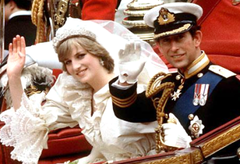
We also may remember, not quite as tragically, perhaps, the fairy-tale marriage of Princess Diana to Charles, the Prince of Wales, on this day in 1981, an extravaganza which cost an estimated $48 million. There is a statistic that the more is spent on a wedding, the less likely the marriage is to survive, which bears some pondering in the bloated enterprise ‘weddings’ have become. But, more to the point, Charles and Diana too seemed ill-suited, coming from different backgrounds, milieux, tastes and proclivities. As but one small but significant point, her favourite music at the time was Duran Duran, which I am rather sure grated upon the ears of Charles, as it should upon those of even remotely refined taste. On the flip side, his and his family’s stiff royal-ness and all the etiquette was a strain to the ungoverned Diana, used to a more bohemian existence in a flat with her girlfriends in London. Whatever went on, we all know the tragic outcome: Separation, divorce, and Diana’s death in a high-velocity car crash, with her boyfriend, Dodi Fayed, fleeing the paparrazi in late August of 1997, obscuring Mother Theresa’s own passing on September 5th. But that is another story.
Today’s saint is Martha, one week after we celebrated her sister Mary (presuming Mary Magdalene is the same Mary who listened at the feet of Jesus). Any true marriage requires the spirit of both of them: First and foremost the contemplative outlook of Mary, who chose the ‘better part’, for couples must first lead each other to heaven by prayer, the sacraments, not least holy Mass and frequent Communion, all this is entailed in listening to the ‘word of God. But marriage also needs the practical dimension of Martha, ‘busy with many things’, ordering means to the end, building an oikonomia, a household, a hearth and home, where children may be raised in a stable and secure environment, fed and watered, taught and matured, brought to what heights of perfection they may reach.
The problem, to which Our Lady may have been referring, is that most people, Catholics included, seem to have little clue of what marriage really is: Not a romantic infatuation, or a hotbed of sensual delights, or even a mutually economic ‘partnership’, a refined business merger, to be dissolved when any one of these ceases to be, or be what one thought it might.
Rather, marriage is a covenant, in which two souls promise to bring each other, and their children, to heaven, who will stick things out, through thick and thin, in joy and friendship, in all the graces and blessings, but also, and even more so, in all the suffering and sacrifice.
For we must keep firmly in mind that marriage, for all of its importance, is only for this life, a transitory reality, and we are all destined, if we cooperate and so choose, to be one day like the ‘angels in heaven’. Some are called straight there, in the religious and consecrated life. Others must make their way as best they can in a single life, whether chosen for some greater good, or thrust upon them by circumstances beyond their control, a situation ever more common in our fractious, broken world. While still others – the majority, still – journey through the ‘pots and pans’, as Saint Theresa put it, in all the mess and morass of family life.
The key is that in whatever path we may be called, we all must keep our eyes on the prize, the goal of all our striving. If we lose sight of that, everything else – marriage included – falls apart.

Carney’s Amoral Majority
After five defections – euphemistically described as ‘crossing the floor’ – and three by-elections, Mark Carney and his Liberals how have their coveted majority. One wonders what bowls of pottage were offered in back-room deals. In the archaic monarchical system that is the Dominion of Canada, this majority allows the newly-minted Prime Minister to rule[…]Continue reading→

Saint Kateri , Canada’s Protectress
This was the title given to Saint Kateri Tekakwitha, by Pope Benedict XVI, when he canonized her on October 28th, 2012, along with six others, in Saint Peter’ Square (she had been beatified by Pope John Paul II back in 1980). With Saint Joseph as our protector, along with the Canadian martyrs, we seem to[…]Continue reading→

Remembering Father Alphonse de Valk
(Today marks the sixth anniversary of the death of Father Alphonse de Valk, C.S.B., a faithful, courageous and indefatigable Basilian priest, pro-life-and-family apostle, and the founder of Catholic Insight magazine. Here is what we wrote those on his entering into eternity five years ago, as we continue to remember him in our prayers and thoughts)[…]Continue reading→

A Tale of Two Benedicts
A grace-filled Holy Week to all our readers! As we await and prepare for the Resurrection about to dawn upon us, we might keep in mind two Benedicts: Pope Emeritus Benedict XVI, requiescat in pace, elected on this day in 2005; and today’s commemoration of the mystic pilgrim, Benedict Joseph Labre, who died on this[…]Continue reading→

My Name is Bernadette
April 16th is a propitious day, for besides the anniversary of Father de Valk’s death, who founded Catholic Insight in its print form decades ago, and the commemoration of the ‘two Benedicts’, mentioned in accompanying posts, today we also recall Saint Bernadette Soubirous, the young visionary to whom the Virgin Mary appeared numerous times at[…]Continue reading→

Saint Lydwina of Schiedam and Suffering Joyfully
Saint Lydwina of Schiedam (1380 – 1433) was one of the countless and glorious ‘victim souls’ in the history of the Church, those whose lives are filled with suffering, often of an unimaginable intensity, but who suffer joyfully. She was a fifteen-year old Dutch girl, out skating one day, when she fell and broke one[…]Continue reading→

The Glorious Martyrdoms of Martin and Maximus
As we enter into Eastertide, we recall on this 13th of April Pope Saint Martin I (+655), one of the noblest, if most tragic, of the successors of Saint Peter. Born in Umbria, Italy, he was of noble lineage, with great intelligence combined with charity and love of the poor and the Church. While still[…]Continue reading→

Canonizing Sister Faustina and Divine Mercy
HOMILY OF THE HOLY FATHER MASS IN ST PETER’S SQUARE FOR THE CANONIZATION OF SR MARY FAUSTINA KOWALSKA Sunday, 30 April 2000 1. “Confitemini Domino quoniam bonus, quoniam in saeculum misericordia eius”; “Give thanks to the Lord for he is good; his steadfast love endures for ever” (Ps 118: 1). So the Church sings on the Octave of[…]Continue reading→

Divine Mercy Sunday – An Echo of Every Mass
Reach out your hand and put it in my side. Do not doubt but believe’… ‘My Lord and my God!’ (Jn. 20:18)). Today is Divine Mercy Sunday, and as we celebrate the end of the Easter Octave, we contemplate the wounded side of our Saviour, the Church’s source of life. On Good Friday in the[…]Continue reading→

Saint Stanislaus of Szczepanów
We celebrate Saint Stanislaus today (+ April 11, 1079), in light of this Easter Octave, a bishop and martyr who accepted the episcopacy only at the direct order of Pope Alexander II. He proved a wise and courageous leader of his flock, put to death by his own king, Boleslaus, for rebuking the monarch’s ‘immoral[…]Continue reading→