
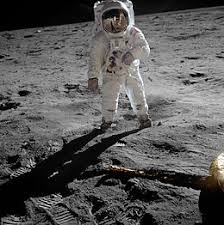
Fifty Years On, the Controversy Continues
I was not sure we should mention the fiftieth anniversary of the moon landings, fraught as they are with so-called conspiracy theories. Whatever one thinks of the latter group, one must admit that there are various unanswered, or not fully answered, questions about the moon landings, a few of which I will raise.
The commonly accepted account is that a crew of three men, Buzz Aldrin, Neil Armstrong – who both walked on the lunar surface – and Michael Collins, who piloted the return module around the lunar orbit before picking them up, went across the vast chasm of space at about 25,000 miles per hour in a Saturn rocket to the Moon, taking off on July 17th, and landing on this day. We are all aware of Armstrong’s aptly-chosen, and likely rehearsed, words as he stepped onto the rocky surface, covered with fine layer of dust: ‘One small step for man…’, for which the patriarchal pilot would now be chastised for non-inclusive language. The iconic moment, captured on television – although we should add that all the original footage has been ‘lost’ – bound a nation together, and allowed America to win the ‘space race’ with Soviet Russia.
There were what seemed insurmountable difficulties in leaving planet Earth, and the Russians were the first to complete various technological hurdles: The first satellite in orbit; the first man in space; the first to have a human complete an orbit of the earth. The Americans were being left quite literally in the dust. John F. Kennedy, in 1961, promised, or threatened, to put a man on the moon before the end of the decade; and, lo and behold, 1969 was the year of destiny.
It seemed quasi-miraculous that, after all their setbacks, the Americans were suddenly were able to fly three men across deep space; have them eject from the orbiting module in a craft about the size of two Humvees; land safely, walk around for a combined total of 21 hours; climb back into said landing module; fly back to the orbiting module, and hook up safely; then fly back across space, enter Earth’s orbit, and land safely in the ocean.
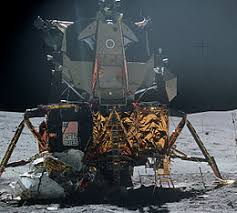
In all, the Americans repeated this feat five more times in the Apollo missions between 1969 and 1972, with twelve men walking on the lunar surface, before apparently tiring of the whole thing and abandoning the project.
Just a few facts to ponder on this anniversary:
Only the United States has claimed to have staged a manned mission to the Moon; no other nation has ever done so, nor ever come close, not even the Russians in their mania to succeed, for which no expense nor human consideration was spared.
Besides that, no one, American included, has ever returned to the lunar surface since Apollo 17 in mid-December of 1972.
The farthest any human has been from the surface of the Earth since the Moon landings is about 254 miles, the height of the space station. ‘Space’ itself is a rather arbitrary concept, with NASA declaring that it begins at 76 miles above Earth (when atmospheric drag ceases to be a factor in flight, and pilots – astronauts – must use thrusters to steer).
The Moon, on the other hand, is about 240,000 miles away, a thousand times that distance. One could fit 20 planet Earths between us and the Moon. To put it mildly, this seems incredible.
One wonders. Why have we not been back to the Moon, and what is stopping us? If we could go back and forth six times in a span of four years, with no loss of life (prescinding from the three astronauts burned in an accident while on the ground in Apollo 1 in 1967), why can we not do so now, with far greater ease and efficiency?
This seems contrary to our collective human drive to excel and perfect what technologies we invent, from cars, to boats, to weaponry and airplanes. We should have a base on the moon by now, with shuttles back and forth.
Yet NASA claims to have ‘lost the technology’ that made what seemed impossible possible in 1969, in an age with no computers to speak of, no GPS, no advanced guidance systems and so on.
One could go on with the various difficulties which have been only lightly explained way: The cosmic radiation, which can penetrate lead shielding; the difficulty of traversing that distance through deep space in what we would now see as primitive vehicles; the temperature on the Moon; the difficulty of landing and taking off from the lunar surface in a gravity one-sixth that of Earth, something the astronauts had never done before, yet executed perfectly, without a hitch; problems with the film footage, the shots, the flag, the camera.
Half a century on, there are vast swathes of people who do not believe in the moon landings, which should at least give us pause. Are they are all unhinged cranks?
At the very least, we should ask questions, and wonder, especially, why does no one – anyone, China, India, Elon Musk – seem able to return? Instead, we get vague promissory notes of a new moon landing in ‘2050’ or some other randomly chosen, conveniently distant, date.
Then again, the conspiracy theorists – we may prefer to call them questioners – have to deal with the difficulty of how such a vast fraud was foisted upon the world, one that has been kept secret and secure for half a century. If the moon landings were all filmed on some indoor and outdoor stages in Nevada, how many people must have been involved, and how did they all maintain the strict omerta of secrecy? What sort of coercive force did the government – CIA, NSA, or some other agency without even an acronym – use? Would not someone – one of the astronauts, perhaps – repent on his deathbed, after having lived and breathed such a momentous lie? Were they themselves somehow fantastically duped, like Charlton Heston landing on what he later discovered to be Earth?
Whatever your leanings on this issue – the United States did achieve a victory, either a technological wonder, unable now to repeated; or a breathtaking falsehood, which would also be impossible, or far more difficult, in today’s age of hyperconnectedness. Back then, people would believe anything they saw on television. Nowadays, in the era of deepfakes, not so much, or at least one would hope.
So we wait for someone’s return to the moon, perhaps even a visit to Mars – and if you think the Moon landing impossible, we could wax eloquent on how much more so a manned Mars mission would be – or at least to some region beyond near-Earth orbit.
Until then, we may wonder and marvel, one way or the other.

Carney’s Amoral Majority
After five defections – euphemistically described as ‘crossing the floor’ – and three by-elections, Mark Carney and his Liberals how have their coveted majority. One wonders what bowls of pottage were offered in back-room deals. In the archaic monarchical system that is the Dominion of Canada, this majority allows the newly-minted Prime Minister to rule[…]Continue reading→

Saint Kateri , Canada’s Protectress
This was the title given to Saint Kateri Tekakwitha, by Pope Benedict XVI, when he canonized her on October 28th, 2012, along with six others, in Saint Peter’ Square (she had been beatified by Pope John Paul II back in 1980). With Saint Joseph as our protector, along with the Canadian martyrs, we seem to[…]Continue reading→

A Tale of Two Benedicts
A grace-filled Holy Week to all our readers! As we await and prepare for the Resurrection about to dawn upon us, we might keep in mind two Benedicts: Pope Emeritus Benedict XVI, requiescat in pace, elected on this day in 2005; and today’s commemoration of the mystic pilgrim, Benedict Joseph Labre, who died on this[…]Continue reading→

My Name is Bernadette
April 16th is a propitious day, for besides the anniversary of Father de Valk’s death, who founded Catholic Insight in its print form decades ago, and the commemoration of the ‘two Benedicts’, mentioned in accompanying posts, today we also recall Saint Bernadette Soubirous, the young visionary to whom the Virgin Mary appeared numerous times at[…]Continue reading→

Saint Lydwina of Schiedam and Suffering Joyfully
Saint Lydwina of Schiedam (1380 – 1433) was one of the countless and glorious ‘victim souls’ in the history of the Church, those whose lives are filled with suffering, often of an unimaginable intensity, but who suffer joyfully. She was a fifteen-year old Dutch girl, out skating one day, when she fell and broke one[…]Continue reading→

The Glorious Martyrdoms of Martin and Maximus
As we enter into Eastertide, we recall on this 13th of April Pope Saint Martin I (+655), one of the noblest, if most tragic, of the successors of Saint Peter. Born in Umbria, Italy, he was of noble lineage, with great intelligence combined with charity and love of the poor and the Church. While still[…]Continue reading→

Saint Stanislaus of Szczepanów
We celebrate Saint Stanislaus today (+ April 11, 1079), in light of this Easter Octave, a bishop and martyr who accepted the episcopacy only at the direct order of Pope Alexander II. He proved a wise and courageous leader of his flock, put to death by his own king, Boleslaus, for rebuking the monarch’s ‘immoral[…]Continue reading→

Saint Gemma Galgani
On this April 11th, in 1903 – the same year that the Italian Guiseppe Sarto was elected Pope later that summer as Pius X – a lovely, young Italian woman died, by the name of Gemma Galgani. She lived a brief life of 24 years, as did a number of other young saints, including Pier[…]Continue reading→

An Ideological and Improper Translation
I noticed something odd with the psalm reading at Mass the other day. Our bishops’ conference here in Canada has decreed that the Mass in English – Novus Ordo – use the ‘NRSV’, the ‘New Revised Standard Version’, an ‘updated’ translation of the original RSV, first published in 1952. This ‘new translation’ has the tendency[…]Continue reading→
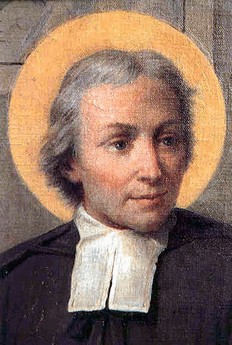
Saint Jean-Baptiste de la Salle: A Teacher for Teachers
Jean-Baptiste de la Salle (1651 – 1719), a French nobleman, ordained a priest, founded the first order in the Church’s history entirely without priests, and this came about almost by accident. I say ‘almost’, for, of course, there are no accidents with God. Destined for ordination from an early age, Jean-Baptiste never looked back, even[…]Continue reading→