
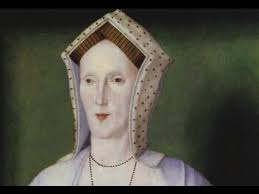
The Tragic Dignity of Margaret Pole
A brief mention of today’s saint, Blessed Margaret Pole, Countess of Salisbury (+1541), the daughter of George, Duke of Clarence, who was in turn the brother of Kings Edward IV and Richard III, of Shakespeare’s fame – but the last of the Plantagenets has been somewhat maligned, methinks. When Richard fell in the Battle of Bosworth in 1485, she was one of the few surviving members of the Plantagenet dynasty to hold her lands, after the upstart Welshman Henry Tudor claimed the throne – some say illegitimately – as Henry VII, thus beginning a familial hegemony that would end with the tragic excommunicated spinster Queen Elizabeth – who, after falling into a drawn-out melancholia, purportedly died wailing at hideous spirits others could not see.
But back to Margaret, who was left impecunious for a time, until the reign of Henry’s eponymous successor and son, the Eighth, when she reclaimed favour, even acting as governess for Henry’s daughter Mary Tudor. For a good part of her life, she was one of richest, most landed and influential women in England, producing four sons and one daughter by her husband, Richard Pole.
Yet all was undone in the later, paranoid, and tyrannical part of Henry’s reign, the once-fair and handsome king, now ridden with disease and pustules and so obese he could no longer walk. This was long after he had parted ways with the Church, claiming to himself full supremacy in matters temporal and spiritual, dissolving the monasteries, and arrogating all ecclesiastical wealth and lands into the royal coffers, putting to death, by means mostly foul, any who were even suspected of being ‘against’ the King’s new role as the English vicar of Christ.
Well, one who was against the King and his sacrilegious usurpation was Cardinal Reginald Pole, one of Countess Margaret’s four sons, who, as special envoy to England, gave aid and advice to the Pilgrimage of Grace to overthrow Henry, and install a more Catholic regime.
Henry could not touch Cardinal Pole, who was in exile on the continent, so he took his rage out on his Eminence’s mother, arresting and throwing her in the dank Tower of London with no trial, and no charge, where she was kept for two and a half years, albeit with a few more amenities than the usual prisoner – a faint touch of mercy.
That is, until the fateful morning of May 27th, 1541, when the Countess, now 67 years old – a venerable age in that era – was told she was to be executed within the hour. She demanded to know her crime, but none was given. Escorted to the courtyard, her head was to be removed in private, in keeping with her noble station. But in indignation, she refused to lay that same noble head upon the block. Further, as the main executioner had been sent north to deal with the rebels, an inexperienced youth was summoned to do the dastardly deed. Hence, the dignified Margaret Pole, trying to avoid the swinging axe, was, by eyewitness accounts, quite literally and brutally hacked to death as she ran about, a sign of the bloody chaos of Henry’s reign, and of the undoing of England. The dissolution of the kingdom begun under Henry has now just about reached completion.
Margaret was beatified by Pope Leo XIII in 1886, precisely ten years before the same Pope, in the papal bull Apostolicae Curae, declared Anglican orders ‘null and void’. A century and thirteen years after that, Pope Benedict XVI, with the 2009 Apostolic Constitution, Anglicanorum Coetibus, would provide for an Anglican rite in the Catholic Church, easing the way for conversions back to truth and unity, while keeping one’s own traditions.
God always has His time and His ways, even if they seem rather chaotic and haphazard from our perspective. The saints still intercede, standing before the throne of God, and, with that, we may hope that what England was, she may, even in some small part, be again.

Carney’s Amoral Majority
After five defections – euphemistically described as ‘crossing the floor’ – and three by-elections, Mark Carney and his Liberals how have their coveted majority. One wonders what bowls of pottage were offered in back-room deals. In the archaic monarchical system that is the Dominion of Canada, this majority allows the newly-minted Prime Minister to rule[…]Continue reading→

Saint Kateri , Canada’s Protectress
This was the title given to Saint Kateri Tekakwitha, by Pope Benedict XVI, when he canonized her on October 28th, 2012, along with six others, in Saint Peter’ Square (she had been beatified by Pope John Paul II back in 1980). With Saint Joseph as our protector, along with the Canadian martyrs, we seem to[…]Continue reading→

Remembering Father Alphonse de Valk
(Today marks the sixth anniversary of the death of Father Alphonse de Valk, C.S.B., a faithful, courageous and indefatigable Basilian priest, pro-life-and-family apostle, and the founder of Catholic Insight magazine. Here is what we wrote those on his entering into eternity five years ago, as we continue to remember him in our prayers and thoughts)[…]Continue reading→

A Tale of Two Benedicts
A grace-filled Holy Week to all our readers! As we await and prepare for the Resurrection about to dawn upon us, we might keep in mind two Benedicts: Pope Emeritus Benedict XVI, requiescat in pace, elected on this day in 2005; and today’s commemoration of the mystic pilgrim, Benedict Joseph Labre, who died on this[…]Continue reading→

My Name is Bernadette
April 16th is a propitious day, for besides the anniversary of Father de Valk’s death, who founded Catholic Insight in its print form decades ago, and the commemoration of the ‘two Benedicts’, mentioned in accompanying posts, today we also recall Saint Bernadette Soubirous, the young visionary to whom the Virgin Mary appeared numerous times at[…]Continue reading→

Saint Lydwina of Schiedam and Suffering Joyfully
Saint Lydwina of Schiedam (1380 – 1433) was one of the countless and glorious ‘victim souls’ in the history of the Church, those whose lives are filled with suffering, often of an unimaginable intensity, but who suffer joyfully. She was a fifteen-year old Dutch girl, out skating one day, when she fell and broke one[…]Continue reading→

The Glorious Martyrdoms of Martin and Maximus
As we enter into Eastertide, we recall on this 13th of April Pope Saint Martin I (+655), one of the noblest, if most tragic, of the successors of Saint Peter. Born in Umbria, Italy, he was of noble lineage, with great intelligence combined with charity and love of the poor and the Church. While still[…]Continue reading→

Divine Mercy Sunday – An Echo of Every Mass
Reach out your hand and put it in my side. Do not doubt but believe’… ‘My Lord and my God!’ (Jn. 20:18)). Today is Divine Mercy Sunday, and as we celebrate the end of the Easter Octave, we contemplate the wounded side of our Saviour, the Church’s source of life. On Good Friday in the[…]Continue reading→

Saint Stanislaus of Szczepanów
We celebrate Saint Stanislaus today (+ April 11, 1079), in light of this Easter Octave, a bishop and martyr who accepted the episcopacy only at the direct order of Pope Alexander II. He proved a wise and courageous leader of his flock, put to death by his own king, Boleslaus, for rebuking the monarch’s ‘immoral[…]Continue reading→

Saint Gemma Galgani
On this April 11th, in 1903 – the same year that the Italian Guiseppe Sarto was elected Pope later that summer as Pius X – a lovely, young Italian woman died, by the name of Gemma Galgani. She lived a brief life of 24 years, as did a number of other young saints, including Pier[…]Continue reading→