
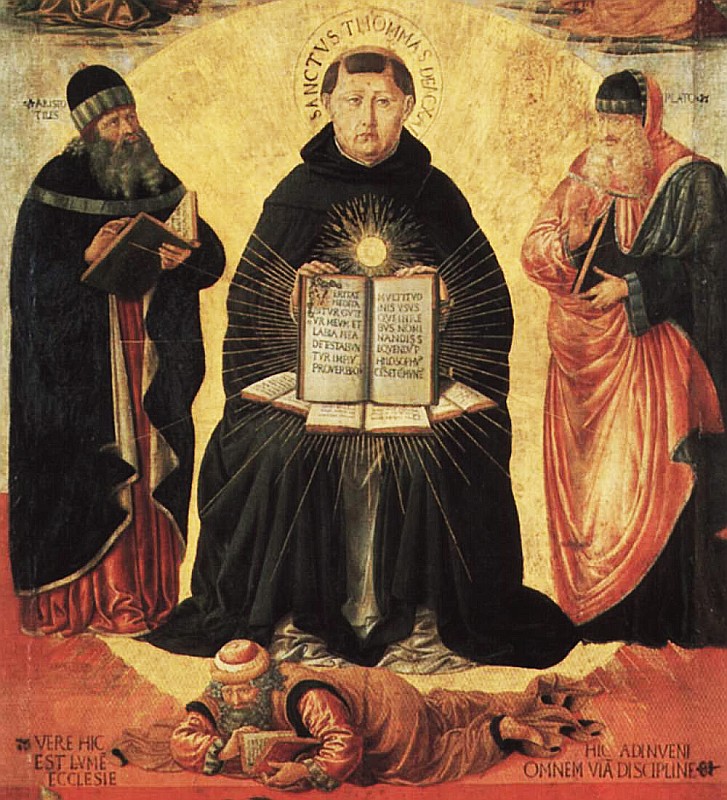
Thomas’ Enduring Legacy
Today is the anniversary of the death of Saint Thomas Aquinas. In March of 1274, he fell ill on his way to the second Council of Lyons, and so retired to the Cistercian monastery of Fossanuova where he recited a commentary on the Song of Songs for the grateful monks, in the midst which he went to his eternal reward in his fiftieth year, leaving behind a corpus of writing nearly miraculous in their scope, breadth and clarity. This used to be his feast day, but was moved after the Second Vatican Council to a day outside of Lent – the 28th of January, commemorating the transfer of his relics to the Dominican Convent of the Jacobins in Toulouse in 1369; there they rested until the French Revolution in 1789, when they were moved again to the Basilica of Saint Sernin in Toulouse until 1974, when they were moved back to the convent of the Jacobins, where they rest to this day.
We will never tire writing of Saint Thomas, as his doctrine is the backbone to the intellectual foundation of the Church, something Saint John Paul II, following any number of other Pontiffs, Doctors and theologians still filled with salt have reiterated since his death. The rational structure he offered for theology, that synthesis between faith and reason, has been indispensable, and the neglect of him, and his writing, we have fallen into a subjective, emotional mush – houses built on sand – which cannot stand against the buffets of the world and the devil. Sadly, this is where so much not only of the Church, but the rest of society, is at present, in her doctrine, her academic formation, her liturgy, and what often passes for ‘pastoral’ guidance. Saint Thomas once said that the hallmark of a trained intellect was the capacity to make the proper distinctions, which allow one to see the truth of things, right down to their essence.
Need we point out that this is being lost, a loss against which Pope Saint Pius X warned over a century ago in his encyclical Pascendi against the insidious heresy of modernism: That without Thomas, and the scholastic system, we would lose the capacity to reason properly, or even reason at all?
In the words of Pope John Paul in his Thomistically-grounded masterpiece, Fides et Ratio – choosing amongst any number of encomia heaped over the centuries upon the humble, quiet Dominican.
This is why the Church has been justified in consistently proposing Saint Thomas as a master of thought and a model of the right way to do theology (#43)
Indeed. And what follows soon after:
The Magisterium’s intention has always been to show how Saint Thomas is an authentic model for all who seek the truth. In his thinking, the demands of reason and the power of faith found the most elevated synthesis ever attained by human thought, for he could defend the radical newness introduced by Revelation without ever demeaning the venture proper to reason. (#78).
Ah, yes, the most elevated synthesis ever attained by human thought. But Thomas admitted that he learned more at the foot of the Cross than he did from all the books and lectures he absorbed (and he absorbed quite a bit), for clarity of mind can only derive from charity in the will. Orthodoxy and orthopraxy go together harmoniously, or perish miserably apart.
The American author Flannery O’Connor reminisced in her letters on her daily perusal of Thomas’ magnum opus, his Summa Theologica:
I couldn’t make any judgment on the Summa, except to say this: I read it every night before I go to bed. If my mother were to come in during the process and say, “Turn off that light. It’s late” I with lifted finger and broad, bland, beatific expression, would reply, “On the contrary, I answer that the light, being eternal and limitless, cannot be turned off. Shut your eyes, “ or some other such thing.
And she goes on to reiterate what all can gather from Thomas’ gentle, yet forceful and clear, words:
I feel I can personally guarantee that St. Thomas loved God because for the life of I cannot help loving Saint Thomas.
And would that we all would so love Saint Thomas.
Let us leave it there for now, for we will return soon to the Angelic and Universal Doctor with a few words about the political shenanigans in Ottawa.

Carney’s Amoral Majority
After five defections – euphemistically described as ‘crossing the floor’ – and three by-elections, Mark Carney and his Liberals how have their coveted majority. One wonders what bowls of pottage were offered in back-room deals. In the archaic monarchical system that is the Dominion of Canada, this majority allows the newly-minted Prime Minister to rule[…]Continue reading→

Saint Kateri , Canada’s Protectress
This was the title given to Saint Kateri Tekakwitha, by Pope Benedict XVI, when he canonized her on October 28th, 2012, along with six others, in Saint Peter’ Square (she had been beatified by Pope John Paul II back in 1980). With Saint Joseph as our protector, along with the Canadian martyrs, we seem to[…]Continue reading→

A Tale of Two Benedicts
A grace-filled Holy Week to all our readers! As we await and prepare for the Resurrection about to dawn upon us, we might keep in mind two Benedicts: Pope Emeritus Benedict XVI, requiescat in pace, elected on this day in 2005; and today’s commemoration of the mystic pilgrim, Benedict Joseph Labre, who died on this[…]Continue reading→

My Name is Bernadette
April 16th is a propitious day, for besides the anniversary of Father de Valk’s death, who founded Catholic Insight in its print form decades ago, and the commemoration of the ‘two Benedicts’, mentioned in accompanying posts, today we also recall Saint Bernadette Soubirous, the young visionary to whom the Virgin Mary appeared numerous times at[…]Continue reading→

Saint Lydwina of Schiedam and Suffering Joyfully
Saint Lydwina of Schiedam (1380 – 1433) was one of the countless and glorious ‘victim souls’ in the history of the Church, those whose lives are filled with suffering, often of an unimaginable intensity, but who suffer joyfully. She was a fifteen-year old Dutch girl, out skating one day, when she fell and broke one[…]Continue reading→

The Glorious Martyrdoms of Martin and Maximus
As we enter into Eastertide, we recall on this 13th of April Pope Saint Martin I (+655), one of the noblest, if most tragic, of the successors of Saint Peter. Born in Umbria, Italy, he was of noble lineage, with great intelligence combined with charity and love of the poor and the Church. While still[…]Continue reading→

Saint Stanislaus of Szczepanów
We celebrate Saint Stanislaus today (+ April 11, 1079), in light of this Easter Octave, a bishop and martyr who accepted the episcopacy only at the direct order of Pope Alexander II. He proved a wise and courageous leader of his flock, put to death by his own king, Boleslaus, for rebuking the monarch’s ‘immoral[…]Continue reading→

Saint Gemma Galgani
On this April 11th, in 1903 – the same year that the Italian Guiseppe Sarto was elected Pope later that summer as Pius X – a lovely, young Italian woman died, by the name of Gemma Galgani. She lived a brief life of 24 years, as did a number of other young saints, including Pier[…]Continue reading→

An Ideological and Improper Translation
I noticed something odd with the psalm reading at Mass the other day. Our bishops’ conference here in Canada has decreed that the Mass in English – Novus Ordo – use the ‘NRSV’, the ‘New Revised Standard Version’, an ‘updated’ translation of the original RSV, first published in 1952. This ‘new translation’ has the tendency[…]Continue reading→
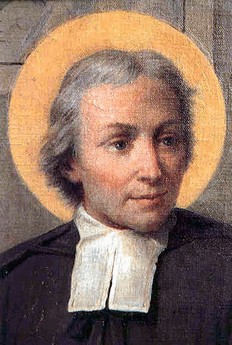
Saint Jean-Baptiste de la Salle: A Teacher for Teachers
Jean-Baptiste de la Salle (1651 – 1719), a French nobleman, ordained a priest, founded the first order in the Church’s history entirely without priests, and this came about almost by accident. I say ‘almost’, for, of course, there are no accidents with God. Destined for ordination from an early age, Jean-Baptiste never looked back, even[…]Continue reading→