
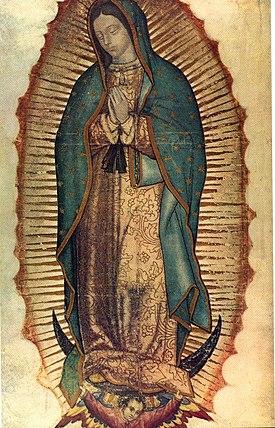
Am I not your Mother?
On a rather chilly morning on a hillside outside what is now Mexico City, in the year of our Lord 1531, while the Protestant ‘Reformation’ was wreaking spiritual and societal havoc across the Atlantic in Europe – Thomas More and John Fisher were less than four years from the chopping block – the Virgin Mary appeared – quite literally out of the blue – to an unlettered peasant named Juan Diego in 1531.
As with most true visionaries, Juan was perplexed, wondering – as Mary did a millennium and a half before – what sort of greeting this might be. In the midst of their conversations, and Juan’s hesitancy, Our Lady tenderly asked, and through him posed the question to all of us: ‘Juanito’ – as she called him – ‘Am I not your mother?’, to which there is really only one answer. ‘Mother’ is a perennial title of the Virgin, from the Theotokos proclaimed at the Council of Ephesus in 431 – literally, the ‘one who gives birth to God – to the Advent-Christmas antiphon, Alma Redemptoris Mater, ‘Nourishing Mother of the Redeemer’, which Palestrina set to transcendent polyphony in three different – but equally beautiful – versions in the decades after Our Lady appeared, thousands of miles from Rome.
Most know the subsequent story: Juan bringing his message to the bishop, who was himself hesitant and unbelieving, until the peasant unfolded his tilma, spilling out the miraculous roses, and the even-more miraculous image suddenly ‘appearing’ on Juan’s peasant garment, the tilma. A chapel was duly built to house the precious, well what would one call it, a relic? a supernatural photograph? – let’s just stick with ‘image’. Then, as the crowds increased, a bigger chapel, and eventually a basilica. The people seemed drawn by some invisible force – grace, one might think – to the image, whose peaceful and comforting smile – am I not your mother? – has a far more mysterious and supernatural quality than the Mona Lisa. Thousands, eventually millions, sought baptism, and Mexico became almost overnight a Catholic nation, which she held until the ravages of the atheistic persecutions of the early twentieth century (see the recent reflection on Miguel Pro), which helped make the nation more or less what it now is – a lawless regime run by drug cartels, the rich hiding behind fortified gated communities, and the vast majority of the poor eking out what living they might.
But the Catholicism and Faith are still there underneath, or perhaps above, the chaos, and the image still stands to this day, still drawing millions of pilgrims per year. By any laws of physics we know, the tilma, made of course organic material, should have disintegrated centuries ago, with the image sort of ‘floating’ above the fibres of the garment, maintaining a temperature of 98.6 degrees; scientists have detected a heartbeat, and there is in her eyes, only recently discernible by modern microscopic analysis, a reflected image of the bishop and someone else, as they likely appeared to Our Lady as she appeared to them on this day in December, 1531. The stars on her garment signify the southern constellations, but as seen from above. I’m not sure about this last one, but, if true, it’s saying something. The tilma is truly one of the most remarkable of the motiva credibilitatis, those ‘motives of credibility’ that bolster and support our Faith, offering us a window in the world beyond this transitory one.
Realizing the supernatural significance of Guadalupe, Pope John Paul II, on the eve of the third millennium, elevated what was a commemoration to the status of a feast. He also declared Our Lady of Guadalupe the patroness of all of ‘America’, south, central, and north, as well as patroness of the unborn, the Virgin who conquered the human sacrifice of the native Mexicans, a massacre now being repeated in a different mode through abortion and euthanasia.
Yet, in the midst of the evil, Our Lady is still our Mother and Queen, and we know not how many souls she has has brought into the Church through her miraculous image, how many babies and children saved, how many conversions, prompts to holiness, how many saints, especially the quiet, hidden ones, as she was in her earthly life.
We are now more than halfway through Advent, when the Light will soon be increasing, and Christmas upon us, when the Virgin will give birth to the Saviour. With that, hold on to truth and hope, even though the darkness seems, and I say seems, to prevail. In the end, light and goodness always win.
Nuestra Señora de Guadalupe, ruega por nosotros!
Carney’s Amoral Majority
After five defections – euphemistically described as ‘crossing the floor’ – and three by-elections, Mark Carney and his Liberals how have their coveted majority. One wonders what bowls of pottage were offered in back-room deals. In the archaic monarchical system that is the Dominion of Canada, this majority allows the newly-minted Prime Minister to rule[…]Continue reading→

Saint Kateri , Canada’s Protectress
This was the title given to Saint Kateri Tekakwitha, by Pope Benedict XVI, when he canonized her on October 28th, 2012, along with six others, in Saint Peter’ Square (she had been beatified by Pope John Paul II back in 1980). With Saint Joseph as our protector, along with the Canadian martyrs, we seem to[…]Continue reading→
A Closed, Unsustainable, Descending Loop
As a follow-up to my thoughts on Payette’s payout, here be a stark image of where are here in Canada. As the graph shows in, well, graphic terms, since 2025, the public sector has contributed to 95.5% of economic growth. The private sector – which funds the public sector, or is supposed to – has[…]Continue reading→

A Tale of Two Benedicts
A grace-filled Holy Week to all our readers! As we await and prepare for the Resurrection about to dawn upon us, we might keep in mind two Benedicts: Pope Emeritus Benedict XVI, requiescat in pace, elected on this day in 2005; and today’s commemoration of the mystic pilgrim, Benedict Joseph Labre, who died on this[…]Continue reading→

My Name is Bernadette
April 16th is a propitious day, for besides the anniversary of Father de Valk’s death, who founded Catholic Insight in its print form decades ago, and the commemoration of the ‘two Benedicts’, mentioned in accompanying posts, today we also recall Saint Bernadette Soubirous, the young visionary to whom the Virgin Mary appeared numerous times at[…]Continue reading→

Saint Lydwina of Schiedam and Suffering Joyfully
Saint Lydwina of Schiedam (1380 – 1433) was one of the countless and glorious ‘victim souls’ in the history of the Church, those whose lives are filled with suffering, often of an unimaginable intensity, but who suffer joyfully. She was a fifteen-year old Dutch girl, out skating one day, when she fell and broke one[…]Continue reading→

The Glorious Martyrdoms of Martin and Maximus
As we enter into Eastertide, we recall on this 13th of April Pope Saint Martin I (+655), one of the noblest, if most tragic, of the successors of Saint Peter. Born in Umbria, Italy, he was of noble lineage, with great intelligence combined with charity and love of the poor and the Church. While still[…]Continue reading→
Pope Leo and a Rosary for Peace
Pope Leo XIV has asked Catholics across the world to join him in a Rosary for peace today, at 18:00 Rome time (6 pm), which would be noon from where I write (EST). If you are able, whether at that time or another, and in whatever way you pray, to join in intercession with the[…]Continue reading→
Payette’s Payout
I was glancing through some headlines, and noticed a mention of Julie Payette – engineer and astronaut and sometime the Queen’s representative in Canada – which brought back vague memories. She was appointed Governor-General by Justin Trudeau in 2017. Ms. Payette resigned in 2021, amidst claims that she created a ‘toxic work environment’, with allegations[…]Continue reading→

Saint Stanislaus of Szczepanów
We celebrate Saint Stanislaus today (+ April 11, 1079), in light of this Easter Octave, a bishop and martyr who accepted the episcopacy only at the direct order of Pope Alexander II. He proved a wise and courageous leader of his flock, put to death by his own king, Boleslaus, for rebuking the monarch’s ‘immoral[…]Continue reading→