
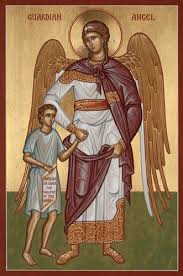
Angels Guardian and the Youth Synod
This memorial of the Guardian Angels goes back to the year 1500, the very dawn of the Protestant ‘Reformation’, seventeen years before Luther would pin his theses to the church door at Wittenburg; as far as I know, even though Luther, Calvin and company rejected the Mass and their priesthood, they still believed in angels. Some saints could see their angels, who would disappear if the saint-in-the-making (for no one is such until they enter eternity) committed a fault, and reappear upon repentance.
This feast, whose roots go back to the great tradition of the early Fathers, to Christ, whose warning about scandalizing children entails their angels always beholding the face of the Father, and back before that to Moses and the Israelites, to whom God gave an ‘angel to guard their way’, and to whom they are bound to listen.
This commemoration seems to have taken initial shape by the impetus of the Franciscans, whose founder (whose feast is in two days) had an angelic quality about him, and a great devotion to the angels. Then again, the Dominicans can also claim something of a role, for it was the great Saint Thomas who, in the century after Francis, wrote the foundational treatise on angels in the Prima Pars of his Summa (Questions 50 to 74, if you are interested, and well you should be :)).
The feast was made official and universal in the post-Tridentine era by Pope Paul V in 1607, with the decree co-signed by the Jesuit Saint Robert Bellarmine, who was one of the most clear-sighted of men in that era of confusion, and believed very much in angels, as all clear-sighted men do. This day also marks the foundation of the lay apostolate, canonically the ‘personal prelature’, of Opus Dei by Saint Josemaria Escriva in 1928.
What we believe as Catholics is that every human being has an angel ‘assigned’ to him at his (the human’s) creation, to ‘light and to guard’ his way to heaven. As Thomas teaches, angels are remarkably powerful beings of pure intellect and will, not limited by matter, space and time, forming a hierarchy, if you will, in terms of their own ‘likeness’ to God. They are our spiritual bodyguards, but more than that, our friends and confidantes, if we but make them so, for like any friendship, it is fostered by conversation which, in the supernatural realm, we call ‘prayer’.
So pray to your angel, ask his guidance, inspiration, protection, not least in these times of scandal and doubt.
Angel of God, my guardian dear,
To whom God’s love commits me here,
Even this night (or day) be at my side,
To light and to guard, to rule and to guide.
And from the 11th century Cistercian Bernard of Clairvauxi in today’s Office of Readings:
We should then, my brothers, show our affection for the angels, for one day they will be our co-heirs just as here below they are our guardians and trustees appointed and set over us by the Father. We are God’s children although it does not seem so, because we are still but small children under guardians and trustees, and for the present little better than slaves.
But along with the good angels, who chose beatitude by choosing humility and service, there are also the bad angels, who are bad because they chose badly, through pride and arrogance. Our tradition calls demons or devils, made hokey by Hollywood, but quite real and quite evil. They prowl about with their own master looking for souls to devour. Of course, they cannot really ‘devour’ souls in a physical sense, but rather by tempting (within the limits of God’s providence) we may voluntarily allow ourselves to be ‘eaten’ by their wiles, our souls enmeshed, as Saint Peter would graphically put it, in the vomit of our own sin. As Milton has Satan declare in despair in his own Paradise Lost:
So farewell hope, and with hope, farewell fear, / Farewell remorse! All good to me is lost; / Evil, be thou my good.
But we have no reason to fear to share his dreadful fate, as we return to Saint Bernard:
Even though we are children and have a long, a very long and dangerous way to go, with such protectors what have we to fear? They who keep us in all our ways cannot be overpowered or led astray, much less lead us astray. They are loyal, prudent, powerful. Why then are we afraid? We have only to follow them, stay close to them, and we shall dwell under the protection of God’s heaven.
The Church is the primary institution guarding us from the forces of evil and the Evil One, by her teaching on faith and morals, her sacraments, her saints and, yes, her myriads of angels, all the means of holiness at our disposal. But there are also false teachers, some guided by the false angels, leading souls astray, and we must discern the spirits.
On that note, Julia Meloni has an open letter to Archbishop Chaput, following up on his own criticism of the working document for the upcoming Youth Synod. Whatever the intentions of those powers-that-be organizing and participating in this event, we must be wary of the fruits. Ambiguous and misleading teaching is not much help to young people, and in fact can be scandalous, to those who are so desirous of clarity and truth, even if this truth be difficult to put into practice. In this age of anxiety and despair, obfuscation, lies, deceit and stonewalling, they long for the peace of soul which only the fullness of truth can offer, especially the truth on sexuality, life, vocation, chastity. For, like the angels, only those who are pure in heart, or at least striving for such, will see God as He is, in which our happiness, our true fulfilment, resides.

Carney’s Amoral Majority
After five defections – euphemistically described as ‘crossing the floor’ – and three by-elections, Mark Carney and his Liberals how have their coveted majority. One wonders what bowls of pottage were offered in back-room deals. In the archaic monarchical system that is the Dominion of Canada, this majority allows the newly-minted Prime Minister to rule[…]Continue reading→

Saint Kateri , Canada’s Protectress
This was the title given to Saint Kateri Tekakwitha, by Pope Benedict XVI, when he canonized her on October 28th, 2012, along with six others, in Saint Peter’ Square (she had been beatified by Pope John Paul II back in 1980). With Saint Joseph as our protector, along with the Canadian martyrs, we seem to[…]Continue reading→

A Tale of Two Benedicts
A grace-filled Holy Week to all our readers! As we await and prepare for the Resurrection about to dawn upon us, we might keep in mind two Benedicts: Pope Emeritus Benedict XVI, requiescat in pace, elected on this day in 2005; and today’s commemoration of the mystic pilgrim, Benedict Joseph Labre, who died on this[…]Continue reading→

My Name is Bernadette
April 16th is a propitious day, for besides the anniversary of Father de Valk’s death, who founded Catholic Insight in its print form decades ago, and the commemoration of the ‘two Benedicts’, mentioned in accompanying posts, today we also recall Saint Bernadette Soubirous, the young visionary to whom the Virgin Mary appeared numerous times at[…]Continue reading→

Saint Lydwina of Schiedam and Suffering Joyfully
Saint Lydwina of Schiedam (1380 – 1433) was one of the countless and glorious ‘victim souls’ in the history of the Church, those whose lives are filled with suffering, often of an unimaginable intensity, but who suffer joyfully. She was a fifteen-year old Dutch girl, out skating one day, when she fell and broke one[…]Continue reading→

The Glorious Martyrdoms of Martin and Maximus
As we enter into Eastertide, we recall on this 13th of April Pope Saint Martin I (+655), one of the noblest, if most tragic, of the successors of Saint Peter. Born in Umbria, Italy, he was of noble lineage, with great intelligence combined with charity and love of the poor and the Church. While still[…]Continue reading→

Saint Stanislaus of Szczepanów
We celebrate Saint Stanislaus today (+ April 11, 1079), in light of this Easter Octave, a bishop and martyr who accepted the episcopacy only at the direct order of Pope Alexander II. He proved a wise and courageous leader of his flock, put to death by his own king, Boleslaus, for rebuking the monarch’s ‘immoral[…]Continue reading→

Saint Gemma Galgani
On this April 11th, in 1903 – the same year that the Italian Guiseppe Sarto was elected Pope later that summer as Pius X – a lovely, young Italian woman died, by the name of Gemma Galgani. She lived a brief life of 24 years, as did a number of other young saints, including Pier[…]Continue reading→

An Ideological and Improper Translation
I noticed something odd with the psalm reading at Mass the other day. Our bishops’ conference here in Canada has decreed that the Mass in English – Novus Ordo – use the ‘NRSV’, the ‘New Revised Standard Version’, an ‘updated’ translation of the original RSV, first published in 1952. This ‘new translation’ has the tendency[…]Continue reading→
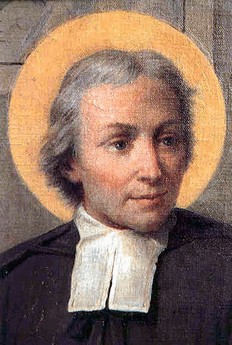
Saint Jean-Baptiste de la Salle: A Teacher for Teachers
Jean-Baptiste de la Salle (1651 – 1719), a French nobleman, ordained a priest, founded the first order in the Church’s history entirely without priests, and this came about almost by accident. I say ‘almost’, for, of course, there are no accidents with God. Destined for ordination from an early age, Jean-Baptiste never looked back, even[…]Continue reading→