
Cupertino’s Physics
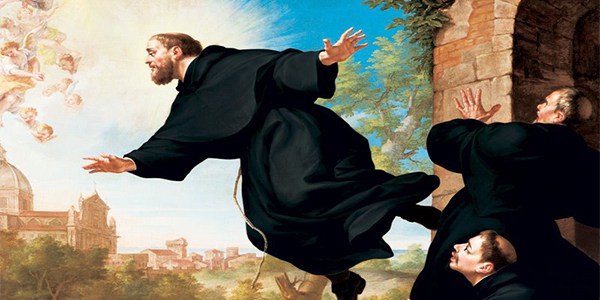
To be hidden in God, known only by Him is a great treasure, which today’s saint, the Franciscan Joseph of Cupertino, lived to the full. Amare nesciri, Saint Philip Neri would say, ‘love to be unknown’. With his father’s death while Joseph was still in utero, the Italian boy, whose hometown was on the ‘heel’ of the boot of Italy, had a difficult upbringing, often abused and neglected. But from childhood, Joseph, by the grace of God, maintained a joyful disposition, gifted with ecstatic visions. He was so rapt in the love of God that he would suddenly fall motionless while drying a dish or hoeing a field, a beatific smile on his face, mouth agape, imperturbable, always cheerful, practising a rather severe asceticism which flowed from the deep well of his charity.
He was generally seen as ‘useless’, but, after a number of rejections, was finally accepted into the Franciscans in 1620. He would obey his superiors and the rule without a moment’s hesitation, always seeing Christ or Our Lady in each person he met. It was almost as though holiness came naturally to him. His continued prayer and ecstasies made study difficult, but he passed the examination for the diaconate, as the Bishop examiner asked the one Scripture passage on which he could discourse with ease (hence, he is the patron saint of exam-takers, students take note!). Ordained in 1628 (again, after an apparently miraculous examination) Friar Joseph’s devotion increased, and, paradoxically, he soon had to be secluded, for there were so many eyewitness accounts of him levitating, absorbed in God (as was recorded of other saints, such as Thomas Aquinas, a man whose build would defy easy hovering). Modern sceptics try to claim that Joseph was actually ‘leaping around’ like some gymnast from Circque de Soleil, but the monks and townspeople would see the friar of Cupertino quite literally fly (he is also the patron saint of aviators). At one point, while in the presence of Pope Urban VIII (the one embroiled in the Galileo fiasco, but who also sent the Jesuit missionaries to Canada), Joseph hovered upwards in a fit of devotion for the Vicar of Christ, and only came back to earth at the direct order of his superior. The spectacle became such that the Franciscans eventually placed him in a solitary cell, away from any public events or community prayer, a ‘being alone with God’ which Friar Joseph did not mind all that much, so long as he could continue to say Mass.
Joseph was eventually permitted back into conventual life in 1657, and died on this day 1663.
A few decades after Friar Joseph’s heavenly aviation, without guy-wires and ropes, Newton formulated his laws of physics, published in 1687 in his great Principia Mathematica, introducing the mechanistic model of the universe, one governed by immutable laws, which every schoolboy now learns (at least, I think they still do).
Yet are they? The laws immutable, I mean? Einstein discovered three hundred years after Newton that time and space are not quite what they seem to be. And, more to our point, in today’s Gospel, Christ raises a young man from the dead, and He Himself ascended before the eyes of the Apostles into heaven, both apparently ‘impossible’. But with God, all things…
We should remember that, in reality, heaven is not ‘up there’, nor ‘far away’, but rather all around us, with eternity and time intermingling, the former sometimes bursting forth into the latter, with the remarkable results that we call ‘miracles’.
The ‘great’ ones of the world may never have heard of Saint Joseph of Cupertino, and most don’t believe in miracles, which is too bad. For, really, as Chesterton points out in his ‘Logic of Elfland’, is not the entirety of creation a miracle, that trees produce bright red delicious apples, and water clear and refreshing? Our narrow materialistic age might see things more clearly, or perhaps more broadly, if we could see ourselves and everything around us, as the saint of Cupertino did, sub specie aternitatis, under the aspect of eternity. Only then do things make sense; and only then will everything that transpires in this passing world, at some deep and abiding level, make us truly joyful.
As Chesterton also once quipped, the angels can fly because they take themselves so lightly. Would that we could, with the happy Friar, see heaven all around us, however dim and obscured by the sin around us. For Christ has already overcome the world, and His arrival will reveal what we should, and could, have seen all along.
Carney’s Amoral Majority
After five defections – euphemistically described as ‘crossing the floor’ – and three by-elections, Mark Carney and his Liberals how have their coveted majority. One wonders what bowls of pottage were offered in back-room deals. In the archaic monarchical system that is the Dominion of Canada, this majority allows the newly-minted Prime Minister to rule[…]Continue reading→

Saint Kateri , Canada’s Protectress
This was the title given to Saint Kateri Tekakwitha, by Pope Benedict XVI, when he canonized her on October 28th, 2012, along with six others, in Saint Peter’ Square (she had been beatified by Pope John Paul II back in 1980). With Saint Joseph as our protector, along with the Canadian martyrs, we seem to[…]Continue reading→

Remembering Father Alphonse de Valk
(Today marks the sixth anniversary of the death of Father Alphonse de Valk, C.S.B., a faithful, courageous and indefatigable Basilian priest, pro-life-and-family apostle, and the founder of Catholic Insight magazine. Here is what we wrote those on his entering into eternity five years ago, as we continue to remember him in our prayers and thoughts)[…]Continue reading→
A Tale of Two Benedicts
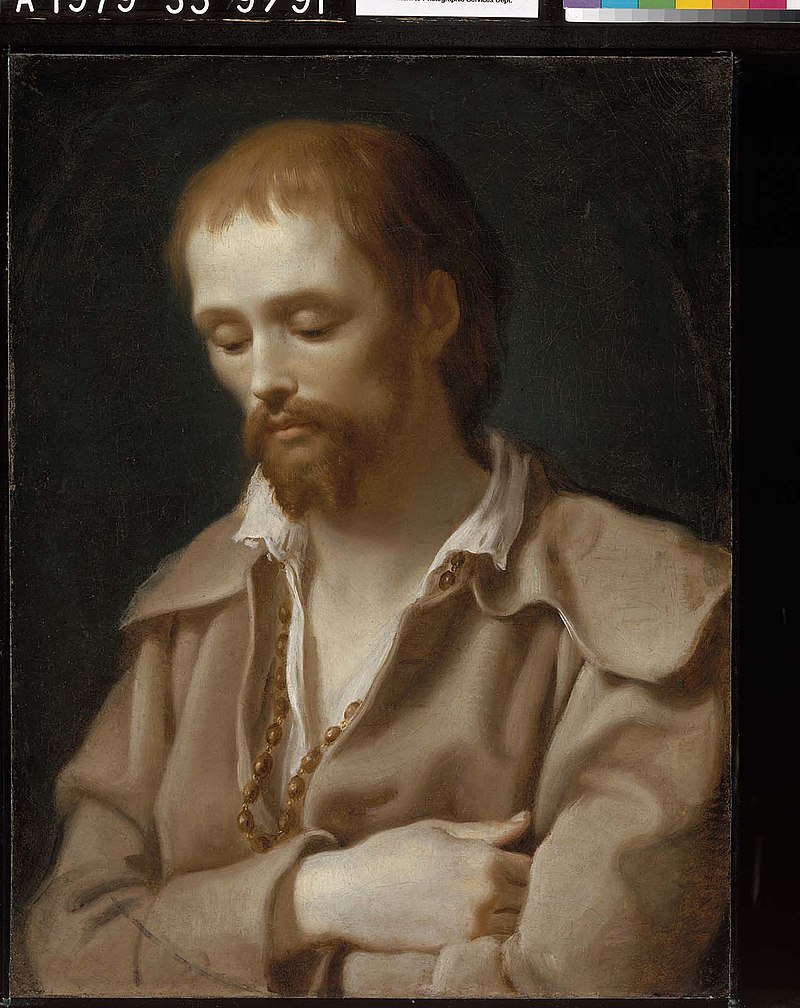
A grace-filled Holy Week to all our readers! As we await and prepare for the Resurrection about to dawn upon us, we might keep in mind two Benedicts: Pope Emeritus Benedict XVI, requiescat in pace, elected on this day in 2005; and today’s commemoration of the mystic pilgrim, Benedict Joseph Labre, who died on this[…]Continue reading→

My Name is Bernadette
April 16th is a propitious day, for besides the anniversary of Father de Valk’s death, who founded Catholic Insight in its print form decades ago, and the commemoration of the ‘two Benedicts’, mentioned in accompanying posts, today we also recall Saint Bernadette Soubirous, the young visionary to whom the Virgin Mary appeared numerous times at[…]Continue reading→
Saint Lydwina of Schiedam and Suffering Joyfully
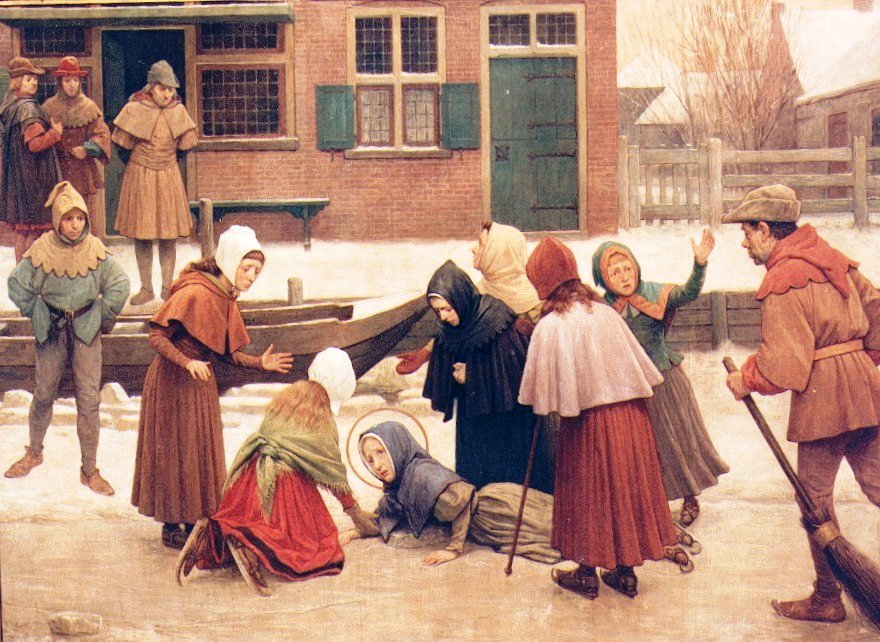
Saint Lydwina of Schiedam (1380 – 1433) was one of the countless and glorious ‘victim souls’ in the history of the Church, those whose lives are filled with suffering, often of an unimaginable intensity, but who suffer joyfully. She was a fifteen-year old Dutch girl, out skating one day, when she fell and broke one[…]Continue reading→
The Glorious Martyrdoms of Martin and Maximus
As we enter into Eastertide, we recall on this 13th of April Pope Saint Martin I (+655), one of the noblest, if most tragic, of the successors of Saint Peter. Born in Umbria, Italy, he was of noble lineage, with great intelligence combined with charity and love of the poor and the Church. While still[…]Continue reading→

Divine Mercy Sunday – An Echo of Every Mass
Reach out your hand and put it in my side. Do not doubt but believe’… ‘My Lord and my God!’ (Jn. 20:18)). Today is Divine Mercy Sunday, and as we celebrate the end of the Easter Octave, we contemplate the wounded side of our Saviour, the Church’s source of life. On Good Friday in the[…]Continue reading→

Saint Stanislaus of Szczepanów
We celebrate Saint Stanislaus today (+ April 11, 1079), in light of this Easter Octave, a bishop and martyr who accepted the episcopacy only at the direct order of Pope Alexander II. He proved a wise and courageous leader of his flock, put to death by his own king, Boleslaus, for rebuking the monarch’s ‘immoral[…]Continue reading→
Saint Gemma Galgani
On this April 11th, in 1903 – the same year that the Italian Guiseppe Sarto was elected Pope later that summer as Pius X – a lovely, young Italian woman died, by the name of Gemma Galgani. She lived a brief life of 24 years, as did a number of other young saints, including Pier[…]Continue reading→