
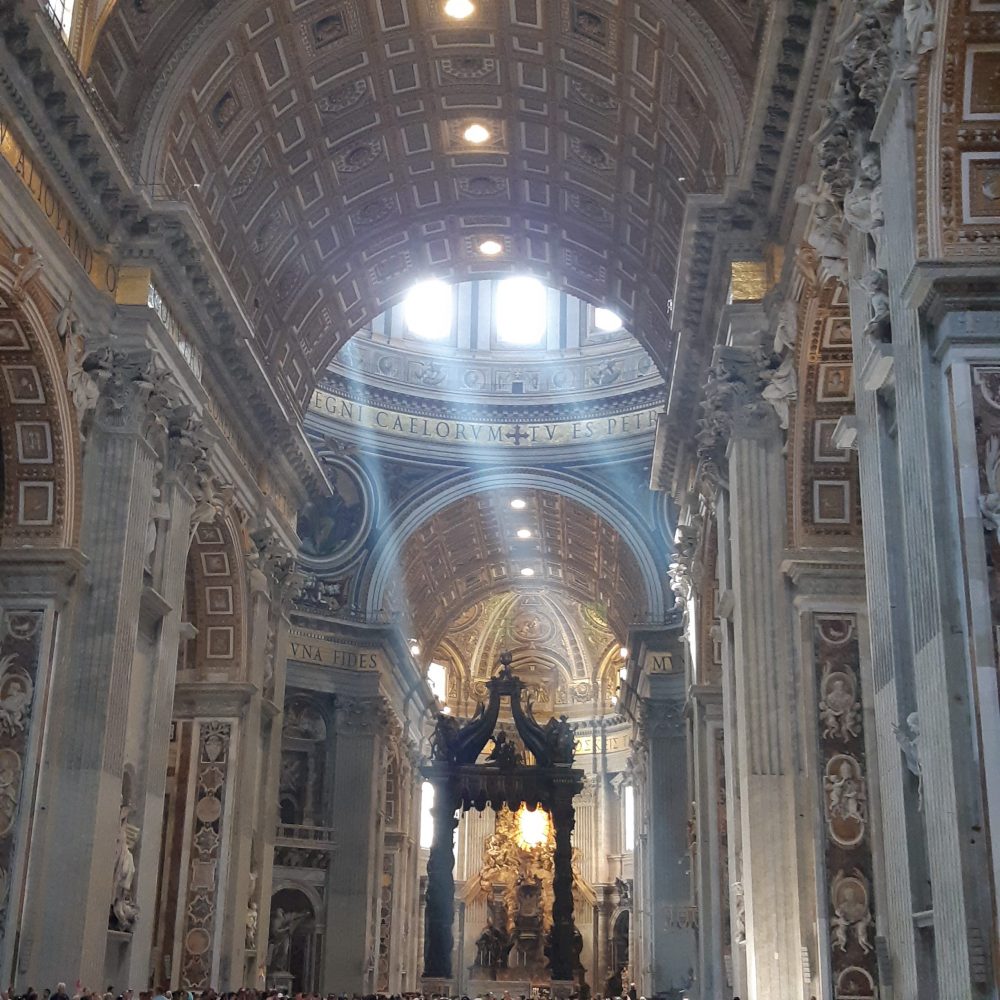
Reflections on Rome
I post this final report, for now, on my recent pilgrimage, and my final destination, the eternal city to which all roads lead, Roma. These few words may be read in light of the recent revelations that there seems to be something rotten in the state of the Vatican, wherein much prayer and purification are required.
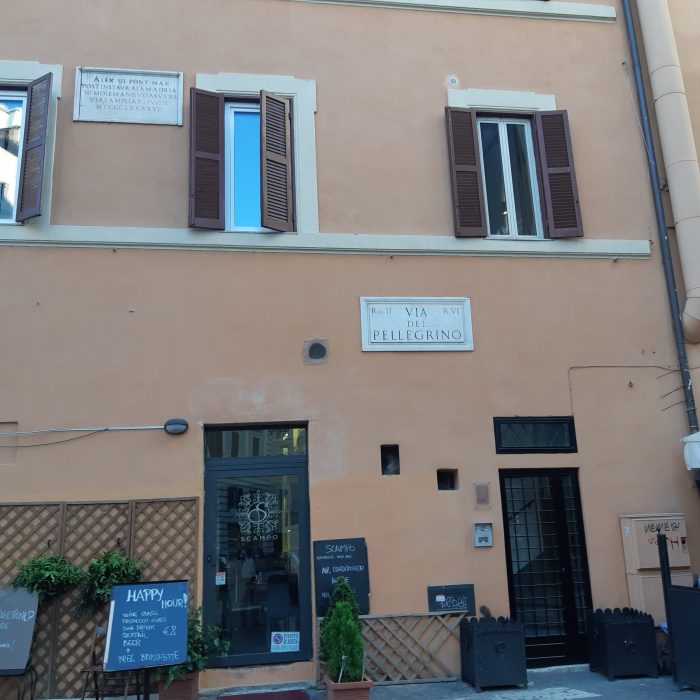 I arrived in Rome in the early evening of August 9th, departing Paris’ Gare du Lyon on my 6:37 a.m. train, after that harrowing night I described in a recent post. One can now cover the distance between the two cities, over 1400 km (at least), by means of the high-speed trains, which traverse the countryside at speeds of over 250 km/h. It is a curious way to travel, for one cannot focus on things right before your eyes out the window, but only on the distance, the hills, fields, towns, and, yes, the Alps, which I had never seen before. They are as majestic as one might imagine, as God’s creation often is, even to our modern jaded eyes.
The TGV from Paris, through Milan, to Rome, was a pleasant enough trip, even if in the first half of the journey, the train carriage in which I was sitting gradually climbed to what I thought must be 95 degrees. So I spent time in the dining car, where it was cooler, I could stand up to clear the heat-induced lethargy, and watch the scenery drifting by.
Also, truth be told, I had not showered in days, and I wondered how I, well, ‘appeared’ to people. I washed up as I could, but after leaving Britain and Canterbury, things had been rather grim on the soaps-and-suds front. No one seemed to notice much, but I prayed, as our train approached Rome in the late afternoon, that the hostel I had booked was decent enough and maybe, just maybe, had a functioning shower.
My ‘smart’ phone would not connect to the train’s wi-fi, so I asked a young-ish Italian father in front of me if he could look up directions to the hostel’s address. He happily complied, in English no less, and I soon afterward departed the train, to find my way through the subway, and onto a bus, which drove down a busy road, then started climbing a steep hill, at the top of which the driver, to whom I had mentioned my stop, Cantalamuccia, in what Italian I could muster (not much), let me off.
I had a bit of trouble at first finding the hostel, which was behind a locked security gate, which led into a parking lot, behind which stood the converted convent, which still functioned partly as a house for Sisters, I was soon to discover.
As I walked into the foyer, there was a statue of Our Lady, a crucifix, gleaming white floor and cream-coloured walls, everything clean and bright. There were Sisters coming and going, a lovely chapel with the Real Presence, open at all hours just below my room, and a pleasant man who booked me in to all this relative luxury.
I went to my room on the second floor, with one of those old-style keys that you have to wiggle in the keyhole to get to work, and opened my door to a very pleasant, if monastic, room, a comfy bed, a desk, a window, and, yes, an ensuite bathroom with a fully functioning shower – need I impress upon the reader how rare this is – hot water galore, the first such luxury I had experienced since I stepped foot off the plan in Glasgow.
God is good, and, well, showers his gifts as He will, on the good and the evil alike.
And, yes, Italian continental breakfast included: Unlimited coffee, croissants, meat, cheese, honey, jam, yogourt, fresh bread and juice.
It was all this that fortified my days of walking around Rome, in brutal heat and humidity; but if you put your head down, and just get on with things, it was actually quite pleasant. There was an occasional breeze, and some of my wanders took me by long meanderings by the side of the Tiber. Rome also has these random fountains, spewing forth fresh, cold water, to drink or splash oneself, like oases in the desert. There are also any number of gelato shops, offering fine refreshment.
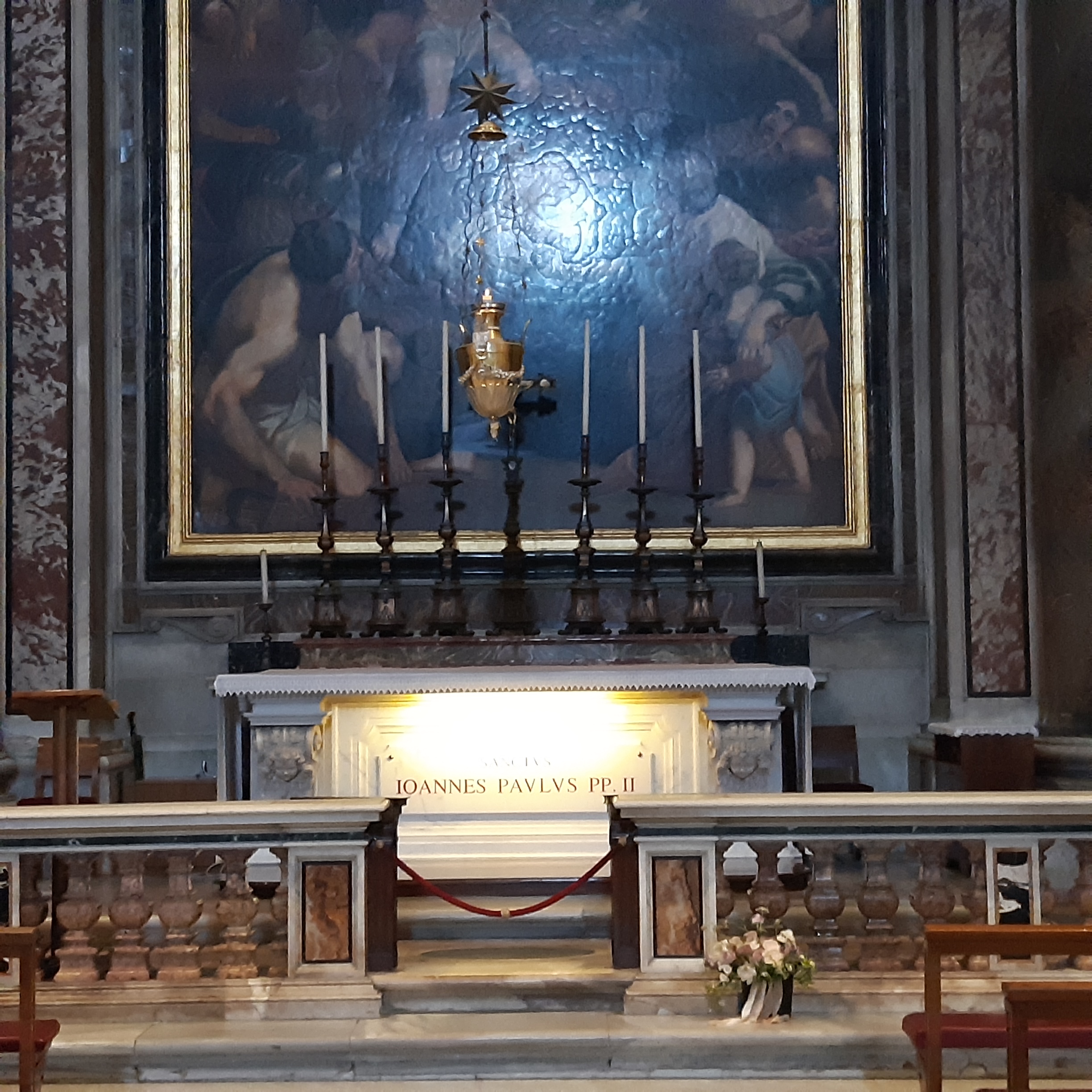
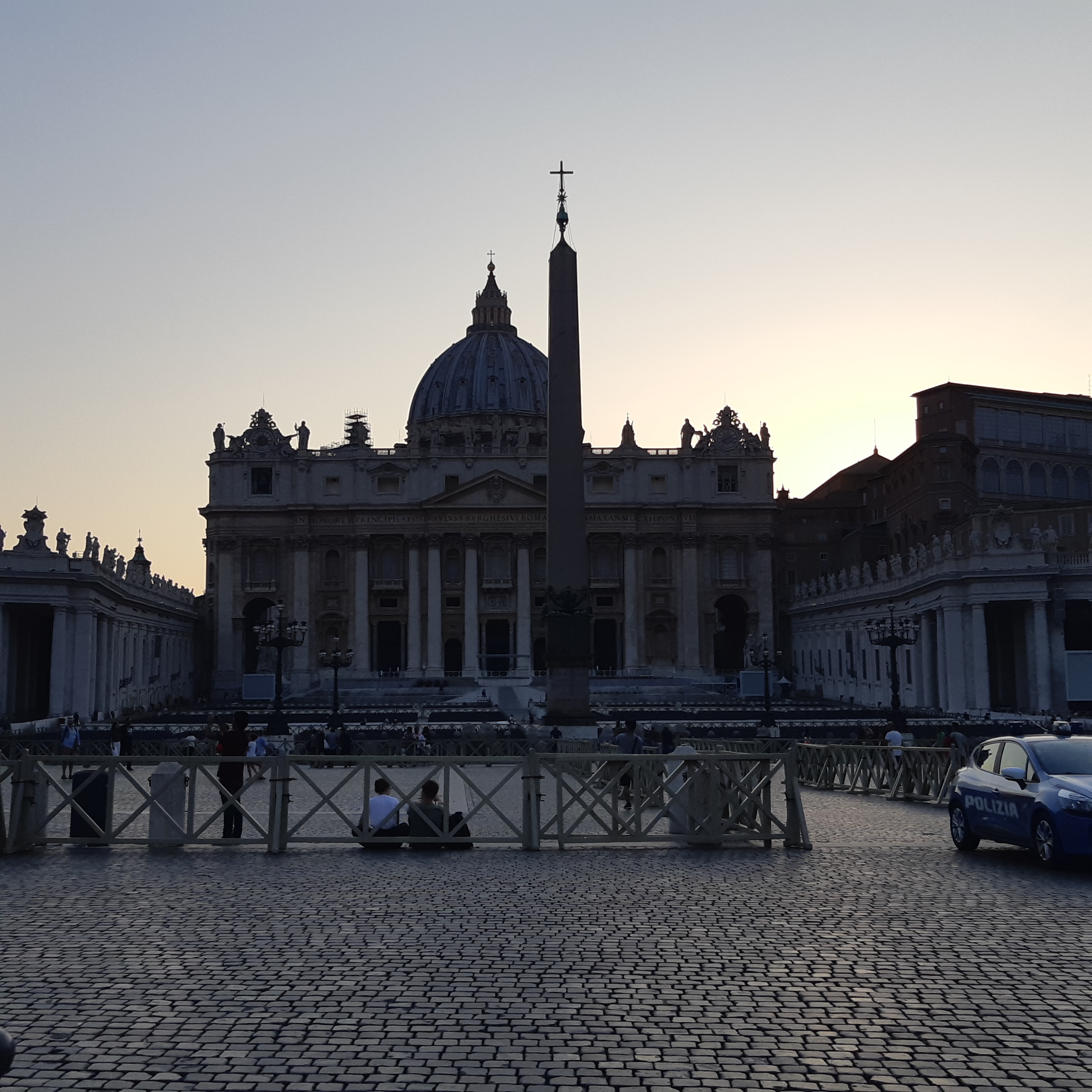
The first thing I did the next morning, the feast of Saint Lawrence the Deacon, a day that also happens to be, less significantly, my birthday, was to complete my pilgrimage to the tomb of Pope Saint John Paul II. After so much harrowed journeying, to kneel before the saint, now moved from the crypt to the main basilica, just to the right at the entrance, below the altar of Saint Sebastian, well, what can I say, was an emotionally moving experience, one that I will not soon forget.
 The queue to get into Saint Peter’s was hundreds long, as everyone had to go through security, which is omnipresent: fully-armed soldiers, check points, metal detectors, people funnelled like cattle in and out of the bigger churches through gates. Alas. Much of the romance of just entering a church is lost in all this, and I was a bit late for Mass one day, with loads of tourists in front of me, unloading cameras and bags galore. They should have a separate line for pilgrims attending liturgy…
Over the five or so days I was in Rome, I managed to walk through the hot pavements in my trusty, leather sandals, making my way to all but one of the seven ‘churches of Rome’, the major basilicas, which dot around the city: Santa Maria Maggiore, Saint Peter’s, San Lorenzo, Basilica of the Holy Cross, Saint John Lateran, Saint Paul’s and, the one I missed, Saint Sebastian’s.
Saint Philip Neri used to organize a pilgrimage to all seven in one day, over a 20 km trek back in the mid-1500’s, when most of the area was quiet, pastoral, Italian countryside, with villas where they would have picnic breaks, with bread, wine, cheese, grapes…
Well, Rome has come a long way since, and not necessarily upwards. The churches are still there, the architecture and artwork magnificent and often breathtaking, but much of what I tramped through in the city was litter-strewn, graffiti-ridden, with the faint, or sometimes not-so-faint, air of neglect, and this includes many of the churches (at least their outside, which are strewn with weeds and such). Even inside some of the churches, there is a smell of mildew, as though they were not open enough to the fresh air.
There are, in the tourist areas, which includes all of central Rome from Saint Peter’s outwards, men of certain ethnic origins hawking kitsch of all kinds, water, and, yes shawls.
Why would one by a shawl in Rome as hot as an oven? I though it was for shade, and perhaps for some they do function so. But then I discovered that, after one has gone through all the X-ray and metal-detector security, one must also get by the ‘modesty police’, two men (they are not armed) who will turn you away from the gates of the basilica, like some kind of eschatological Petrine prelude, if you are dressed ‘immodestly’, especially the women, if their shoulders are bare, or their shorts or skirts too short. The shawls are there as a last-minute cover-up.
I watched this for a while, and witnessed some rather incensed, and embarrassed, ladies, girls (yes, enforced for young girls), along with their men-folk. I am all for modesty (and have an article forthcoming on the topic even before I witnessed this), but in our milieu of clerical scandals of the deepest depravity, I think people see this as the Church straining at gnats while swallowing camels. Further, it seemed rather haphazardly enforced, with some getting through bare-shouldered.
Anon. The basilicas are filled with tourists, shawled and unshawled, snapping the endless stream of photos at which they may never look, lingering, listless, before the statuary and altars, filtering in an out.
Yet grace abounds. Many people do pray, and I have seen many acts of devotion.
Mass at Santa Maria Maggiore, the fifth-century basilica (much modified and rebuilt since those glory days), dedicated to Our Lady in honour of the proclamation of her as truly the Mother of God, Theotokos, at the Council of Ephesus in 431. There, in the crypt below the altar, one can venerate wood from the actual crèche of Christ.
I pilgrimaged to the church of Saint Lawrence-outside-the-walls, making it there just before the afternoon closing, praying before the actual gridiron on which he was roasted. A Poor Clare Sister found me, with a warning that they were about to lock the doors, or I may have had to spend the whole afternoon inside. Not a bad deal, but I wandered off into the hot afternoon Sun, only a little less scorching, to my fevered mind, than Lawrence’s rack.
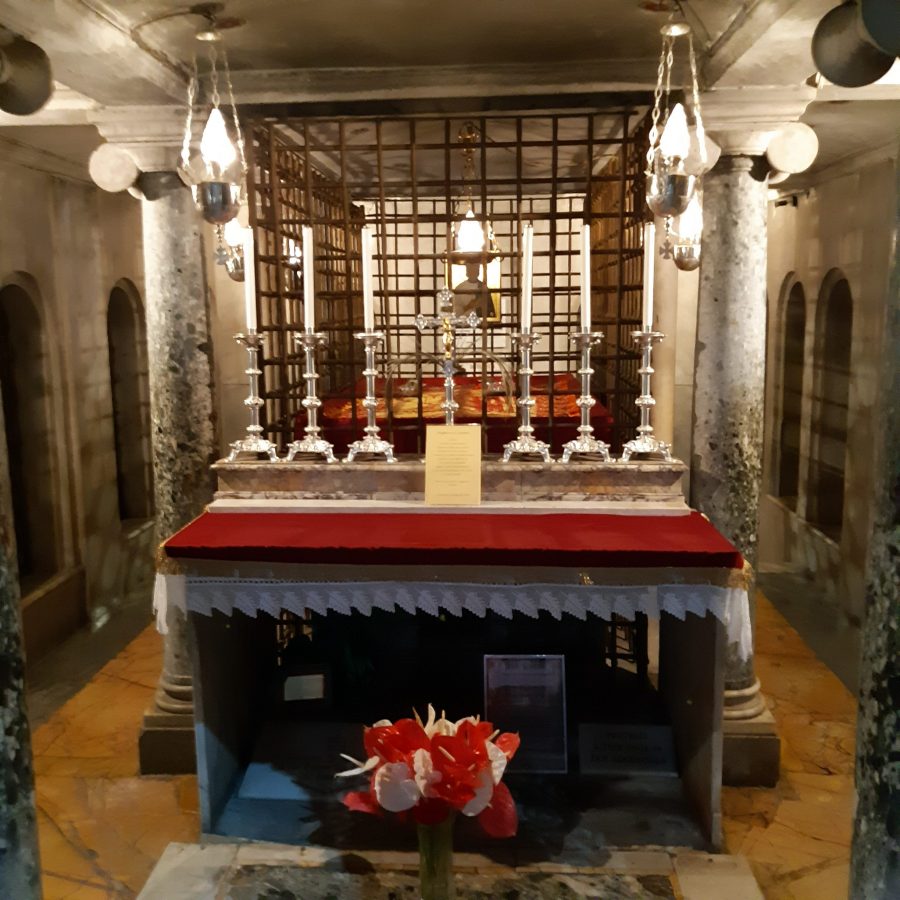
Next, a mile or two distant, I made my way then to the Basilica of the Holy Cross in Jerusalem, where they have the actual relics of the Passion (the nails, the wood, the actual sign above Christ…). I saw groups of people truly moved, high-schoolers from London in particular.
Down the road, a twenty minute walk, there is the glory of Cathedral of Saint John Lateran, dedicated to Christ the Saviour, but in honour also of the two first Saints John, the Evangelist and the Baptist. This is the Pope’s own church, the highest-ranked in all Christendom, its nave lined with magnificent, towering statues of the twelve Apostles.
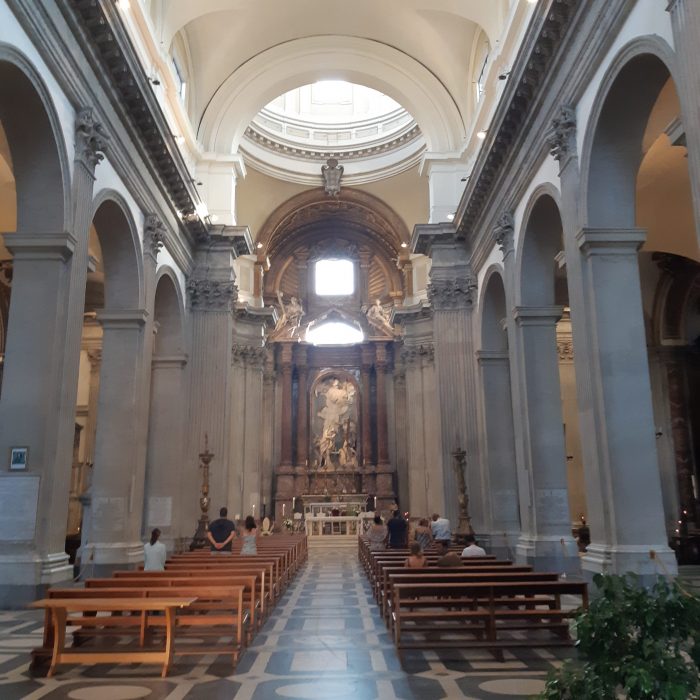 Across the street is the Scala Santa, by tradition, the same steps that Christ ascended to His audience with Pontius Pilate. Tradition requires that you ascend the stairs on your knees, and the lady at the desk makes sure you do, yelling at those who dare stand up. Well, we hardy pilgrims had to make do with a replica of the stairs, for the real ‘scala’ is being restored.
The final major church, on my last night in Rome, was Saint Paul’s, determined, as I was, to finish the whole pelegrinage. The basilica was miles away, through suburbs and highways (how different it must have been back then, with Saint Paul beheaded in the countryside, well outside of Rome).
The church is on the Via Ostiense, over the site of his martyrdom, on the ancient Roman road (and those Legionary engineers knew how to build, with all their roads, straight as arrows, still standing). Plodding along, stirred on mainly by grace, with a dash of Irish stubborness, through brutal heat and humidity, I made it there with about ten minutes to spare before closing. Enough, to complete my pilgrimage, and offer up what I can.
On the journey back, the first time I took the public transit system since arriving, I stopped for a well-deserved (to my mind) break in a restaurant not far from the hostel, which had intrigued me since my arrival. I had a scrumptious, fresh, oven-baked pizza, and a tortino dessert. The waiter, Giovanni, intrigued by my story of pilgrimage, perhaps, allowed me to sit on the terrace as long as I liked, writing away in this quintessential Roman-esque atmosphere, plying me with Italian fizzy water. In many ways, and in little pockets, it’s still Rome.
On that note, there were innumerable other treasures, too many to recount here, such as a church I wandered by dedicated to ‘All saints named Maria’, where I prayed for my Mum and others of that fair name; a divine mercy walk around the Coliseum, a side trip to the basilica of Saints John and Paul and the Chiesa Nuova, the church of Saint Philip Neri… Little hidden alleyways open up into quaint churches, shrines, restaurants, and never-ending other quaint streets.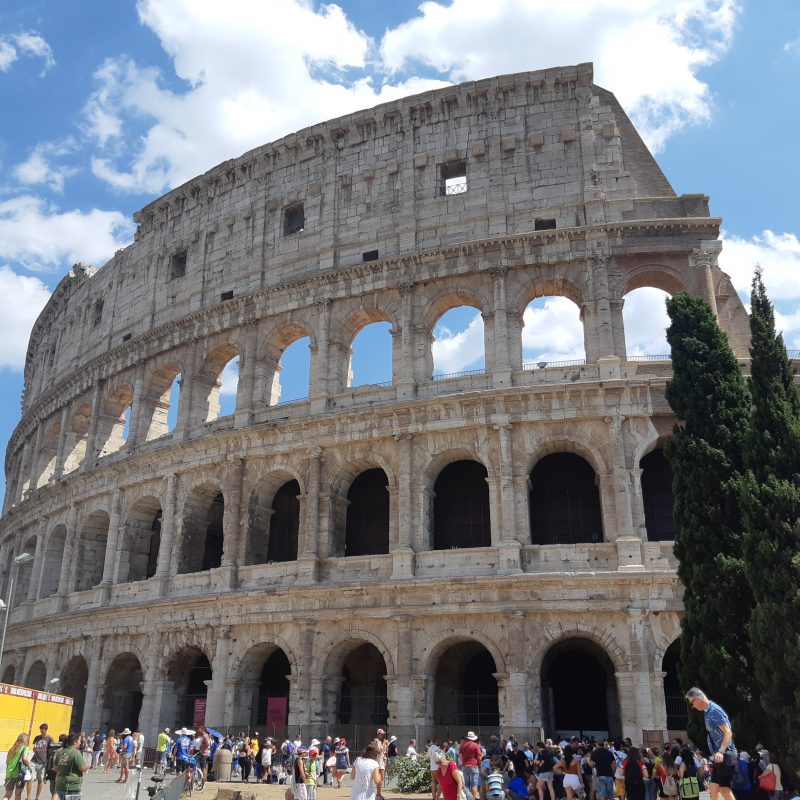
But much grace is needed, for the whole of Europe is divided (in more ways than one). Behind all the touristy allure of Rome, there is a decidedly minority upper-middle-class, who live in increasingly ‘secure’ enclaves; everywhere, there are metal gates, bars and doors, alarm systems, bollards. Tourists who stay in just such guarded hotels, take taxis, and go on carefully planned walks in the ‘tourist’ areas. Churches outside these are mostly empty (to my relief, I must admit).
Outside the ‘enclaves’, metaphorical and literal, there is a swath of poverty, listlessness, hordes of men with not much to do all day, sullen and angry. Like Paris, it seems a cauldron, ready to boil over. Italy is in a demographic death spiral, with thousands, even millions of desperate migrants just waiting across the Mediterranean. What will she do when this real inundation of people washes over her shores?
I have discovered more viscerally than before that only the Church and her teaching can give us purpose, cohesion, that whole ‘point to life’. Without it, as Belloc rightly pointed out, Europe is moribund, with all of its culture, history, language and monuments. After all, it is the Faith that built all the cathedrals, basilicas, churches, all the shrines and renaissance statuary. Without that Faith, they will moulder away. The tourists keep most things going for now, but what will happen if, nay, when, they too dwindle?
In contrast to the ebullient days of John Paul II, followed by Benedict, there was a certain – what word shall I use – melancholia? in the air of Rome, that could not quite be dispelled by a youth event held in the Circus Maximus, with Mass the following morning in front of Saint Peter’s, the music not much different from a low-grade Disney film. (Is there a pill for liturgical despair?) Perhaps this was partly subjective, a reflection of my own spirit, at least at times, but it may also have been that calm before the storm, as events since seem to have borne out.
Yet, all in all, like England, I could have explored Rome for many more days. One cannot deny what millennia of history have given us, even if it much of it has an elegiac quality. The magnificent churches, underused and many neglected, now serve as relics, things ‘left behind’, testifying to an era of Faith that is no more. Who could carve all that intricate statuary anymore, and who would? For the purpose of all beauty is to lead us to holiness, and beauty devoid of sanctity is an empty shell; all the glory of Rome may hopefully lead many to Faith, without which it is all but a funerary monument, foretelling a tragic end, in emptiness.
The choice, really, is ours, ex urbe vel in urbe.
Carney’s Amoral Majority
After five defections – euphemistically described as ‘crossing the floor’ – and three by-elections, Mark Carney and his Liberals how have their coveted majority. One wonders what bowls of pottage were offered in back-room deals. In the archaic monarchical system that is the Dominion of Canada, this majority allows the newly-minted Prime Minister to rule[…]Continue reading→

Saint Kateri , Canada’s Protectress
This was the title given to Saint Kateri Tekakwitha, by Pope Benedict XVI, when he canonized her on October 28th, 2012, along with six others, in Saint Peter’ Square (she had been beatified by Pope John Paul II back in 1980). With Saint Joseph as our protector, along with the Canadian martyrs, we seem to[…]Continue reading→

Remembering Father Alphonse de Valk
(Today marks the sixth anniversary of the death of Father Alphonse de Valk, C.S.B., a faithful, courageous and indefatigable Basilian priest, pro-life-and-family apostle, and the founder of Catholic Insight magazine. Here is what we wrote those on his entering into eternity five years ago, as we continue to remember him in our prayers and thoughts)[…]Continue reading→
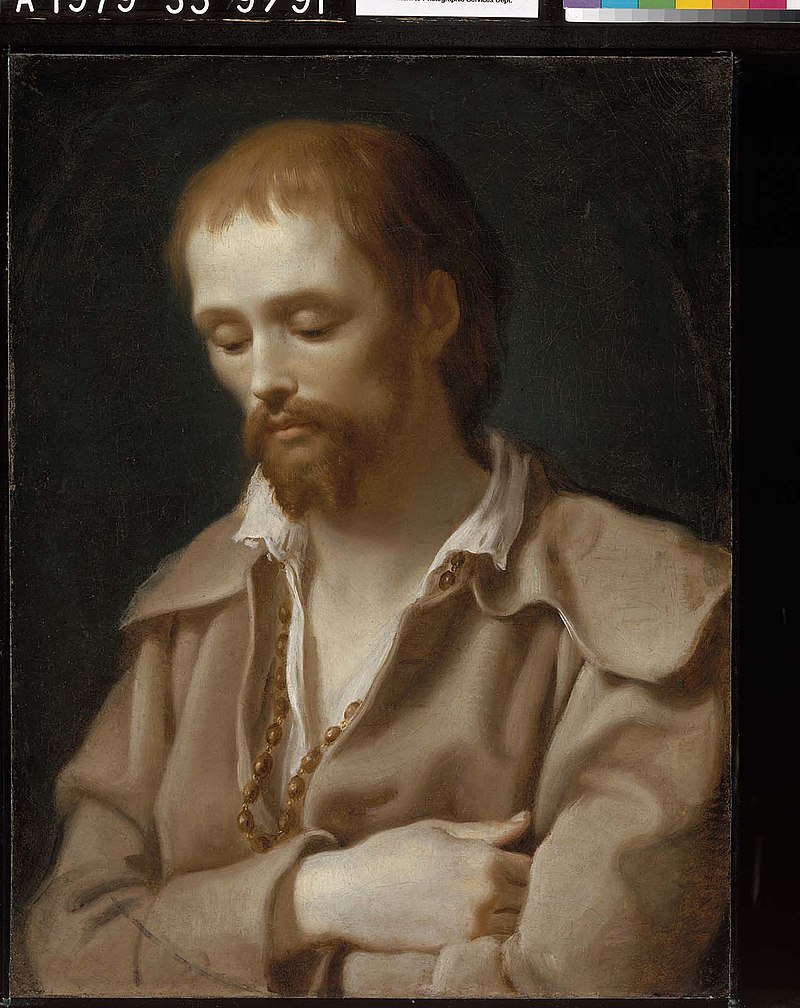
A Tale of Two Benedicts
A grace-filled Holy Week to all our readers! As we await and prepare for the Resurrection about to dawn upon us, we might keep in mind two Benedicts: Pope Emeritus Benedict XVI, requiescat in pace, elected on this day in 2005; and today’s commemoration of the mystic pilgrim, Benedict Joseph Labre, who died on this[…]Continue reading→

My Name is Bernadette
April 16th is a propitious day, for besides the anniversary of Father de Valk’s death, who founded Catholic Insight in its print form decades ago, and the commemoration of the ‘two Benedicts’, mentioned in accompanying posts, today we also recall Saint Bernadette Soubirous, the young visionary to whom the Virgin Mary appeared numerous times at[…]Continue reading→
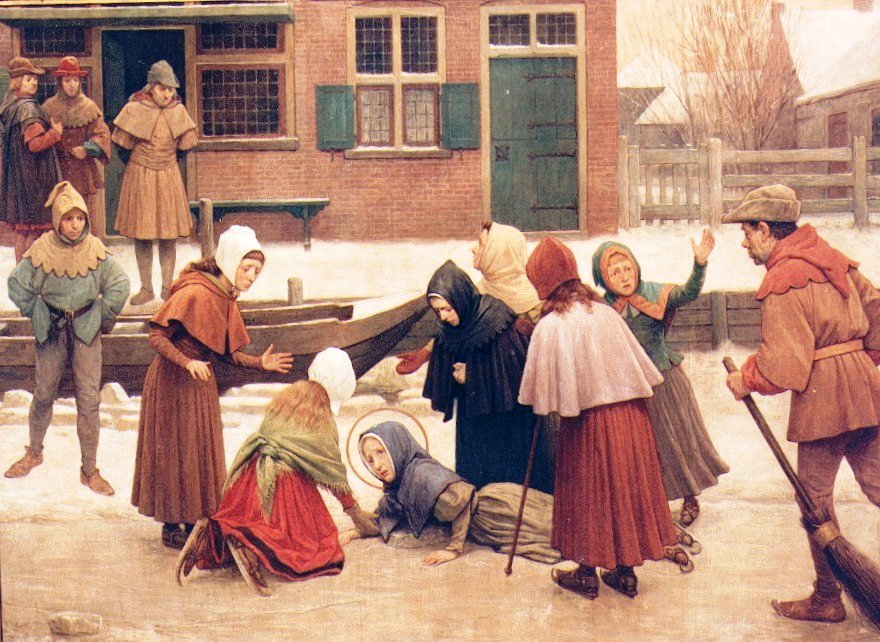
Saint Lydwina of Schiedam and Suffering Joyfully
Saint Lydwina of Schiedam (1380 – 1433) was one of the countless and glorious ‘victim souls’ in the history of the Church, those whose lives are filled with suffering, often of an unimaginable intensity, but who suffer joyfully. She was a fifteen-year old Dutch girl, out skating one day, when she fell and broke one[…]Continue reading→
The Glorious Martyrdoms of Martin and Maximus
As we enter into Eastertide, we recall on this 13th of April Pope Saint Martin I (+655), one of the noblest, if most tragic, of the successors of Saint Peter. Born in Umbria, Italy, he was of noble lineage, with great intelligence combined with charity and love of the poor and the Church. While still[…]Continue reading→

Canonizing Sister Faustina and Divine Mercy
HOMILY OF THE HOLY FATHER MASS IN ST PETER’S SQUARE FOR THE CANONIZATION OF SR MARY FAUSTINA KOWALSKA Sunday, 30 April 2000 1. “Confitemini Domino quoniam bonus, quoniam in saeculum misericordia eius”; “Give thanks to the Lord for he is good; his steadfast love endures for ever” (Ps 118: 1). So the Church sings on the Octave of[…]Continue reading→

Divine Mercy Sunday – An Echo of Every Mass
Reach out your hand and put it in my side. Do not doubt but believe’… ‘My Lord and my God!’ (Jn. 20:18)). Today is Divine Mercy Sunday, and as we celebrate the end of the Easter Octave, we contemplate the wounded side of our Saviour, the Church’s source of life. On Good Friday in the[…]Continue reading→

Saint Stanislaus of Szczepanów
We celebrate Saint Stanislaus today (+ April 11, 1079), in light of this Easter Octave, a bishop and martyr who accepted the episcopacy only at the direct order of Pope Alexander II. He proved a wise and courageous leader of his flock, put to death by his own king, Boleslaus, for rebuking the monarch’s ‘immoral[…]Continue reading→