
Fathers, Presidents and History
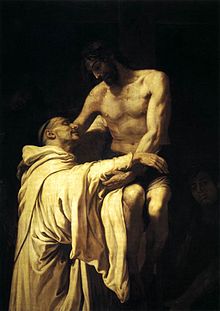
Today is the memorial of Saint Bernard of Clairvaux (1190 – 1153), named after the ‘clear valley’ in which he helped establish a Cistercian monastery, itself named after the Citeaux monastery, near Dijon in France, where, in 1098, Robert of Molesme and Stephen Harding set up their own community to live more strictly the sixth-century rule of Saint Benedict.
Bernard was seen as the ‘second founder’ of what would be called the Cistercians, when, after a strong call from God while at prayer, he showed up with thirty companions at the debilitated monastery at Clairvaux in 1113, reviving the community to glory, and was soon elected its most famous abbot.
A strong, charismatic figure, with evident intellectual gifts, Bernard, wrote much on the spiritual life in his melodic Latin prose, and was declared the sixteenth of thirty six doctors of the Church during the brief pontificate of Pius VIII in 1830. Pope Pius XII wrote an encyclical on Bernard, under his title of the Mellifluus Doctor, in which he described the Cistercian monk as the ‘last of the Fathers’.
Although naturally of a retiring disposition and a deep contemplative, Bernard’s great talents were soon discovered, and he was involved in much of the ecclesial and political events of his time, from preaching the second Crusade in 1146, with enthusiasm waning after the difficulties of the First in 1095, to finally take back the Holy Land from the marauding Muslims (and they did begin as defensive wars); he also helped heal schisms in the church, and wrote against the early ‘liberal’ theologian Peter Abelard, debunking his modernist (if that is not an anachronism) theories (yes, the same Abelard who got in all that romantic trouble with the beautiful Eloise; but both died reconciled to the Church).
Carl Sundell has a vivid apologia, recounting the oft-forgotten religious principles motivating some of the great presidents of the United States. Yes, I know this is a Canadian magazine, but we can learn much from our neighbours to the south, not least that immersion in one’s national history helps one, as the adage goes, to avoid the mistakes of the past, while continuing and improving upon the valuable aspects of their legacy. Americans seem much more aware of what came before (how many young Canadians know anything about our own history, I often wonder, especially its more Catholic elements).
Alas, even in the land of the free, knowledge of their history is diminishing. Like us, there is a wave of modern ignorant and violent iconoclasts trying to erase the past, taking down, defacing or demolishing statues and monuments, and re-writing textbooks and articles, a la Orwell’s prescient dystopia 1984. History is whatever the zeitgeist of the moment says it is, a passing fancy of political correctness.
The past is not perfect, but neither are we, in many ways less so than those who came before; we can only become more virtuous, as persons and as societies, by learning from our forefathers, spiritually, but also politically.
Sancte Bernarde, ora pro nobis!

Carney’s Amoral Majority
After five defections – euphemistically described as ‘crossing the floor’ – and three by-elections, Mark Carney and his Liberals how have their coveted majority. One wonders what bowls of pottage were offered in back-room deals. In the archaic monarchical system that is the Dominion of Canada, this majority allows the newly-minted Prime Minister to rule[…]Continue reading→

Saint Kateri , Canada’s Protectress
This was the title given to Saint Kateri Tekakwitha, by Pope Benedict XVI, when he canonized her on October 28th, 2012, along with six others, in Saint Peter’ Square (she had been beatified by Pope John Paul II back in 1980). With Saint Joseph as our protector, along with the Canadian martyrs, we seem to[…]Continue reading→

A Tale of Two Benedicts
A grace-filled Holy Week to all our readers! As we await and prepare for the Resurrection about to dawn upon us, we might keep in mind two Benedicts: Pope Emeritus Benedict XVI, requiescat in pace, elected on this day in 2005; and today’s commemoration of the mystic pilgrim, Benedict Joseph Labre, who died on this[…]Continue reading→

My Name is Bernadette
April 16th is a propitious day, for besides the anniversary of Father de Valk’s death, who founded Catholic Insight in its print form decades ago, and the commemoration of the ‘two Benedicts’, mentioned in accompanying posts, today we also recall Saint Bernadette Soubirous, the young visionary to whom the Virgin Mary appeared numerous times at[…]Continue reading→

Saint Lydwina of Schiedam and Suffering Joyfully
Saint Lydwina of Schiedam (1380 – 1433) was one of the countless and glorious ‘victim souls’ in the history of the Church, those whose lives are filled with suffering, often of an unimaginable intensity, but who suffer joyfully. She was a fifteen-year old Dutch girl, out skating one day, when she fell and broke one[…]Continue reading→

The Glorious Martyrdoms of Martin and Maximus
As we enter into Eastertide, we recall on this 13th of April Pope Saint Martin I (+655), one of the noblest, if most tragic, of the successors of Saint Peter. Born in Umbria, Italy, he was of noble lineage, with great intelligence combined with charity and love of the poor and the Church. While still[…]Continue reading→

Saint Stanislaus of Szczepanów
We celebrate Saint Stanislaus today (+ April 11, 1079), in light of this Easter Octave, a bishop and martyr who accepted the episcopacy only at the direct order of Pope Alexander II. He proved a wise and courageous leader of his flock, put to death by his own king, Boleslaus, for rebuking the monarch’s ‘immoral[…]Continue reading→

Saint Gemma Galgani
On this April 11th, in 1903 – the same year that the Italian Guiseppe Sarto was elected Pope later that summer as Pius X – a lovely, young Italian woman died, by the name of Gemma Galgani. She lived a brief life of 24 years, as did a number of other young saints, including Pier[…]Continue reading→

An Ideological and Improper Translation
I noticed something odd with the psalm reading at Mass the other day. Our bishops’ conference here in Canada has decreed that the Mass in English – Novus Ordo – use the ‘NRSV’, the ‘New Revised Standard Version’, an ‘updated’ translation of the original RSV, first published in 1952. This ‘new translation’ has the tendency[…]Continue reading→
Saint Jean-Baptiste de la Salle: A Teacher for Teachers
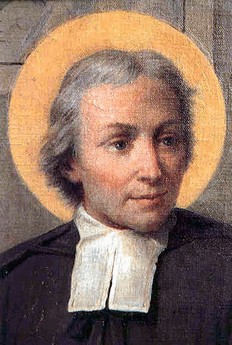
Jean-Baptiste de la Salle (1651 – 1719), a French nobleman, ordained a priest, founded the first order in the Church’s history entirely without priests, and this came about almost by accident. I say ‘almost’, for, of course, there are no accidents with God. Destined for ordination from an early age, Jean-Baptiste never looked back, even[…]Continue reading→