
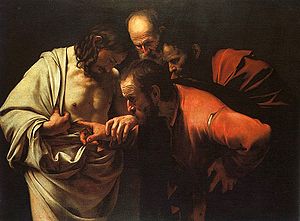
Christ and the Resurrected Body
We are now on the seventh day of the Easter Octave, eight days that are one long, glorious day, so this Friday is treated as a full solemnity, a Sunday, a day to rejoice and sing for joy, so once again, a blessed and joyous Easter to all our readers!
The reason for elation is obvious enough: Christ’s triumph over death, entropy, the dissolution of all things, and the kingdom of darkness.
Yet it was not obvious right away, and the Apostles were understandably mystified, even terrified, when they saw the Risen Christ, but it was a fear mixed with much joy and gladness.
The accounts of these meetings are indeed mysterious: Appearing when and how He wills, now here, now there, not recognized, then recognized, walking through walls and locked doors.
We might be tempted, as was Peter, to think this ‘new’ Christ some sort of ethereal and almost-not-there ‘ghost’, as did the Apostles. But in today’s Gospel, recounting His appearance by the lake of Tiberias (or Galilee, as you will), Christ asks the mystified Apostles if have anything to eat; at His command, they miraculously catch a whole lot of fish, which, in Saint Luke’s account, he eats before their eyes. So His body was a real body, but one with new and rather astounding powers.
When I ponder this, I am drawn to two thoughts:
First, to C.S. Lewis’ delightful allegory The Great Divorce, published in 1945 just as the World War was ending, about a group of dead people brought to judgement. When they step off onto the ‘lawn’ outside the pearly gates, the grass hurts their feet because it is too ‘real’ for them, too solid, just too much ‘there’.
Second, at the dawn of the century, in 1909, a New Zealander physicist, Ernest Rutherford, working at McGill university here in Canada, conducted an experiment in which he shot tiny alpha particles (basically, helium nuclei, or two protons) through a thinly-stretched sheet of gold foil. To his surprise, 99.999% of the particles went through the foil as though nothing were there, with a very small percentage (about one in ten thousand) bouncing off at odd angles.
From this rather fantastic phenomena, Rutherford proposed a model of the atom which has stood, with some quantum modifications, to this day: That most of what we know as ‘matter’ is quite literally empty space, an electron cloud, with a tiny nucleus in the centre, where all the ‘mass’ is (if an atom were the size of the Houston Astrodome, the nucleus would be a marble floating in the centre). We, and all we see around us, is more or less not much there at all, veritable clouds of electricity. If our electrons were to stop moving, we would literally collapse almost to nothing.
Hence, Christ could walk through doors not because He was less real than they were, but more so. To His new reality, it was the doors and walls that were ethereal, almost ‘not there’, and He the Real One, the Truth and the Life.
A comforting thought? Well, it is for me, and perhaps for you, as we live in these all-too-limited bodies, with their aches, pains, blemishes and imperfections, to which we should not cling too closely, for they are returning by the inexorable second law of thermodynamics to the nothing from which they came. But every day older is also a day closer to that new and much-improved glorified and resurrected body, the same as this one, but also very, very different.
It is Christ Who offers us that permanence we call ‘eternity’, if we but choose to follow Him, to live in the truth and conform ourselves thereto. And the bodies we receive in that state are far more real, more perfect, than these animal bodies in which, or rather by which, we now live, as Saint Paul does his best to describe at the end of his first letter to the Corinthians:
So is it with the resurrection of the dead. What is sown is perishable, what is raised is imperishable. It is sown in dishonour, it is raised in glory. It is sown in weakness, it is raised in power. It is sown a physical body, it is raised a spiritual body. If there is a physical body, there is also a spiritual body…
Just as we have borne the image of the man of dust, we shall also bear the image of the man of heaven. I tell you this, brethren: flesh and blood cannot inherit the kingdom of God, nor does the perishable inherit the imperishable.
Lo! I tell you a mystery. We shall not all sleep, but we shall all be changed…
And as Saint Peter did this morning from the boat on the Sea of Galilee, when we see that ‘It is the Lord’, we should cast ourselves into the sea to find him, even though, or rather because, we quite literally have nothing on, and I’m not primarily talking about clothes.
Indeed, death, where is thy sting?
Christus resurrexit! Dominus surrexit vere! Alleluia!

Carney’s Amoral Majority
After five defections – euphemistically described as ‘crossing the floor’ – and three by-elections, Mark Carney and his Liberals how have their coveted majority. One wonders what bowls of pottage were offered in back-room deals. In the archaic monarchical system that is the Dominion of Canada, this majority allows the newly-minted Prime Minister to rule[…]Continue reading→

Saint Kateri , Canada’s Protectress
This was the title given to Saint Kateri Tekakwitha, by Pope Benedict XVI, when he canonized her on October 28th, 2012, along with six others, in Saint Peter’ Square (she had been beatified by Pope John Paul II back in 1980). With Saint Joseph as our protector, along with the Canadian martyrs, we seem to[…]Continue reading→

Remembering Father Alphonse de Valk
(Today marks the sixth anniversary of the death of Father Alphonse de Valk, C.S.B., a faithful, courageous and indefatigable Basilian priest, pro-life-and-family apostle, and the founder of Catholic Insight magazine. Here is what we wrote those on his entering into eternity five years ago, as we continue to remember him in our prayers and thoughts)[…]Continue reading→

A Tale of Two Benedicts
A grace-filled Holy Week to all our readers! As we await and prepare for the Resurrection about to dawn upon us, we might keep in mind two Benedicts: Pope Emeritus Benedict XVI, requiescat in pace, elected on this day in 2005; and today’s commemoration of the mystic pilgrim, Benedict Joseph Labre, who died on this[…]Continue reading→

My Name is Bernadette
April 16th is a propitious day, for besides the anniversary of Father de Valk’s death, who founded Catholic Insight in its print form decades ago, and the commemoration of the ‘two Benedicts’, mentioned in accompanying posts, today we also recall Saint Bernadette Soubirous, the young visionary to whom the Virgin Mary appeared numerous times at[…]Continue reading→

Saint Lydwina of Schiedam and Suffering Joyfully
Saint Lydwina of Schiedam (1380 – 1433) was one of the countless and glorious ‘victim souls’ in the history of the Church, those whose lives are filled with suffering, often of an unimaginable intensity, but who suffer joyfully. She was a fifteen-year old Dutch girl, out skating one day, when she fell and broke one[…]Continue reading→

The Glorious Martyrdoms of Martin and Maximus
As we enter into Eastertide, we recall on this 13th of April Pope Saint Martin I (+655), one of the noblest, if most tragic, of the successors of Saint Peter. Born in Umbria, Italy, he was of noble lineage, with great intelligence combined with charity and love of the poor and the Church. While still[…]Continue reading→

Canonizing Sister Faustina and Divine Mercy
HOMILY OF THE HOLY FATHER MASS IN ST PETER’S SQUARE FOR THE CANONIZATION OF SR MARY FAUSTINA KOWALSKA Sunday, 30 April 2000 1. “Confitemini Domino quoniam bonus, quoniam in saeculum misericordia eius”; “Give thanks to the Lord for he is good; his steadfast love endures for ever” (Ps 118: 1). So the Church sings on the Octave of[…]Continue reading→

Divine Mercy Sunday – An Echo of Every Mass
Reach out your hand and put it in my side. Do not doubt but believe’… ‘My Lord and my God!’ (Jn. 20:18)). Today is Divine Mercy Sunday, and as we celebrate the end of the Easter Octave, we contemplate the wounded side of our Saviour, the Church’s source of life. On Good Friday in the[…]Continue reading→

Saint Stanislaus of Szczepanów
We celebrate Saint Stanislaus today (+ April 11, 1079), in light of this Easter Octave, a bishop and martyr who accepted the episcopacy only at the direct order of Pope Alexander II. He proved a wise and courageous leader of his flock, put to death by his own king, Boleslaus, for rebuking the monarch’s ‘immoral[…]Continue reading→