
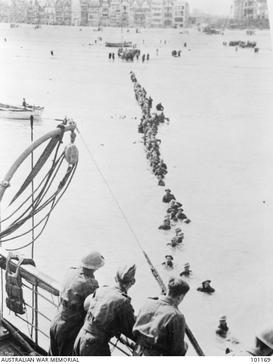
The Despair of Dunkirk
I am not entirely sure what Christopher Nolan was going for in his recent re-make of Dunkirk, a visually lush version of the heroic evacuation of hundreds of thousands of British soldiers from the shores of France across the English Channel at the end of May, 1940. (There was an original 1958 film, which I have not seen).
The story is a familiar one: Germany had overwhelmed Allied forces in a blitzkrieg across France, driving the French and their British allies north to the coast. Surrounded and trapped, they were doomed to certain annihilation, had not hundreds of civilian vessels, in an historic display of British heroism with a dash of Wellingtonian ‘doing one’s duty’, crossed the sea in the face of gunfire and bombing, picking up the soldiers, and ferrying them home to the safety of England, so they could fight another day.
In real-life, it was a stirring and moving historical tale. Although Nolan sets the scenes right, his re-telling limps, leaving one feeling as stale and empty as a three-day old crumpet.
First, there is the enemy, which is never named, nor even identified; the opening lines of text simply identifies them as, you guessed it, ‘the enemy’. I cannot even recall seeing a swastika. Perhaps most know that the ‘enemy’ were the army of German National Socialists, known by their Germanic shorthand ‘Nazis’, but some may not, and why not say so?
Second, there is the protagonist, if he may be called such, whose name was apparently ‘Tommy’, but I didn’t catch that, since he doesn’t speak much, nor is he much spoken to. A young British soldier, whom we meet in the opening scene, he is scouring the streets of Dunkirk with some of his mates when they are set upon by gunfire from the unnamed and, now that I think of it, almost always unseen, ‘enemy’. They are all shot in the back as they run, except our anonymous ‘hero’, who spends the rest of the film just trying to survive, sometimes by underhanded means, hiding under the dock, trying to get on the ship with wounded men, surreptitiously finding a space near the hatch on the ship, anything for easy escape and keeping body and soul together. He incites, at least in me, no heroism, no valour, no glory; just a boy-man who knows not why he is there, nor what he is doing; all he wants is off that hellish beach and back to Britain.
I sort of thought of him as a projection of modern man, taking a millennial and making him a mid-century man, or the other way around, as is the wont of the time-jumping direction of Nolan, and so many other revisionist films: What would a ‘modern man’ would do in that situation? What would we do if faced with the mayhem and despair of Dunkirk?
Fine, but films should also strive to elevate us, asking not only what we might and even would have done, but also, and more dramatically, what we should have.
Kenneth Branagh as the admiral-in-charge pacing up and down the pier, encouraging the men in the mode of Henry the Vth, goes through the motions, striving to infuse a heroism that seems as elusive as the coast 20 miles north of him.
The film focuses on the chaos, mayhem, men dying in boats, in the water, on land, drowning, being blown up, all big-budget shots with vivid imagery, but we know none of the victims, and the emotional engagement minimal.
There is a quasi-hero in the air, with Tom Hardy doing his usual laconic shtick, this time as a fighter pilot who protects the ships from German planes. But even he has a sort of robotic feel, wearing his leathery facemask most of the film, sort of creepily reminiscent of the villain Bane he played in the Dark Knight series, which Nolan also directed. Is there a hidden message here I’m missing?
And then we have Mark Rylance, who plays ‘Mr. Dawson’, a British leisure boater who motors his craft across the Channel, with his son and his son’s friend along. Like his character as a Russian agent in Bridge of Spies, he says little, sort of muttering along the way in subdued English fashion. They rescue a shell-shocked sailor, sitting on the propeller of his sunken ship. While recovering on board, the sailor flies into a rage when he discovers that they are actually going back to Dunkirk, from which hell he had just miraculously escaped; he knocks one of the boys (not Dawson’s son) down the stairs of the ship, giving him a fatal brain injury, from which the lad slowly, and rather pathetically, dies, alone.
What is troubling, and idiosyncratic, is that Mr. Dawson does nothing; just a shrug of the shoulders and back to one’s duty. Is this another hidden code, that those with what we now diagnose as ‘PTSD’ are not responsible, a vague, spectrum disorder which now justifies and exculpates all sorts of malfeasance and mayhem?
The central point, if there is one, is that there is little hope and few heroes in Dunkirk, just a fog of despair and listlessness and pointless violence; even when the protagonist finally returns back to England, he expects ridicule and abuse, and is surprised the crowds are cheering. To the desperate soldiers, who just wanted to live, it all seems disconnected, unhinged from the reality of their experience.
Come to think of it, Nolan also directed Inception, an odd film that takes place in the odder dreamscape of Leonardo DiCaprio, which might explain the central weakness of Dunkirk: It has the feel of reality, but comes across as more of a montage of various scenes, the characters within which we care little for. Perhaps this is a window into the mind of Nolan, and how he visualizes Dunkirk, or how he visualizes how modern man might visualize Dunkirk, or how 1940’s man might have, if he were more modern…Or perhaps it was all a bad dream? Or something.
Sure enough, Dunkirk was quite nearly a rout, and certainly a retreat and rearguard action. But we should be reminded that there were real, flesh and blood heroes in the valiant escape which saved the core of the British Expeditionary Force, whose story deserves to be told, and the world sorely in need of more of them. Heroes, that is.
.

Carney’s Amoral Majority
After five defections – euphemistically described as ‘crossing the floor’ – and three by-elections, Mark Carney and his Liberals how have their coveted majority. One wonders what bowls of pottage were offered in back-room deals. In the archaic monarchical system that is the Dominion of Canada, this majority allows the newly-minted Prime Minister to rule[…]Continue reading→

Saint Kateri , Canada’s Protectress
This was the title given to Saint Kateri Tekakwitha, by Pope Benedict XVI, when he canonized her on October 28th, 2012, along with six others, in Saint Peter’ Square (she had been beatified by Pope John Paul II back in 1980). With Saint Joseph as our protector, along with the Canadian martyrs, we seem to[…]Continue reading→

Remembering Father Alphonse de Valk
(Today marks the sixth anniversary of the death of Father Alphonse de Valk, C.S.B., a faithful, courageous and indefatigable Basilian priest, pro-life-and-family apostle, and the founder of Catholic Insight magazine. Here is what we wrote those on his entering into eternity five years ago, as we continue to remember him in our prayers and thoughts)[…]Continue reading→

A Tale of Two Benedicts
A grace-filled Holy Week to all our readers! As we await and prepare for the Resurrection about to dawn upon us, we might keep in mind two Benedicts: Pope Emeritus Benedict XVI, requiescat in pace, elected on this day in 2005; and today’s commemoration of the mystic pilgrim, Benedict Joseph Labre, who died on this[…]Continue reading→

My Name is Bernadette
April 16th is a propitious day, for besides the anniversary of Father de Valk’s death, who founded Catholic Insight in its print form decades ago, and the commemoration of the ‘two Benedicts’, mentioned in accompanying posts, today we also recall Saint Bernadette Soubirous, the young visionary to whom the Virgin Mary appeared numerous times at[…]Continue reading→

Saint Lydwina of Schiedam and Suffering Joyfully
Saint Lydwina of Schiedam (1380 – 1433) was one of the countless and glorious ‘victim souls’ in the history of the Church, those whose lives are filled with suffering, often of an unimaginable intensity, but who suffer joyfully. She was a fifteen-year old Dutch girl, out skating one day, when she fell and broke one[…]Continue reading→

The Glorious Martyrdoms of Martin and Maximus
As we enter into Eastertide, we recall on this 13th of April Pope Saint Martin I (+655), one of the noblest, if most tragic, of the successors of Saint Peter. Born in Umbria, Italy, he was of noble lineage, with great intelligence combined with charity and love of the poor and the Church. While still[…]Continue reading→

Canonizing Sister Faustina and Divine Mercy
HOMILY OF THE HOLY FATHER MASS IN ST PETER’S SQUARE FOR THE CANONIZATION OF SR MARY FAUSTINA KOWALSKA Sunday, 30 April 2000 1. “Confitemini Domino quoniam bonus, quoniam in saeculum misericordia eius”; “Give thanks to the Lord for he is good; his steadfast love endures for ever” (Ps 118: 1). So the Church sings on the Octave of[…]Continue reading→

Divine Mercy Sunday – An Echo of Every Mass
Reach out your hand and put it in my side. Do not doubt but believe’… ‘My Lord and my God!’ (Jn. 20:18)). Today is Divine Mercy Sunday, and as we celebrate the end of the Easter Octave, we contemplate the wounded side of our Saviour, the Church’s source of life. On Good Friday in the[…]Continue reading→

Saint Stanislaus of Szczepanów
We celebrate Saint Stanislaus today (+ April 11, 1079), in light of this Easter Octave, a bishop and martyr who accepted the episcopacy only at the direct order of Pope Alexander II. He proved a wise and courageous leader of his flock, put to death by his own king, Boleslaus, for rebuking the monarch’s ‘immoral[…]Continue reading→