
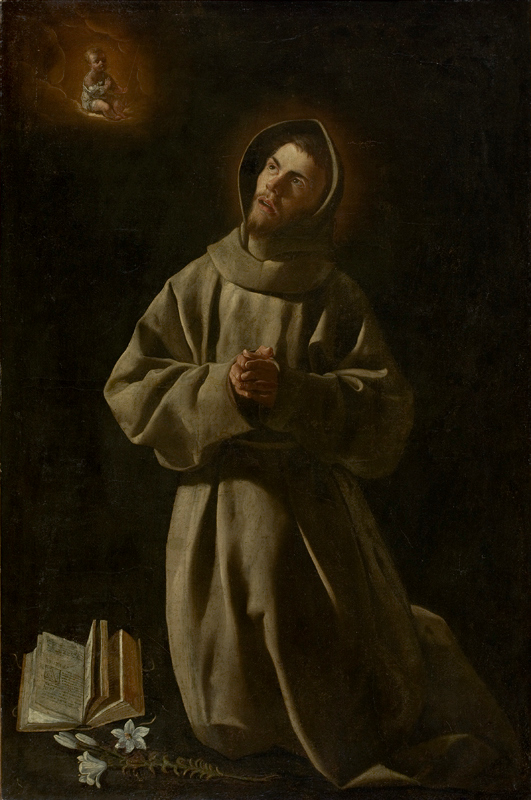
Saint Anthony and Our Lady
There is a curious connection with today’s memorial of Saint Anthony of Padua, the place in Italy where he died (in 1231), for he is also known as Saint Anthony of Lisbon, the place in Portugal where he was born (in 1195). There has been quite a long historical struggle over who ‘owns’ the saint more. Does one belong to one’s birthplace and where one was raised, or to the region where one lived and worked in one’s mature years?
The connection, of course, is that today is also the anniversary of the second apparition at Fatima, about 70 miles or so from where Anthony was born as Fernando Martins. And just as the message of Fatima has gone far beyond the Iberian village where the three children saw the angel and Our Lady, so too in his own lifetime, and more so after his death and glory in heaven, has the fame and renown of Saint Anthony spread throughout the world.
Anthony was and is known as one of the most gifted preachers who ever lived. In his youth, he joined the local Augustinian monastery, then transferred his vocational adherence to the Franciscans, taking the name Anthony, after hearing of one of their number being martyred as a missionary to the Muslims in northern Africa. Anthony received permission also to set sail across the Mediterranean, but he fell sick, and as the ship was returning to Portugal, was providentially blown off course and landed in Sicily, thus beginning the Italian chapter of Anthony’s life, for which he is still more known.
Soon afterward, at an ordination, there was a miscommunication, with no preacher to be had, so young Anthony asked to preach at the last minute, saying ‘whatever the Holy Spirit put into his mouth’. Well, the sermon blew everyone away, with his eloquence, his knowledge of Scripture, his holiness, the whole logos, ethos and pathos of superlative public speaking, elevated supernaturally.
Thus began the brief missionary apostolate of Saint Anthony (he died at the even-then young age of 36), for which he is still remembered. As a testament, his tongue is incorrupt. He is also the patron saint of ‘lost’ things, for reasons that are obscure, but there are many many testaments to his ability to ‘find’ such things. I myself will often spiritualize such loss, asking Saint Anthony to help me find such things as my lost patience, or my equanimity, or cheerfulness. There is just something about Fernando/Antonio that lives through the ages (he was one of the most quickly canonized saints in history), the echo of his sanctity and humility, now exalted by the Most High God, sort of like the Blessed Virgin we honour today as well.
Our Lady of Fatima and Saint Anthony of Lisbon and Portugal, orate pro nobis!
Carney’s Amoral Majority
After five defections – euphemistically described as ‘crossing the floor’ – and three by-elections, Mark Carney and his Liberals how have their coveted majority. One wonders what bowls of pottage were offered in back-room deals. In the archaic monarchical system that is the Dominion of Canada, this majority allows the newly-minted Prime Minister to rule[…]Continue reading→

Saint Kateri , Canada’s Protectress
This was the title given to Saint Kateri Tekakwitha, by Pope Benedict XVI, when he canonized her on October 28th, 2012, along with six others, in Saint Peter’ Square (she had been beatified by Pope John Paul II back in 1980). With Saint Joseph as our protector, along with the Canadian martyrs, we seem to[…]Continue reading→

A Tale of Two Benedicts
A grace-filled Holy Week to all our readers! As we await and prepare for the Resurrection about to dawn upon us, we might keep in mind two Benedicts: Pope Emeritus Benedict XVI, requiescat in pace, elected on this day in 2005; and today’s commemoration of the mystic pilgrim, Benedict Joseph Labre, who died on this[…]Continue reading→

My Name is Bernadette
April 16th is a propitious day, for besides the anniversary of Father de Valk’s death, who founded Catholic Insight in its print form decades ago, and the commemoration of the ‘two Benedicts’, mentioned in accompanying posts, today we also recall Saint Bernadette Soubirous, the young visionary to whom the Virgin Mary appeared numerous times at[…]Continue reading→

Saint Lydwina of Schiedam and Suffering Joyfully
Saint Lydwina of Schiedam (1380 – 1433) was one of the countless and glorious ‘victim souls’ in the history of the Church, those whose lives are filled with suffering, often of an unimaginable intensity, but who suffer joyfully. She was a fifteen-year old Dutch girl, out skating one day, when she fell and broke one[…]Continue reading→

The Glorious Martyrdoms of Martin and Maximus
As we enter into Eastertide, we recall on this 13th of April Pope Saint Martin I (+655), one of the noblest, if most tragic, of the successors of Saint Peter. Born in Umbria, Italy, he was of noble lineage, with great intelligence combined with charity and love of the poor and the Church. While still[…]Continue reading→

Saint Stanislaus of Szczepanów
We celebrate Saint Stanislaus today (+ April 11, 1079), in light of this Easter Octave, a bishop and martyr who accepted the episcopacy only at the direct order of Pope Alexander II. He proved a wise and courageous leader of his flock, put to death by his own king, Boleslaus, for rebuking the monarch’s ‘immoral[…]Continue reading→
Saint Gemma Galgani
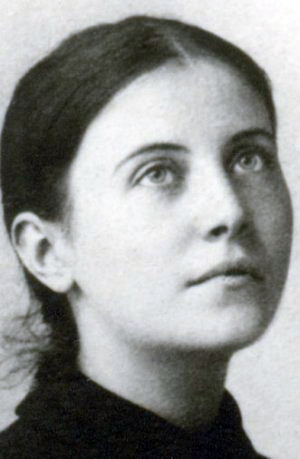
On this April 11th, in 1903 – the same year that the Italian Guiseppe Sarto was elected Pope later that summer as Pius X – a lovely, young Italian woman died, by the name of Gemma Galgani. She lived a brief life of 24 years, as did a number of other young saints, including Pier[…]Continue reading→
An Ideological and Improper Translation
I noticed something odd with the psalm reading at Mass the other day. Our bishops’ conference here in Canada has decreed that the Mass in English – Novus Ordo – use the ‘NRSV’, the ‘New Revised Standard Version’, an ‘updated’ translation of the original RSV, first published in 1952. This ‘new translation’ has the tendency[…]Continue reading→
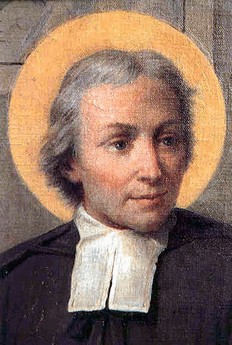
Saint Jean-Baptiste de la Salle: A Teacher for Teachers
Jean-Baptiste de la Salle (1651 – 1719), a French nobleman, ordained a priest, founded the first order in the Church’s history entirely without priests, and this came about almost by accident. I say ‘almost’, for, of course, there are no accidents with God. Destined for ordination from an early age, Jean-Baptiste never looked back, even[…]Continue reading→
One thought on “Saint Anthony and Our Lady”
Comments are closed.
And isn’t it amazing how many ‘Martins’ are recognized as saints ! Martin of Braga, Martin de Porres, pope Martin I, Martin of Arades, Jacinta and Francisco (Marto), Therese Lisieux and all her sisters and parents (Martin). Two of the Vietnamese martyrs were named Martin, and there’s no doubt that many others exist. There are at least six Sint-Martens towns in Belgium and a dozen Saint-Martins in France, not to mention two Caribbean islands and St Martin-in-the-fields, London. All of them were named after Martin of Tours who, like Anthony, is seen as a spiritual span over Europe. Martin was born in (now) Szombathely, Hungary, grew up in Pavia, and spent much of his life in France. In these spring and summer days, let’s keep our eyes and ears open for purple martins (the bird) and eschew martens (the weasel).