
The Long and Short of Nukes and Koreans
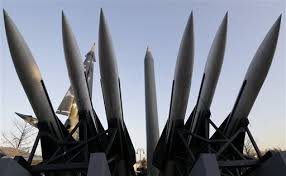
The North Koreans have tested yet another potentially-intercontinental missile, this one reaching scant 1000 km before crashing into the sea. Not bad, some might say, for the impoverished country, but one uses the term ‘intercontinental’ with a grain of salt, for they have a long way to go yet. The distance from Pyongyang to Los Angeles is 9569 km, so any long-jong missile has to have another 8000 kilometres of juice before it can hit the continental U.S. Anchorage is 3000 km closer, but what’s the benefit of nukeing Alaska? For the U.S.-hating Kim Jong-Un, Beverly Hills makes a much more attractive target, in more ways than one. Aim right for the Hollywood sign..
I wonder why these nutty doomsday types bother with missiles, when it would be technically easier just to smuggle a warhead on board a ship or a truck, and detonate from a distance, or even while you’re sitting on top of it, like Slim Pickens in the final scene from Dr. Strangelove.
Either way, the damage would be, to understate the case, catastrophic. To grasp what effects such a bomb would cause, peruse accounts of the last time a nuclear bomb was detonated in war, on the morning of August 6, 1945, over Hiroshima, Japan, then three days later over Nagasaki on August 9th. According to reports, the two bombs killed 129,000 people instantly, men (including 20, 000 soldiers), women, children, and whatever unborn there were in both cities. Many more thousands died of radiation burns and poisoning in the days, weeks and years afterwards.
It was partly in response to these atrocities that the Pastoral Constitution on the Church, Gaudium et Spes, taught the following at the end of the Second Vatican Council in 1965, a teaching that was put into this form in the universal Catechism:
Every act of war directed to the indiscriminate destruction of whole cities or vast areas with their inhabitants is a crime against God and man, which merits firm and unequivocal condemnation.” A danger of modern warfare is that it provides the opportunity to those who possess modern scientific weapons especially atomic, biological, or chemical weapons – to commit such crimes (cf., GS, 80.3; CCC, 2314)
We should keep in mind that soon after the war, the United States and Russia developed hydrogen bombs, so-called thermonuclear warheads, based on nuclear fusion of hydrogen into helium (the same energy that powers the Sun and stars), many times more powerful than the initial atomic bombs, which get their power from the fission of heavy elements (such as uranium). Even a one-megaton hydrogen bomb (the atomic bombs dropped on Japan were in the kiloton range, ten times less powerful) could easily level the entire city of Manhattan, instantly killing many of its inhabitants, and there are bombs out there with five to ten times that power. And to ponder that this apocalytpic technology is now also in the hands of Britain, France, China, Pakistan, India, Israel, and, presumably, North Korea. Any one of them could in theory start a nuclear war, at least of limited extent.
One could think of a scenario where nuclear weapons could be morally justified, say, in destroying an enemy fleet in mid-transit across the Pacific, or even blowing up an asteroid a la Bruce Willis (an impossibility, by any physical standards). In any real life use, there is always the danger, if not usually the outright intention, of untold numbers of innocent collateral casulaties, that can never really full be removed, nor justified.
It was Albert Einstein’s Special Theory of Relativity, which he formulated way back in 1905, and its famous equation, E= mc2, that first predicted the bomb (as well as nuclear power, to give the good side of all of this). That is, the energy (E) in any particle of matter is equal to its mass (m) times the speed of light (c) squared. Now, the speed of light is a very, very big number (186,000 miles per second, squared). There is enough energy in the ‘mass’ of the atoms of a piece of paper to power a whole city. It’s just that it is practically inaccessible.
But the power of certain atoms, uranium, plutonium, hydrogen and such, is indeed ‘accessible’ with the right technology, and Einstein realized the potential ‘yield’ that could be derived from even a small amount of mass, but did not want to reveal it, for he knew what evil the power of the atom could unleash upon the world. And once that genie was out of the bottle, as we all too well know, there is no way to put him back in. He just roams around the world looking for someone to annihilate.
It was only when he discovered that the Nazis were working on technology to develop ‘the bomb’ that Einstein in 1939 penned a two-page letter to the then-President of the United States, Franklin D. Roosevelt, explaining the technology of “a massive nuclear chain reaction involving uranium (that) could lead to the construction of “extremely powerful bombs of a new type” — the atomic bomb”. Einstein figured it was better for the U.S. to have the bomb, rather than the Nazis. Or perhaps for both, the beginning of that unstable state of nuclear deterrence.
Thus began the five year top-secret Manhattan Project, the most ambitious and expensive research program not only in U.S., but in world history, with the best and brightest scientific minds dedicated to producing the most lethal weapon ever devised. As we know, the Germans never perfected the bomb, but America did, and hence we have Hiroshima and Nagasaki. And now the technology is in the hands of nutjobs and ideologues and who knows who else.
The question is: What next? Pandora’s box was opened on those fateful days in August, 1945 (the first, curiously, on the feast of the Transfiguration), but has remained closed ever since. God has His hand in all of this, and we should pray that the evil of nuclear weaponry, and all such means of indiscriminate mass destruction, remain quiescent and rusting away until Judgement Day, and then some…
Our Lady of Peace, ora pro nobis!
Carney’s Amoral Majority
After five defections – euphemistically described as ‘crossing the floor’ – and three by-elections, Mark Carney and his Liberals how have their coveted majority. One wonders what bowls of pottage were offered in back-room deals. In the archaic monarchical system that is the Dominion of Canada, this majority allows the newly-minted Prime Minister to rule[…]Continue reading→

Saint Kateri , Canada’s Protectress
This was the title given to Saint Kateri Tekakwitha, by Pope Benedict XVI, when he canonized her on October 28th, 2012, along with six others, in Saint Peter’ Square (she had been beatified by Pope John Paul II back in 1980). With Saint Joseph as our protector, along with the Canadian martyrs, we seem to[…]Continue reading→

A Tale of Two Benedicts
A grace-filled Holy Week to all our readers! As we await and prepare for the Resurrection about to dawn upon us, we might keep in mind two Benedicts: Pope Emeritus Benedict XVI, requiescat in pace, elected on this day in 2005; and today’s commemoration of the mystic pilgrim, Benedict Joseph Labre, who died on this[…]Continue reading→

My Name is Bernadette
April 16th is a propitious day, for besides the anniversary of Father de Valk’s death, who founded Catholic Insight in its print form decades ago, and the commemoration of the ‘two Benedicts’, mentioned in accompanying posts, today we also recall Saint Bernadette Soubirous, the young visionary to whom the Virgin Mary appeared numerous times at[…]Continue reading→

Saint Lydwina of Schiedam and Suffering Joyfully
Saint Lydwina of Schiedam (1380 – 1433) was one of the countless and glorious ‘victim souls’ in the history of the Church, those whose lives are filled with suffering, often of an unimaginable intensity, but who suffer joyfully. She was a fifteen-year old Dutch girl, out skating one day, when she fell and broke one[…]Continue reading→

The Glorious Martyrdoms of Martin and Maximus
As we enter into Eastertide, we recall on this 13th of April Pope Saint Martin I (+655), one of the noblest, if most tragic, of the successors of Saint Peter. Born in Umbria, Italy, he was of noble lineage, with great intelligence combined with charity and love of the poor and the Church. While still[…]Continue reading→

Saint Stanislaus of Szczepanów
We celebrate Saint Stanislaus today (+ April 11, 1079), in light of this Easter Octave, a bishop and martyr who accepted the episcopacy only at the direct order of Pope Alexander II. He proved a wise and courageous leader of his flock, put to death by his own king, Boleslaus, for rebuking the monarch’s ‘immoral[…]Continue reading→
Saint Gemma Galgani
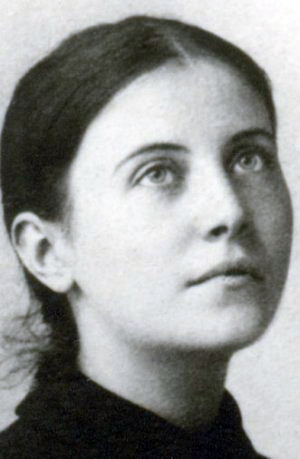
On this April 11th, in 1903 – the same year that the Italian Guiseppe Sarto was elected Pope later that summer as Pius X – a lovely, young Italian woman died, by the name of Gemma Galgani. She lived a brief life of 24 years, as did a number of other young saints, including Pier[…]Continue reading→
An Ideological and Improper Translation
I noticed something odd with the psalm reading at Mass the other day. Our bishops’ conference here in Canada has decreed that the Mass in English – Novus Ordo – use the ‘NRSV’, the ‘New Revised Standard Version’, an ‘updated’ translation of the original RSV, first published in 1952. This ‘new translation’ has the tendency[…]Continue reading→
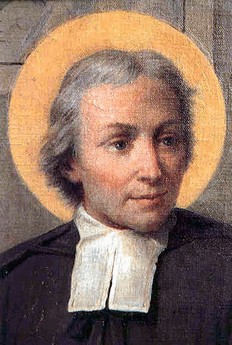
Saint Jean-Baptiste de la Salle: A Teacher for Teachers
Jean-Baptiste de la Salle (1651 – 1719), a French nobleman, ordained a priest, founded the first order in the Church’s history entirely without priests, and this came about almost by accident. I say ‘almost’, for, of course, there are no accidents with God. Destined for ordination from an early age, Jean-Baptiste never looked back, even[…]Continue reading→