

Normalizing Deviancy
Well, another evening CBC episode, dedicated this time to the flying of the rainbow flag in various locales, the most controversial being the American embassy in Jamaica, where homosexuality is, shall we say, less than tolerated.
We must clear the air here, and allow me a final distinction before we leave this subject alone for a time. There seems to be a rather fundamental confusion in the minds of individuals and in the ethos of our culture between what might be termed homo-philia, friendship between persons of the same sex, and homo-eros, sexual expression between persons of the same sex. I dare say that this confusion stems from a lack of nuance implied in the English word ‘love’, which we use for just about everything, our spouses, our friends, our shoes, our food and our sports and our leisure.
Greek, on the other hand, from which these words derive (along with that doubly-confused term ‘homophobia’) has at least four words for ‘love’, classically and clearly distinguished by the great C.S. Lewis in his book titled, appropriately enough, The Four Loves. There is agape, pure unselfish love, philia, the love of friendship, especially between brothers, storge, affection love, a deep bond usually borne of spending a long time with another and, of course, the one most familiar, eros, which is passionate, sexual love, seeking pleasure from the other.
It is requisite to keep these distinctions in mind as we consider how and why we ‘love’ the various persons we do. In the Christian view, all loves must be subsumed under agape, which is the term Christ uses, and that the Church has adopted, to mean ‘charity’, pure, disinterested love, which wills the good of the other, without necessarily seeking our own good.
We, however, usually consider ‘love’ as between persons of the opposite sex, erotic love, as in ‘falling in love’. This is the stuff of literature, plays, songs and films. As Virgil sang all those years ago, ‘amor vincit omnia, et nos cedamus amori’, ‘love conquers all, and let us too yield to love’.
But what of ‘love’ between persons of the same sex? In itself, there is nothing wrong, and indeed much that is good, in men loving men and women loving women. In fact, throughout history, the sexes have spent most of their time with, and much of their affections upon, persons of the same sex, without this friendship, this philia becoming erotic. Soldiers, workers, monks, priests, knights, missionaries, miners, hunters, gatherers, all the way to our modern poker, hunting and golfing buddies, hang out together and, yes, love each other. True friendship between ‘brothers’ is only possible, however, if the love remains non-sexualized and every man, deep down, knows this.
To be specific, what the Church warns against in same-sex friendship, following natural law, is eroticizing this natural and healthy bond, turning homo-philia, a good and noble thing, into homo-eros, with the unnatural vices and corruption which that entails. Sadly, in an ironic way, the obsession in our culture with homoerotic tendencies has clouded, obscured and tainted the natural homo-philic friendships of men (and, to a lesser extent, women). Indeed, our hyper-sexualized culture has tainted any normal relationships, parent-child, uncle-child, man-woman, man-man, adult-child, boy-girl. We all look at each other funny, with suspicion and fear, as the latent unbridled eros , unhinged from reason and virtue, swirls in the air like a noxious fog.
How far this is from the Christian view! As Pope Benedict XVI declared in his 2005 encyclical Deus Caritas Est (as with all things Benedict, well worth a read), it is the modern world that has warped eros, not the Church and Christianity, which very early on in the Roman Empire purified eros from its pagan, deviant, and warped tendencies, which were particularly deleterious for women and children, who were subjugated and used as sexual slaves and prostitutes (a tendency, sadly, that is now on the resurgence in our neo-pagan culture, with our loss of Christian mores and values, and the dignity of the human person).
Consider: In a Christian culture, where men are virtuous in their chastity towards women, or at least held to account if they are not, it is the women who hold all the cards in the sexual relationship. It is the exact opposite in an unvirtuous, pagan, or practically pagan, culture, unmoored from Judeo-Christian law, where women are objectified and sexualized, taken by force if need be. Anyone who says the Church is anti-woman knows not history.
For Man to be who is he is meant to be, and for society to flourish, eros must be controlled and channelled, subsumed under the higher love of agape, willing the good of the other. As John Paul II and Benedict both made abundantly clear, this is only possible within monogamous and faithful marriage, wherein the true ‘gift of self’ can occur, with eros ordered to the mutual complementarity and union between husband and wife, and the procreation of children
All of our other friendships should be non-sexual and non-erotic. To put it in the modern colloquia, the only ‘friend with benefits’ should be our husband or wife.
Yet the modern world thinks that it matters not where one ‘gets one’s jollies’. Chaque a son gout, they say, even, perhaps especially, in our sexual proclivities.
 Well, even they have limits. There is still an aversion to adultery, and especially to pedophilia and rape, for example. But even these are becoming more difficult to define as we cast ourselves off from the solid bulwark of Christian revelation and reason. One need look no further than the lionizing of Professor Alfred Kinsey, an entomologist who transformed himself into a ‘sexologist’. He performed sexual experiments on toddlers, masturbating them, yet was portrayed flatteringly by Liam Neeson in a major film (although I never saw it, I am sure they left out the pedophilia, and some of the other bizarre and grievously immoral, even criminal, ‘experiments’). This is all in the public record, but his name still disgracefully adorns the Kinsey Institute in Indiana for studies in ‘sexuality’.
We now think that any sexual activity between ‘consenting adults’ is all right, and no one else’s business. Even here, however, we have trouble defining ‘consensual’ with all the explicit and implicit imbalances of power and authority, and what, really is an ‘adult’? Is that a biological measure, or a psychological and spiritual one? Who is to determine? Furthermore, something harmful does not cease to be harmful just because one consents to it (as we see in euthanasia)
All of this to say that we must not underestimate the power of the sexual drive, and how it affects us and those around us. Unleashed and ungoverned eros, whose origins lie in the deeply wounded libido of Man, is at the basis of many of our societal ills, from the breakdown of the family, the epidemic of sexual diseases, all the way to abortion on demand, with the unborn killed daily in far greater numbers than any other modern tragedy or massacre. Unrestrained sexual licence, and the enshrining of sexual deviancy into law, leads inevitably to societal breakdown.
We should keep this mind as we hoist all those rainbow flags, for what really do they celebrate or commemorate? There are other, and better, ways to remember and pray for the all the victims of this sad and tragic massacre.
Just thought I would further clarify for Neil MacDonald and his readers what the Church is really ‘against’ and, more to the point, what the Church is ‘for’.
Peace to all.

Carney’s Amoral Majority
After five defections – euphemistically described as ‘crossing the floor’ – and three by-elections, Mark Carney and his Liberals how have their coveted majority. One wonders what bowls of pottage were offered in back-room deals. In the archaic monarchical system that is the Dominion of Canada, this majority allows the newly-minted Prime Minister to rule[…]Continue reading→

Saint Kateri , Canada’s Protectress
This was the title given to Saint Kateri Tekakwitha, by Pope Benedict XVI, when he canonized her on October 28th, 2012, along with six others, in Saint Peter’ Square (she had been beatified by Pope John Paul II back in 1980). With Saint Joseph as our protector, along with the Canadian martyrs, we seem to[…]Continue reading→

A Tale of Two Benedicts
A grace-filled Holy Week to all our readers! As we await and prepare for the Resurrection about to dawn upon us, we might keep in mind two Benedicts: Pope Emeritus Benedict XVI, requiescat in pace, elected on this day in 2005; and today’s commemoration of the mystic pilgrim, Benedict Joseph Labre, who died on this[…]Continue reading→

My Name is Bernadette
April 16th is a propitious day, for besides the anniversary of Father de Valk’s death, who founded Catholic Insight in its print form decades ago, and the commemoration of the ‘two Benedicts’, mentioned in accompanying posts, today we also recall Saint Bernadette Soubirous, the young visionary to whom the Virgin Mary appeared numerous times at[…]Continue reading→

Saint Lydwina of Schiedam and Suffering Joyfully
Saint Lydwina of Schiedam (1380 – 1433) was one of the countless and glorious ‘victim souls’ in the history of the Church, those whose lives are filled with suffering, often of an unimaginable intensity, but who suffer joyfully. She was a fifteen-year old Dutch girl, out skating one day, when she fell and broke one[…]Continue reading→

The Glorious Martyrdoms of Martin and Maximus
As we enter into Eastertide, we recall on this 13th of April Pope Saint Martin I (+655), one of the noblest, if most tragic, of the successors of Saint Peter. Born in Umbria, Italy, he was of noble lineage, with great intelligence combined with charity and love of the poor and the Church. While still[…]Continue reading→

Saint Stanislaus of Szczepanów
We celebrate Saint Stanislaus today (+ April 11, 1079), in light of this Easter Octave, a bishop and martyr who accepted the episcopacy only at the direct order of Pope Alexander II. He proved a wise and courageous leader of his flock, put to death by his own king, Boleslaus, for rebuking the monarch’s ‘immoral[…]Continue reading→

Saint Gemma Galgani
On this April 11th, in 1903 – the same year that the Italian Guiseppe Sarto was elected Pope later that summer as Pius X – a lovely, young Italian woman died, by the name of Gemma Galgani. She lived a brief life of 24 years, as did a number of other young saints, including Pier[…]Continue reading→

An Ideological and Improper Translation
I noticed something odd with the psalm reading at Mass the other day. Our bishops’ conference here in Canada has decreed that the Mass in English – Novus Ordo – use the ‘NRSV’, the ‘New Revised Standard Version’, an ‘updated’ translation of the original RSV, first published in 1952. This ‘new translation’ has the tendency[…]Continue reading→
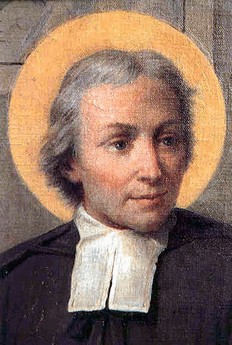
Saint Jean-Baptiste de la Salle: A Teacher for Teachers
Jean-Baptiste de la Salle (1651 – 1719), a French nobleman, ordained a priest, founded the first order in the Church’s history entirely without priests, and this came about almost by accident. I say ‘almost’, for, of course, there are no accidents with God. Destined for ordination from an early age, Jean-Baptiste never looked back, even[…]Continue reading→