
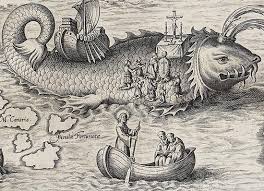
Brendan’s Voyage
Today commemorates Saint Brendan, the sixth century Irish monk, the ‘Navigator’, whose main claim to fame is a supposed seven year trans-Atlantic voyage in a boat made of animal-hides upon which he and sixteen others embarked, with the discovery of North America many centuries before the time Cabot. Many considered his journey pious legend, a fantastic mediaeval tale like many others (and it does contain a number of fantastic elements). That is, until the voyage was re-created, with the same mediaeval materials, by Tim Severin in 1978, chronicled in the book and film The Brendan Voyage, demonstrating that Brendan’s voyage was at the very least eminently possible.
There are many things that Brendan can teach us, but one of them is the limited value of human hubris. We in our modern smugness presume that we are more advanced, morally, spiritually, intellectually than any culture or civilization that came before, a consequence of the virus of the evolutionary paradigm, that things will always proceed upward and get better with time.
Not so. Advance is possible, certainly, but so is regression, evolution along with devolution. In fact, the second law of thermodynamics states that greater perfection can only be achieved by expending mental and physical energy and effort, without which things generally proceed into entropy and chaos.
Who is to say that the monks, and the contemporaneous Vikings, did not have better boats than we? Certainly, the Romans were far more adept at building natural amphitheatres than modern man. To this day, you can hear a pin drop on the stage even in the ruins of one of their outdoor auditoria, utilizing to the maximum in some mysterious forgotten way the surrounding natural features, while we still struggle to build decent concert halls with all of our ‘space age’ materials (cf., the expensive renovation of our own already-lavish Roy Thomson Hall in 2002 due to the poor quality of its acoustics).
Certainly, on the spiritual plane, we have much to learn from our ancestors, which is why the Catholic Church remains so immersed in tradition and history, in her saints, their writings, their experiences, even their journeys and the people they evangelized. We ignore to our peril the great holy men and women who preceded us, and, as Chesterton alludes, one of the unholy evils of ‘modernism’, amongst the many of that multi-headed hydra that Saint Pius X described as the ‘synthesis of all heresies’, is that something is good and true just because it is modern.
Sometimes, many times, it is the old that is truly good and truly true. At the very least, it has stood the test of time.
In the present context, I for one like the pious thought that an Irishmen discovered Canada many centuries before a Frenchman. But, then again, they both claimed Canada for the Church.
Either way, Saint Brendan, ora pro nobis!

Carney’s Amoral Majority
After five defections – euphemistically described as ‘crossing the floor’ – and three by-elections, Mark Carney and his Liberals how have their coveted majority. One wonders what bowls of pottage were offered in back-room deals. In the archaic monarchical system that is the Dominion of Canada, this majority allows the newly-minted Prime Minister to rule[…]Continue reading→

Saint Kateri , Canada’s Protectress
This was the title given to Saint Kateri Tekakwitha, by Pope Benedict XVI, when he canonized her on October 28th, 2012, along with six others, in Saint Peter’ Square (she had been beatified by Pope John Paul II back in 1980). With Saint Joseph as our protector, along with the Canadian martyrs, we seem to[…]Continue reading→

Remembering Father Alphonse de Valk
(Today marks the sixth anniversary of the death of Father Alphonse de Valk, C.S.B., a faithful, courageous and indefatigable Basilian priest, pro-life-and-family apostle, and the founder of Catholic Insight magazine. Here is what we wrote those on his entering into eternity five years ago, as we continue to remember him in our prayers and thoughts)[…]Continue reading→

A Tale of Two Benedicts
A grace-filled Holy Week to all our readers! As we await and prepare for the Resurrection about to dawn upon us, we might keep in mind two Benedicts: Pope Emeritus Benedict XVI, requiescat in pace, elected on this day in 2005; and today’s commemoration of the mystic pilgrim, Benedict Joseph Labre, who died on this[…]Continue reading→

My Name is Bernadette
April 16th is a propitious day, for besides the anniversary of Father de Valk’s death, who founded Catholic Insight in its print form decades ago, and the commemoration of the ‘two Benedicts’, mentioned in accompanying posts, today we also recall Saint Bernadette Soubirous, the young visionary to whom the Virgin Mary appeared numerous times at[…]Continue reading→

Saint Lydwina of Schiedam and Suffering Joyfully
Saint Lydwina of Schiedam (1380 – 1433) was one of the countless and glorious ‘victim souls’ in the history of the Church, those whose lives are filled with suffering, often of an unimaginable intensity, but who suffer joyfully. She was a fifteen-year old Dutch girl, out skating one day, when she fell and broke one[…]Continue reading→

The Glorious Martyrdoms of Martin and Maximus
As we enter into Eastertide, we recall on this 13th of April Pope Saint Martin I (+655), one of the noblest, if most tragic, of the successors of Saint Peter. Born in Umbria, Italy, he was of noble lineage, with great intelligence combined with charity and love of the poor and the Church. While still[…]Continue reading→
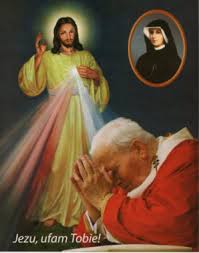
Canonizing Sister Faustina and Divine Mercy
HOMILY OF THE HOLY FATHER MASS IN ST PETER’S SQUARE FOR THE CANONIZATION OF SR MARY FAUSTINA KOWALSKA Sunday, 30 April 2000 1. “Confitemini Domino quoniam bonus, quoniam in saeculum misericordia eius”; “Give thanks to the Lord for he is good; his steadfast love endures for ever” (Ps 118: 1). So the Church sings on the Octave of[…]Continue reading→

Divine Mercy Sunday – An Echo of Every Mass
Reach out your hand and put it in my side. Do not doubt but believe’… ‘My Lord and my God!’ (Jn. 20:18)). Today is Divine Mercy Sunday, and as we celebrate the end of the Easter Octave, we contemplate the wounded side of our Saviour, the Church’s source of life. On Good Friday in the[…]Continue reading→

Saint Stanislaus of Szczepanów
We celebrate Saint Stanislaus today (+ April 11, 1079), in light of this Easter Octave, a bishop and martyr who accepted the episcopacy only at the direct order of Pope Alexander II. He proved a wise and courageous leader of his flock, put to death by his own king, Boleslaus, for rebuking the monarch’s ‘immoral[…]Continue reading→