

Ant-Man vs. Daredevil
(As a bit of light-hearted reading before the issuance of the Holy Father’s Apostolic Letter later today, here are some thoughts on two superheroes, such as they are. Editor).
Yes, I must admit, I did watch Ant-Man, in two instalments, for a I had to sort of motivate myself to finish it. The campy film was better than it might have been, but worse also. Carried along by the charisma of its male lead, the movie has a child-likeness about it, refreshing in the age of jaded superheroes (and heroes in general).
Need I discuss the physical impossibilities of the whole premise? Michael Douglas’ character, Hank Pym (I was surprised to see him, sort of thinking that original Wall Street-guy was nearly dead). Anyway, Pym is the inventor of the ‘technology’ of the ant-suit, based on his discovery of a way to shrink creatures to miniscule size, while maintaining their strength and speed, by reducing the ‘space between their atoms’. The problem is that such creatures would still have the same mass, and thus be just as heavy. Ant-Man would not be as nimble as he is, and would wreck things as he stomped around.
There are, of course, also the insurmountable physiological problems with creatures adapted to large-scale life becoming the size of insects. Even back in Galileo’s day, they realized that surface area and volume increase and decrease at different rates, which is why insects have exoskeletons, while large mammals have endoskeletons. Not just that, but at a cert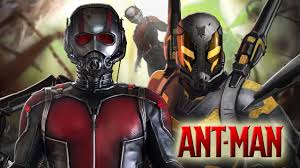 ain size, the lungs and heart would cease to function, to say nothing of the brain.
But why bother with all the science stuff? It is a cartoonish movie, with a few humorous bits to move the plot along, but also with some rather garish violence, unsuitable for the young (and old, for that matter), such as when the villain uses a defective ‘shrinking gun’ on someone, turning him into a reddish blob of bloody tissue, which he wipes up and flushes down the loo. I don’t know, but I found that quite disturbing for some reason.
My main concern was with the subplot of Scott’s (the Ant-Man’s real name) domestic life, such as it is. He apparently abandoned his wife and young daughter to commit a Robin Hood-esque heist, for which he spends a number of years in the slammer. When he gets out, his finds his wife shacked up with a middle-aged cop, with her seven-year girl old in tow. It was a bit embarrassing to see these two middle-aged men, Scott and the cop, vie for the affection of this young girl through the film, all the while her Mum committing open adultery, and her father falling in love with Hank Pym’s daughter. No one seems desirous of any further children, just enjoying themselves. Is it just me, or am I weird in thinking that this messed-up moral situation, with all the ‘adults’ in her life seeking juvenile pleasure, would do far more harm to the young girl-to-be-rescued, than anything the villainous ‘Yellow Jacket’ , arch-enemy of Ant-Man, could ever do?
So, ho-hum, she was saved, only to face a world where growing up normal is all but impossible. But, then again, there are lots of little girls in her situation, and no one seems able to save them, Ant-suit or not.
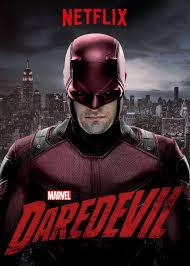 What of the Netflix Daredevil series? Again, I will admit that I watched the first season, being a fan of the comics when I was of the age to read such things, now, yes, of the age to watch them. Like Batman, the character always intrigued me, being a ‘self-made’ superhero, relying by and large upon his own developed skills, with a bit of help from heightened senses. Also, like Batman, Daredevil was vulnerable, and his Catholicism, his struggles with his conscience and the morality of his actions, added to the drama.
They try to bring this out in the series, with some limited success. Hollywood has little idea of the complexities and nuances of Catholicism, nor of its complementary stark lines of evil and good. Matt Murdoch (Daredevil’s real name) is a New York lawyer by day, vigilante by night. He has certain moral lines he will not cross, especially killing anyone, which seems odd, for he will bash, crush and wreak havoc on people, often presented in gory and voyeuristic violence (more vivid when done by the ‘bad guys’). One must wonder that the Daredevil is at the very least causing potentially-lethal harm, itself an evil, unless done strictly in a proportionate manner in self-defense.
Matt is portrayed as Catholic who does not seem to live any sort of regular religious life, a familiar theme, even though he is shown going into his local church, struggling with his conscience, and speaking with his priest now and again. This man of the cloth is presented with more masculinity and moral certainty than most in films. However, he is still weak and wavering, offering often vague advice, allowing Matt to continue with his life of ambiguous and, I would argue, immoral vigilantism.
That allows the comic-book show to continue, but I am glad to see that they at least raise moral questions in this series, leading the jaded viewers, I hope, perhaps to begin the process of asking questions about themselves, and life in general, in however inchoate a Socratic fashion. What indeed is the proper response to violence, especially as such violence creeps ever closer to our own milieu?
As we question, we may at least hope, along with Daredevil, that some good comes out of the evil. The problem with which Daredevil must wrestle, pun intended, lies in doing the evil in the first place, and becoming as dark, brutal and coarse as those against whom he fights.
Carney’s Amoral Majority
After five defections – euphemistically described as ‘crossing the floor’ – and three by-elections, Mark Carney and his Liberals how have their coveted majority. One wonders what bowls of pottage were offered in back-room deals. In the archaic monarchical system that is the Dominion of Canada, this majority allows the newly-minted Prime Minister to rule[…]Continue reading→

Saint Kateri , Canada’s Protectress
This was the title given to Saint Kateri Tekakwitha, by Pope Benedict XVI, when he canonized her on October 28th, 2012, along with six others, in Saint Peter’ Square (she had been beatified by Pope John Paul II back in 1980). With Saint Joseph as our protector, along with the Canadian martyrs, we seem to[…]Continue reading→

A Tale of Two Benedicts
A grace-filled Holy Week to all our readers! As we await and prepare for the Resurrection about to dawn upon us, we might keep in mind two Benedicts: Pope Emeritus Benedict XVI, requiescat in pace, elected on this day in 2005; and today’s commemoration of the mystic pilgrim, Benedict Joseph Labre, who died on this[…]Continue reading→

My Name is Bernadette
April 16th is a propitious day, for besides the anniversary of Father de Valk’s death, who founded Catholic Insight in its print form decades ago, and the commemoration of the ‘two Benedicts’, mentioned in accompanying posts, today we also recall Saint Bernadette Soubirous, the young visionary to whom the Virgin Mary appeared numerous times at[…]Continue reading→

Saint Lydwina of Schiedam and Suffering Joyfully
Saint Lydwina of Schiedam (1380 – 1433) was one of the countless and glorious ‘victim souls’ in the history of the Church, those whose lives are filled with suffering, often of an unimaginable intensity, but who suffer joyfully. She was a fifteen-year old Dutch girl, out skating one day, when she fell and broke one[…]Continue reading→

The Glorious Martyrdoms of Martin and Maximus
As we enter into Eastertide, we recall on this 13th of April Pope Saint Martin I (+655), one of the noblest, if most tragic, of the successors of Saint Peter. Born in Umbria, Italy, he was of noble lineage, with great intelligence combined with charity and love of the poor and the Church. While still[…]Continue reading→

Saint Stanislaus of Szczepanów
We celebrate Saint Stanislaus today (+ April 11, 1079), in light of this Easter Octave, a bishop and martyr who accepted the episcopacy only at the direct order of Pope Alexander II. He proved a wise and courageous leader of his flock, put to death by his own king, Boleslaus, for rebuking the monarch’s ‘immoral[…]Continue reading→

Saint Gemma Galgani
On this April 11th, in 1903 – the same year that the Italian Guiseppe Sarto was elected Pope later that summer as Pius X – a lovely, young Italian woman died, by the name of Gemma Galgani. She lived a brief life of 24 years, as did a number of other young saints, including Pier[…]Continue reading→
An Ideological and Improper Translation
I noticed something odd with the psalm reading at Mass the other day. Our bishops’ conference here in Canada has decreed that the Mass in English – Novus Ordo – use the ‘NRSV’, the ‘New Revised Standard Version’, an ‘updated’ translation of the original RSV, first published in 1952. This ‘new translation’ has the tendency[…]Continue reading→
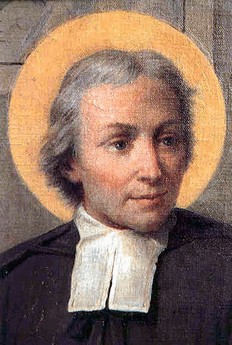
Saint Jean-Baptiste de la Salle: A Teacher for Teachers
Jean-Baptiste de la Salle (1651 – 1719), a French nobleman, ordained a priest, founded the first order in the Church’s history entirely without priests, and this came about almost by accident. I say ‘almost’, for, of course, there are no accidents with God. Destined for ordination from an early age, Jean-Baptiste never looked back, even[…]Continue reading→