
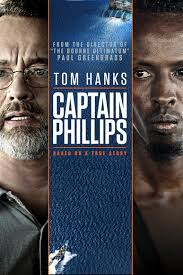
Captain Philips
I just took in the new American-everyman Tom Hank’s movie, Captain Philips which, surprisingly from its limited quality, has made over $218 million so far, and won six Academy awards. Directed in shaky-realistic-video by Paul Greengrass, who also oversaw two of the Bourne movies, the film has a stark realism. The problem, I think, is that it is too realistic. No one in this movie is portrayed as a ‘hero’, although they sort of try to make Captain Philips/Tom Hanks one. Philips is the captain of the ocean-going cargo vessel the Maersk Alabama, which is sailing around the coast of African near Somalia. Sure enough, as they were warned, the boat is attacked by a trio of Somali pirates in a motorboat. The only defense Captain Philips and his crew can offer are a stream of fire hoses, which the pirates easily avoid, and clamber aboard with a ladder.
What follows is a supposedly tense situation wherein the pirates take over the ship then, mysteriously, just as quickly abandon the ship, kidnap the captain and flee to the Somali coast on one of the lifeboats. They are soon cornered by two U.S. Navy warships and, if that is not enough to deal with three malnourished Somalis, a whole team of uber-buff and heavily armed Navy Seals.
All this could have been avoided had the initial crew been even lightly armed. As one of the crewmembers declared as the pirates approached, ‘if only we had a rifle’. Indeed. What I got from the movie, as I do from many of the few movies I watch, was the emasculation of the modern male. Whatever happened to the moral principle of self-defense? One well-aimed rifle indeed could have fended off the trio of pirateers in a glorified rowboat with an outboard motor.
But no. The all-male crew huddle helplessly in the engine compartment, shushing each other to keep quiet; they do eventually ‘take down’ one of the pathetic pirates, but let him go when the Somalians agree to a swap for the captain, whom they, of course, kidnap onto the lifeboat.
Forgive me if I am becoming rather jaded, but I found the whole situation rather ridiculous and, well, boring. The three Somalis, who together seemed to weigh less than one of the Navy Seals’ rifles, do not intimidating enemies make. This diminishes, even removes, the whole tension of the film. The action slows way down when things move off the Alabama to the small lifeboat, with but Captain Philips and three skinny Somalians shouting at each other.
Another principle of self-defense is that it should be proportionate to the threat. I don’t need an automatic rifle to take down a ten year old trying to steal my mountain bike, and the crew members of the Alabama did not need two heavily-armed warships of the U.S. Navy travelling hundreds of miles (at what expense, one may only wonder morosely) to rescue one captain. Even if I did not know the story from ‘real life’, I knew the kidnappers were doomed from the get-go.
It was, really, much ado about nothing. The only ‘tension’ was whether the captain would live or not, but even that got old after a few minutes. At any moment, the good captain could have been killed a dozen times, yet the Navy soldiers delay in good bureaucratic, by-the-rule procedure, until, in a sudden anti-climactic denouement, the Somali pirates are killed in a brief volley of gunfire. After this, the head pirate, whom the Navy managed to bring on board a U.S. Navy vessel, standing amidst the towering military personnel who make him look like a dark-skinned, underfed hobbit, is thrown to the ground, handcuffed, and arrested for trial in America. We are told in the credits that he is currently serving a 33 year sentence in a U.S. prison.
Captain Philips is rescued, understandably blubbering and covered in his kidnapers’ blood as he is brought back aboard, suffering from shock; a snappy female medic (of course), all business, tells him to get it together as she cuts off his shirt. I get that this may well be what actually happened, and no offense to the good captain, for we all have our private moments, but do we really need to see such emasculation and humiliation in the film?
I ponder: What would John Wayne have done in Captain Philip’s role?
I think the film was trying to portray this story ‘based on true events’ as faithfully as possible (although there is much dispute about how true the events in the film really are, and a lawsuit from the crew members is pending), as well to glory in the strength and efficiency of the U.S. military. Rather, I found the whole enterprise rather pathetic and downlifting. All I could think of was how our twitchy cell-phone addicted fingers fly to call upon the whole might of the State to defend us in every even-remotely life-threatening, or even ‘life-disturbing’, situation. A loud party? A bothersome neighbour? Call 911! Get the police! No, forget that, send in the Army! Or, at least, the Navy…At least in Captain Philip’s case, I kept thinking how things would have turned out quite differently with a few simple policies and procedures and a bit more training and weaponry for the crew. Even if they had a pistol or two hidden somewhere in the ‘engine compartment’…
That would also have made, I think, for a far better movie.

Carney’s Amoral Majority
After five defections – euphemistically described as ‘crossing the floor’ – and three by-elections, Mark Carney and his Liberals how have their coveted majority. One wonders what bowls of pottage were offered in back-room deals. In the archaic monarchical system that is the Dominion of Canada, this majority allows the newly-minted Prime Minister to rule[…]Continue reading→

Saint Kateri , Canada’s Protectress
This was the title given to Saint Kateri Tekakwitha, by Pope Benedict XVI, when he canonized her on October 28th, 2012, along with six others, in Saint Peter’ Square (she had been beatified by Pope John Paul II back in 1980). With Saint Joseph as our protector, along with the Canadian martyrs, we seem to[…]Continue reading→

A Tale of Two Benedicts
A grace-filled Holy Week to all our readers! As we await and prepare for the Resurrection about to dawn upon us, we might keep in mind two Benedicts: Pope Emeritus Benedict XVI, requiescat in pace, elected on this day in 2005; and today’s commemoration of the mystic pilgrim, Benedict Joseph Labre, who died on this[…]Continue reading→

My Name is Bernadette
April 16th is a propitious day, for besides the anniversary of Father de Valk’s death, who founded Catholic Insight in its print form decades ago, and the commemoration of the ‘two Benedicts’, mentioned in accompanying posts, today we also recall Saint Bernadette Soubirous, the young visionary to whom the Virgin Mary appeared numerous times at[…]Continue reading→

Saint Lydwina of Schiedam and Suffering Joyfully
Saint Lydwina of Schiedam (1380 – 1433) was one of the countless and glorious ‘victim souls’ in the history of the Church, those whose lives are filled with suffering, often of an unimaginable intensity, but who suffer joyfully. She was a fifteen-year old Dutch girl, out skating one day, when she fell and broke one[…]Continue reading→

The Glorious Martyrdoms of Martin and Maximus
As we enter into Eastertide, we recall on this 13th of April Pope Saint Martin I (+655), one of the noblest, if most tragic, of the successors of Saint Peter. Born in Umbria, Italy, he was of noble lineage, with great intelligence combined with charity and love of the poor and the Church. While still[…]Continue reading→

Saint Stanislaus of Szczepanów
We celebrate Saint Stanislaus today (+ April 11, 1079), in light of this Easter Octave, a bishop and martyr who accepted the episcopacy only at the direct order of Pope Alexander II. He proved a wise and courageous leader of his flock, put to death by his own king, Boleslaus, for rebuking the monarch’s ‘immoral[…]Continue reading→

Saint Gemma Galgani
On this April 11th, in 1903 – the same year that the Italian Guiseppe Sarto was elected Pope later that summer as Pius X – a lovely, young Italian woman died, by the name of Gemma Galgani. She lived a brief life of 24 years, as did a number of other young saints, including Pier[…]Continue reading→

An Ideological and Improper Translation
I noticed something odd with the psalm reading at Mass the other day. Our bishops’ conference here in Canada has decreed that the Mass in English – Novus Ordo – use the ‘NRSV’, the ‘New Revised Standard Version’, an ‘updated’ translation of the original RSV, first published in 1952. This ‘new translation’ has the tendency[…]Continue reading→
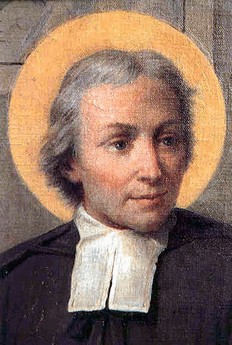
Saint Jean-Baptiste de la Salle: A Teacher for Teachers
Jean-Baptiste de la Salle (1651 – 1719), a French nobleman, ordained a priest, founded the first order in the Church’s history entirely without priests, and this came about almost by accident. I say ‘almost’, for, of course, there are no accidents with God. Destined for ordination from an early age, Jean-Baptiste never looked back, even[…]Continue reading→