
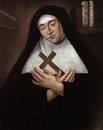
Marie of the Incarnation: A Canadian Mystic
Marie de l’Incarnation: Études de théologie spirituelle by Pierre Gervais, S.J.: A Review
Pierre Gervais is a Canadian-born Jesuit, professor of systematic, sacramental, and spiritual theology at the Institut d’Etudes Theologiques of Brussels as well as editor of the Nouvelle Revue Théologique. In his Foreword, Father Gervais explains the makeup of these “studies” or essays in spiritual theology based on the life and writings of Marie of the Incarnation (1599-1672), an Ursuline nun first of Tours (France) and then of Quebec. Different stages of Marie’s spiritual experience are examined as recounted in her own writings: the extant excerpts of the “Relation” of 1654 and a spiritual autobiography composed for her son (and only at his insistent request), Dom Claude Martin, who was a monk with the Benedictines of Saint-Maur. Gervais presents the general path of Marie’s spiritual journey, outlining the great stages of her growing awareness of her call to an apostolic and missionary vocation in New France. Particular aspects of Marie’s spiritual theology are tied in with special moments in her life but nevertheless have their parallels in present-day questions about the Christian life.
In describing her own spirituality, Marie does not normally use terms in a technical theological way, but her choice of words and distinctions are carefully made. The author analyzes closely Marie’s language and thought, interpreting them in more theological terms, while respecting Marie’s particular inspiration and experience. He also shows that, in spite of the distinctiveness of Marie’s spiritual experiences, it is perfectly consistent with Scripture. Marie’s descriptions of her spiritual experiences, like those of other mystics, can lead theologians to a fresh view of the mysteries of the Christian faith. For instance, Gervais analyzes an early stage in Marie’s spiritual journey, namely, the account (written in 1654) of her conversion of 1620: a vision of blood, followed by sacramental confession and a profound experience of God’s loving mercy. This analysis is applied to past and present pastoral thinking about the meaning of Christian conversion, including the steps involved in the sacrament of reconciliation. What Marie described in 1621 as a “new gift of prayer” was what we would term “evangelical contemplation,” i.e., prayer that centres on the person of Christ as found in the Gospels and leads to“an intimacy” with him in “his sacred mysteries from his birth to death.”
An analysis of traditional spiritual theology exhibits Marie’s overall conformity, in different language, with what Gervais calls “recent” Christian authors (including Thomas Aquinas, who died in 1275!). Her greatest contribution to mystical theology was Trinitarian. Marie’s visions of 1625, 1627, 1631, which moved beyond the senses and the imagination, were “three Trinitarian graces.” Marie distinguishes between her first Trinitarian experience (“grace of light”) and the last two (“grace all for love”). Her life long Marie recorded the growth of the special union with the Persons of the Trinity that was had been granted to her, and her prayer and apostolic vision were strongly marked by these Trinitarian “graces.” Marie’s spiritual relationship with the Persons of the Trinity was in close conformity with Scripture , especially with John’s Gospel. It was more “personalist” than the “essentialist” position generally adopted by theologians who have generally remained at a level comparable to Marie’s first “grace.” For Marie, the eternal Word, the second Person of the Trinity, alone is Spouse of the faithful soul. “Here,” Gervais says, “the Trinitarian mysticism of Marie of the Incarnation takes the exact opposite view of the common doctrine with respect to the Trinity’s indwelling.” His statements about the culminating third grace note her distinct relationship with each Person in a “mystery of alliance” with the Trinity.
Fifteen years after her conversion of 1620, Marie’s mysticism of union with the Trinity began developing into a mysticism of the missionary apostolate. In her “Relation” of 1654, fifteen years after her arrival in New France, Marie recalls that, while she was still in the convent at Tours, she received a personal revelation that somehow her life would be spent elsewhere (in spite of the rigid cloister imposed on religious women at the time). She gradually was led to understand she had an apostolic vocation. To be apostolic was not for her merely a question of saving souls. First and foremost, as Marie expressed it, “the apostolic spirit” was a fruit of the “the Spirit of Jesus Chris,” causing her “spirit to have life only in his,” to be completely absorbed by “the interests” of the divine “Master” and by “zeal for his glory, so that he might be known, loved and adored by all the nations redeemed by his precious Blood.” This spirit left her, with scriptural passages as evidence, to plead aggressively in her prayer like a lawyer, but driven by love: the Father owed it in strict justice to his Incarnate Word to establish Christ’s Kingdom everywhere because of his own repeated promises to the obedient Son who had already saved all people and to whom they now belonged by right. In all this, Marie had now become more ecclesial in spirit and thus a model for present-day religious communities in their apostolic missions.
Marie was the proponent of what Gervais calls “an apostolic type of mysticism,” a “mysticism of a new kind . . . in the history of spirituality, a mysticism that finds in apostolic commitment itself the basis of effective union with God.” There were two stages in this second great phase of her life. The first stage was a period of interior trials (1639-47): moments of self-accusation, emptiness, solitude of spirit, temptations to despair. It was a purgatory, even as she was aware of God present within. Throughout there was an underlying peace, even as she experienced unwillingly feelings of aggression and aversion for others. The second stage became the period of solid commitment to her missionary vocation (1647-72), beginning with an answer to her prayers to the Virgin Mary for deliverance from her trials. Marie’s spiritual growth during this new period was characterized by an astonishingly peaceful acceptance of God’s will after the catastrophic destruction of the Ursuline monastery by fire in 1650. For her, God is a good Father and Spouse. Though she was a cloistered nun, Marie’s union with the Trinity matured through her apostolate as foundress, evangelizer of the native peoples, and spiritual mother of the new Church. At no moment does one find in her a tension between contemplation and action.
Gervais summarizes his study by noting, “every spiritual text that flows from the heart heads to Scripture and makes it live anew; in this sense, however much [such a text] may mirror a particular person, language, and period, it transcends the limits of the past and remains rich in instruction for those who open their ears to it.” In fact, Father Gervais has put this principle into effect in directing eight-day retreats using as a guide Marie of the Incarnation’s spirituality and “states of prayer,” a type of retreat that may be different from the Ignatian approach but is not meant to replace it. As a variant for a certain stage in some persons’ lives, however, it will be appropriate and fruitful.

Carney’s Amoral Majority
After five defections – euphemistically described as ‘crossing the floor’ – and three by-elections, Mark Carney and his Liberals how have their coveted majority. One wonders what bowls of pottage were offered in back-room deals. In the archaic monarchical system that is the Dominion of Canada, this majority allows the newly-minted Prime Minister to rule[…]Continue reading→

Saint Kateri , Canada’s Protectress
This was the title given to Saint Kateri Tekakwitha, by Pope Benedict XVI, when he canonized her on October 28th, 2012, along with six others, in Saint Peter’ Square (she had been beatified by Pope John Paul II back in 1980). With Saint Joseph as our protector, along with the Canadian martyrs, we seem to[…]Continue reading→

Remembering Father Alphonse de Valk
(Today marks the sixth anniversary of the death of Father Alphonse de Valk, C.S.B., a faithful, courageous and indefatigable Basilian priest, pro-life-and-family apostle, and the founder of Catholic Insight magazine. Here is what we wrote those on his entering into eternity five years ago, as we continue to remember him in our prayers and thoughts)[…]Continue reading→

A Tale of Two Benedicts
A grace-filled Holy Week to all our readers! As we await and prepare for the Resurrection about to dawn upon us, we might keep in mind two Benedicts: Pope Emeritus Benedict XVI, requiescat in pace, elected on this day in 2005; and today’s commemoration of the mystic pilgrim, Benedict Joseph Labre, who died on this[…]Continue reading→

My Name is Bernadette
April 16th is a propitious day, for besides the anniversary of Father de Valk’s death, who founded Catholic Insight in its print form decades ago, and the commemoration of the ‘two Benedicts’, mentioned in accompanying posts, today we also recall Saint Bernadette Soubirous, the young visionary to whom the Virgin Mary appeared numerous times at[…]Continue reading→

Saint Lydwina of Schiedam and Suffering Joyfully
Saint Lydwina of Schiedam (1380 – 1433) was one of the countless and glorious ‘victim souls’ in the history of the Church, those whose lives are filled with suffering, often of an unimaginable intensity, but who suffer joyfully. She was a fifteen-year old Dutch girl, out skating one day, when she fell and broke one[…]Continue reading→

The Glorious Martyrdoms of Martin and Maximus
As we enter into Eastertide, we recall on this 13th of April Pope Saint Martin I (+655), one of the noblest, if most tragic, of the successors of Saint Peter. Born in Umbria, Italy, he was of noble lineage, with great intelligence combined with charity and love of the poor and the Church. While still[…]Continue reading→

Canonizing Sister Faustina and Divine Mercy
HOMILY OF THE HOLY FATHER MASS IN ST PETER’S SQUARE FOR THE CANONIZATION OF SR MARY FAUSTINA KOWALSKA Sunday, 30 April 2000 1. “Confitemini Domino quoniam bonus, quoniam in saeculum misericordia eius”; “Give thanks to the Lord for he is good; his steadfast love endures for ever” (Ps 118: 1). So the Church sings on the Octave of[…]Continue reading→

Divine Mercy Sunday – An Echo of Every Mass
Reach out your hand and put it in my side. Do not doubt but believe’… ‘My Lord and my God!’ (Jn. 20:18)). Today is Divine Mercy Sunday, and as we celebrate the end of the Easter Octave, we contemplate the wounded side of our Saviour, the Church’s source of life. On Good Friday in the[…]Continue reading→

Saint Stanislaus of Szczepanów
We celebrate Saint Stanislaus today (+ April 11, 1079), in light of this Easter Octave, a bishop and martyr who accepted the episcopacy only at the direct order of Pope Alexander II. He proved a wise and courageous leader of his flock, put to death by his own king, Boleslaus, for rebuking the monarch’s ‘immoral[…]Continue reading→