

A Dictionary of Modern English Usage
A Dictionary of Modern English Usage by H. W. Fowler
Oxford at the Clarendon Press, London, 1926
Split Infinitives. The English-speaking world may be divided into (1) those who neither know nor care what a split infinitive is; (2) those who do not know, but care very much; (3) those who know and condemn; (4) those who know and approve; and (5) those who know and distinguish.
1. Those who neither know nor care are the vast majority, and are a happy folk, to be envied by most of the minority classes; “to really understand” comes readier to their lips and pens than “really to understand,” they see no reason why they should not say it (small blame to them, seeing that reasons are not their critics’ strong point) and they do say it, to the discomfort of some among us, but not to their own.
2. To the second class, those who do not know but do care, who would as soon be caught putting their knives in their mouths as splitting an infinitive but have hazy notions of what constitutes that deplorable breach of etiquette, this article is chiefly addressed. These people betray by their practice that their aversion to the split infinitive springs not from instinctive good taste, but from tame acceptance of the misinterpreted opinion of others; for they will subject their sentences to the queerest distortions, all to escape imaginary split infinitives. “To really understand” is a split infinitive; “to really be understood” is a split infinitive; “to be really understood” is not one; the havoc that is played with much well-intentioned writing by failure to grasp that distinction is incredible. Those upon whom the fear of infinitive splitting sits heavy should remember that to give conclusive evidence, by distortions, of misconceiving the nature of the split infinitives is far more damaging to their literary pretensions than an actual lapse could be; for it exhibits them as deaf to the normal rhythm of English sentences.
No sensitive ear can fail to be shocked, if the following examples are read aloud, by the strangeness of the indicated adverbs. Why on earth, the reader wonders, is that word out of its place? He will find, on looking through again, that each has been turned out of a similar position, viz between the word “be” and a passive participle. Reflection will assure him that the cause of dislocation is always the same—all these writers have sacrificed the run of their sentences to the delusion that “to be really understood” is a split infinitive.
It is not; and the straitest non-splitter of us all can with a clear conscience restore each of the adverbs to its rightful place [for example, from a variety of newspaper articles]:
He was proposed at the last moment as a candidate likely generally to be accepted.
When the record of this campaign comes dispassionately to be written, and in just perspective, it will be found that
…
The leaders have given instructions that the lives and property of foreigners shall scrupulously be respected.
New principles will have boldly to be adopted if the Scottish case is to be met.
This is a very serious matter, which clearly ought to be further to be inquired into.
There are many points raised in the report which need carefully to be explored.
Only two ways of escaping from the conflict without loss, by this time become too serious squarely to be faced, have ever offered themselves.
The Headmaster of a public school possesses very great powers, which ought most carefully and considerately to be exercised.
The time to get this revaluation put through is when the amount paid by the State to the localities is very largely to be increased.
But the party whose Leader in the House of Commons acts in this way cannot fail deeply to be discredited by the way in which he flings out and about these false charges.
3. The above writers are bogyhaunted creatures who for fear of splitting an infinitive abstain from doing something quite different, i.e. dividing be from its complement by an adverb.
Those who presumably do know what split infinitives are, and condemn them, are not so easily identified, since they include all who neither commit the sin nor flounder about in saving themselves from it, all who combine with acceptance of conventional rules a reasonable dexterity. But when the dexterity is lacking, disaster follows. It does not add to a writer’s readableness if readers are pulled up now and again to wonder—why this distortion? Ah, to be sure, a non-split die-hard!
Photo credit: By William Hoiles from Basking Ridge, NJ, USA (Old books Uploaded by guillom) [CC-BY-2.0 (http://creativecommons.org/licenses/by/2.0)], via Wikimedia Commons.

Saint Kateri , Canada’s Protectress
This was the title given to Saint Kateri Tekakwitha, by Pope Benedict XVI, when he canonized her on October 28th, 2012, along with six others, in Saint Peter’ Square (she had been beatified by Pope John Paul II back in 1980). With Saint Joseph as our protector, along with the Canadian martyrs, we seem to[…]Continue reading→

Remembering Father Alphonse de Valk
(Today marks the sixth anniversary of the death of Father Alphonse de Valk, C.S.B., a faithful, courageous and indefatigable Basilian priest, pro-life-and-family apostle, and the founder of Catholic Insight magazine. Here is what we wrote those on his entering into eternity five years ago, as we continue to remember him in our prayers and thoughts)[…]Continue reading→

My Name is Bernadette
April 16th is a propitious day, for besides the anniversary of Father de Valk’s death, who founded Catholic Insight in its print form decades ago, and the commemoration of the ‘two Benedicts’, mentioned in accompanying posts, today we also recall Saint Bernadette Soubirous, the young visionary to whom the Virgin Mary appeared numerous times at[…]Continue reading→

Canonizing Sister Faustina and Divine Mercy
HOMILY OF THE HOLY FATHER MASS IN ST PETER’S SQUARE FOR THE CANONIZATION OF SR MARY FAUSTINA KOWALSKA Sunday, 30 April 2000 1. “Confitemini Domino quoniam bonus, quoniam in saeculum misericordia eius”; “Give thanks to the Lord for he is good; his steadfast love endures for ever” (Ps 118: 1). So the Church sings on the Octave of[…]Continue reading→

Divine Mercy Sunday – An Echo of Every Mass
Reach out your hand and put it in my side. Do not doubt but believe’… ‘My Lord and my God!’ (Jn. 20:18)). Today is Divine Mercy Sunday, and as we celebrate the end of the Easter Octave, we contemplate the wounded side of our Saviour, the Church’s source of life. On Good Friday in the[…]Continue reading→

First Holy Communion: Sermon from May 16, 1943
Here is a sermon from the good old days by +Rev. Msgr. Vincent Nicholas Foy (August 14, 1915 – March 13, 2017), from 1943. Readers may recall that Pope Saint Pius X, by the decree Quam Singulari in 1910, lowered the customary age of reception of Holy Communion – after the rigours of the plague[…]Continue reading→

In the Glorious Light of Easter, Alleluia!
Set your minds on things that are above, not on things that are on earth, for you have died, and your life is hidden with Christ in God. When Christ who is your life is revealed, then you also will be revealed with him in glory (Col. 3:3-4). The Resurrection of Our Lord and Saviour[…]Continue reading→

An Ancient Homily for Holy Saturday
The time between Good Friday and Easter Sunday is one of waiting, in silence, as the world wonders – anticipates – what will happen, after the death of Christ. We re-live this time each year in the anamnesis of our liturgy, and in turn look forward to the glorious re-creation of all things at the[…]Continue reading→

Europe’s Long Descent
(As we meditate on this day on Christ’s burial, and His descent into hell, it is fitting to ponder here with contributor Peter Marcus how the world seems to be heading there as well. The difference is that, although God cannot ‘redeem’ hell, nor those therein, He can and did redeem the world. There is[…]Continue reading→
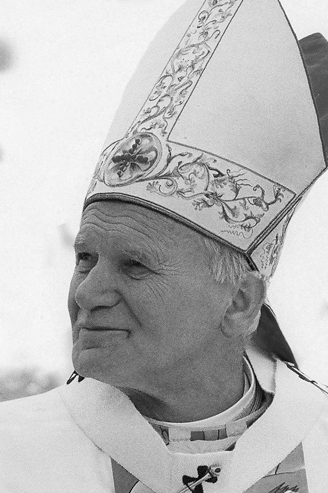
Pope Saint John Paul II’s First Good Friday Homily
ADDRESS OF HIS HOLINESS JOHN PAUL II AT THE CONCLUSION OF THE STATIONS OF THE CROSS AT THE COLOSSEUM Good Friday, 13 April 1979 When we make the Way of the Cross from one station to the next, in spirit we are always at the spot wherethis journey had its “historical” place: where it[…]Continue reading→