

The Children’s Catechism
The Catholic Church and Philosophy by Fr. Vincent McNabb, OP
London, Burns, Oates, and Washbourne, Ltd. Publishers to the Holy See, 1927
But indeed it is not the priest only who received a grounding in philosophy as a preparation for life. Even the Catholic child—I had almost said, especially the Catholic child—in the poor schools is supposed to have an implicit knowledge of philosophy which is a high compliment to its intelligence. The Catholic Church speaks nobly of children reaching the age of reason. Moreover, with profound insight into human nature, she puts this age not at forty or twenty-one years, but at seven years, when she teaches children their first lesson in freedom by helping them to see and say out (confess) their sins.
Before these little ones are thought fit to make their first declaration of their free-will by acknowledging their faults, and therefore their power, they are prepared by a noble handbook of philosophy, fitly called The Children’s Catechism. As every country has its own method of writing and arranging this catechism, we take for our present purpose the catechism which, within a stone’s throw of where I am now writing, is being taught to children of perhaps the most crowded slumland in the world. In sheer philosophic gratitude let me set down the first eight questions of this appeal made by Alma Mater Ecclesia, Dear Mother Church, to the philosophic intelligence of her children of seven!
Q1 Who made you? Ans. God made me.
Q2 Why did God make you? Ans. God made me to know Him, love Him, and serve Him in this world, and to be happy with Him forever in the next.
Q3 To whose image and likeness did God make you? Ans. God made me to His own image and likeness.
Q4 Is this likeness to God in your body, or in your soul? Ans. This likeness is chiefly in my soul.
Q5 How is your soul like to God? Ans. My soul is like to God because it is a spirit and is immortal.
Q6 What do you mean when you say that your soul is immortal? Ans. When I say that my soul is immortal I mean that it can never die.
Q7 Of which must you take most care, of your body or your soul? Ans. I must take most care of my soul; for Christ has said, “What doth it profit a man if he gain the whole world and suffer the loss of his own soul?” (Mt 16:26)
Q8 What must you do to save your soul? Ans. To save my soul I must worship God by Faith.
This fragment of literature torn from the front page of a catechism for the seven-year-old children of the poor is, for the present writer, a priceless gem-book of literature and philosophy.
In the realm of letters, is there any masterpiece in any language that opens so dramatically as this, with its almost fierce accosting question, “Who made you?”
If, since the time of Genesis and Plato, dialogue has been looked upon as a supreme form of literature, is there any more dramatic dialogue than this traffic of question and answer between the wisest institution in the world—and a child of seven?
But even the literary value of this page is less than its value in philosophy. So much sound Greek thought has been assimilated in this Catholic “milk for babes” that these schools of Catholic children, and especially of Catholic poor children, are becoming the last homes of a liberal education. … Especially remarkable is the acceptance of that great Greek generalisation—the Four Causes.
Who made you? (Efficient Cause.)
Why did God make you? (Final Cause.)
To whose image and likeness did God make you? (Formal Exemplar Cause.)
Is this likeness to God in your body (Material Cause) or in your soul (Formal Internal Cause)?
Now the present writer, who has taught not only children but university students for some thirty-two years, bears psychological witness to the fact that little children even from the poorest classes usually give not a notional, but a real assent to these questions. The men who ask for a simpler creed not infrequently are ignorant of the child-mind, and in their ignorance, for something, like a primrose or a toy, which the child can understand but cannot explain, they substitute something like progress or evolution or ether, which the child-mind can neither explain nor understand!
Notice how deftly that part of philosophy called ethics (Q7) is based upon that part of philosophy called metaphysics (Q1, Q2, Q3) and psychology (Q4, Q5, Q6). Notice again how Descartes’ discovery that truth should be investigated sectionally is here made to build up, stone upon stone, an unshakable fortress of truth. Hardly a spear-point of attack could find a fissure between the perfectly fitting courses of the structure. As a synthesis of thought it is masterly. Or again notice that the great truths underlying these questions are all within the discovery of human reason, yet human reason is not merely patient but expectant of faith (Q8).
It will or should be conceded that an institution which offers even its children such solid philosophical food is doing its duty by philosophy.
Photo credit: By William Hoiles from Basking Ridge, NJ, USA (Old books Uploaded by guillom) [CC-BY-2.0 (http://creativecommons.org/licenses/by/2.0)], via Wikimedia Commons.

Saint Kateri , Canada’s Protectress
This was the title given to Saint Kateri Tekakwitha, by Pope Benedict XVI, when he canonized her on October 28th, 2012, along with six others, in Saint Peter’ Square (she had been beatified by Pope John Paul II back in 1980). With Saint Joseph as our protector, along with the Canadian martyrs, we seem to[…]Continue reading→

Remembering Father Alphonse de Valk
(Today marks the sixth anniversary of the death of Father Alphonse de Valk, C.S.B., a faithful, courageous and indefatigable Basilian priest, pro-life-and-family apostle, and the founder of Catholic Insight magazine. Here is what we wrote those on his entering into eternity five years ago, as we continue to remember him in our prayers and thoughts)[…]Continue reading→

My Name is Bernadette
April 16th is a propitious day, for besides the anniversary of Father de Valk’s death, who founded Catholic Insight in its print form decades ago, and the commemoration of the ‘two Benedicts’, mentioned in accompanying posts, today we also recall Saint Bernadette Soubirous, the young visionary to whom the Virgin Mary appeared numerous times at[…]Continue reading→

Canonizing Sister Faustina and Divine Mercy
HOMILY OF THE HOLY FATHER MASS IN ST PETER’S SQUARE FOR THE CANONIZATION OF SR MARY FAUSTINA KOWALSKA Sunday, 30 April 2000 1. “Confitemini Domino quoniam bonus, quoniam in saeculum misericordia eius”; “Give thanks to the Lord for he is good; his steadfast love endures for ever” (Ps 118: 1). So the Church sings on the Octave of[…]Continue reading→

Divine Mercy Sunday – An Echo of Every Mass
Reach out your hand and put it in my side. Do not doubt but believe’… ‘My Lord and my God!’ (Jn. 20:18)). Today is Divine Mercy Sunday, and as we celebrate the end of the Easter Octave, we contemplate the wounded side of our Saviour, the Church’s source of life. On Good Friday in the[…]Continue reading→

First Holy Communion: Sermon from May 16, 1943
Here is a sermon from the good old days by +Rev. Msgr. Vincent Nicholas Foy (August 14, 1915 – March 13, 2017), from 1943. Readers may recall that Pope Saint Pius X, by the decree Quam Singulari in 1910, lowered the customary age of reception of Holy Communion – after the rigours of the plague[…]Continue reading→

In the Glorious Light of Easter, Alleluia!
Set your minds on things that are above, not on things that are on earth, for you have died, and your life is hidden with Christ in God. When Christ who is your life is revealed, then you also will be revealed with him in glory (Col. 3:3-4). The Resurrection of Our Lord and Saviour[…]Continue reading→

An Ancient Homily for Holy Saturday
The time between Good Friday and Easter Sunday is one of waiting, in silence, as the world wonders – anticipates – what will happen, after the death of Christ. We re-live this time each year in the anamnesis of our liturgy, and in turn look forward to the glorious re-creation of all things at the[…]Continue reading→

Europe’s Long Descent
(As we meditate on this day on Christ’s burial, and His descent into hell, it is fitting to ponder here with contributor Peter Marcus how the world seems to be heading there as well. The difference is that, although God cannot ‘redeem’ hell, nor those therein, He can and did redeem the world. There is[…]Continue reading→
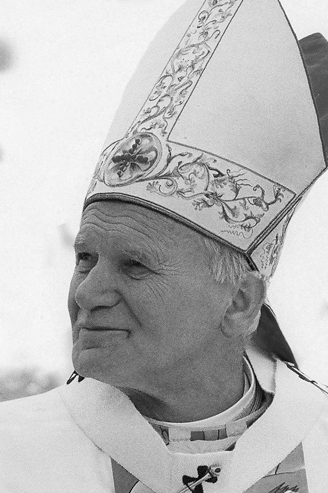
Pope Saint John Paul II’s First Good Friday Homily
ADDRESS OF HIS HOLINESS JOHN PAUL II AT THE CONCLUSION OF THE STATIONS OF THE CROSS AT THE COLOSSEUM Good Friday, 13 April 1979 When we make the Way of the Cross from one station to the next, in spirit we are always at the spot wherethis journey had its “historical” place: where it[…]Continue reading→