
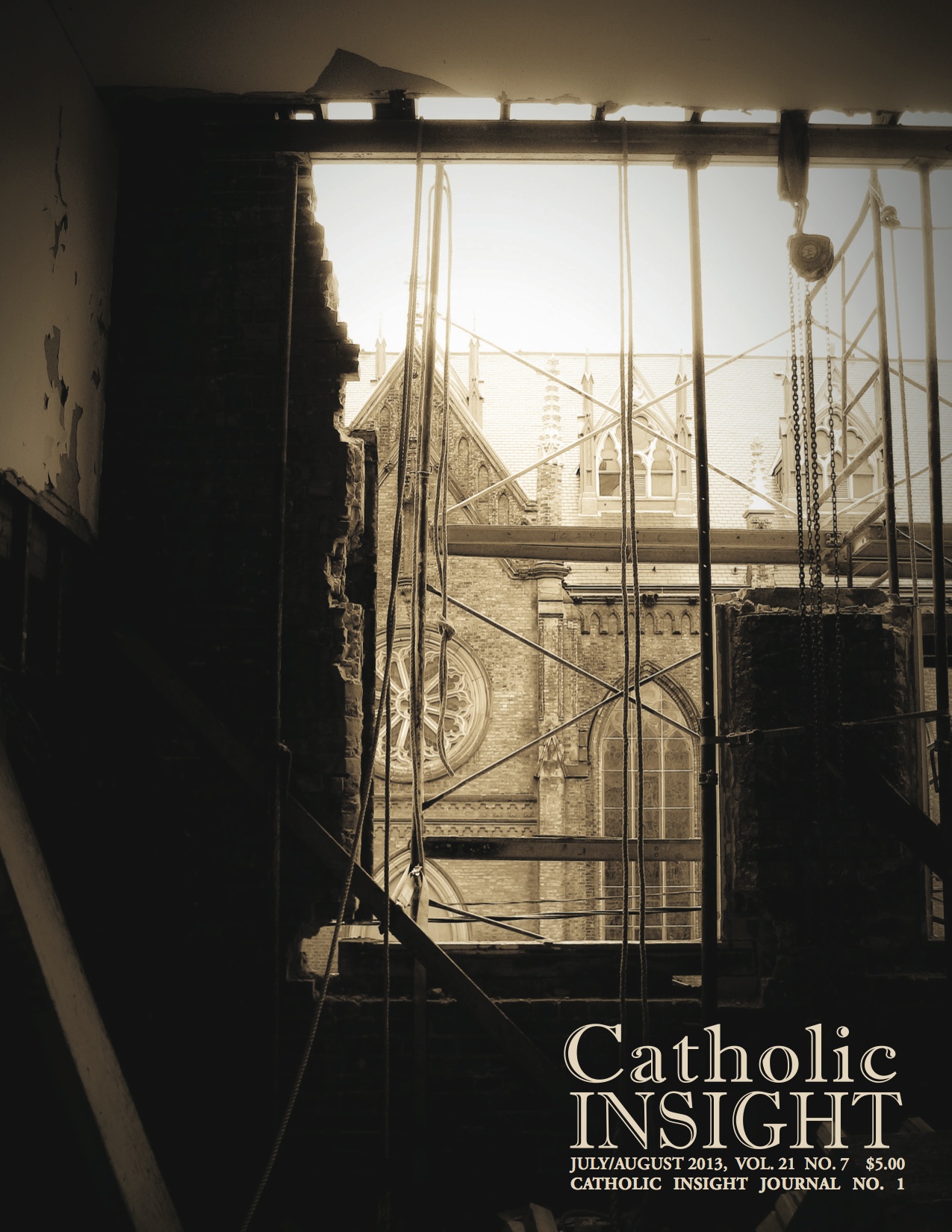
Cathedral
Our July/August 2013 cover artist is Jonathan Castellino, a hobby urban archaeologist and photographer based in the city of Toronto. His photographs document the intersection of built environment and cultural landscape as it speaks to the social imagination. While focusing primarily on contemporary urban ruins, his work also tends to take a broader perspective, examining the place and meaning of these spaces in urban life.
What is this piece about?
This photograph is part of a series entitled “empty.vessels.” The circumstance of the image is a cathedral as seen from an abandoned parsonage undergoing demolition in downtown Toronto. Much of my photography concerns itself with derelict space—that is to say, places after people. I find former places of worship particularly intriguing and have been exploring and documenting them for years. I am always curious to see what remains. Urbanites find modern ruins difficult to stomach. The combined effect of a poorly developed imagination and economics always seem stacked against the decaying buildings. Not wanting to give in to the creeping cultural amnesia actively pursued by many city planners, I try to document these places—to give them one last breath—before they disappear. The building from which this image was taken is now a parking lot.
When did you start taking photographs?
I began making photographs about a decade ago. I had had a pedestrian interest in photography as art before that point, but only began to turn my own snapshots into compositions ten years ago.
From whom or what did you learn?
Learning has a great deal to do with listening. I am a terrible listener, but I am working on it. I am not sure about mentors as such, since I am not formally trained in photography. I would say that music has likely been my greatest teacher. And cities. And friends.
Why did you continue in the medium? What draws you to it?
I always hold that photography is a lived experience that happens to manifest itself in the images we see. Continuation, then, is a function of inspiration. As long as people continue to interact with their built environment in interesting ways, I will continue to photograph them doing so. I am naturally drawn to the city—to its creation, its elements of ruin, and to exploring the hidden, too often unseen, spaces within it.
What do you do with your pieces? Are they ever shown? Are they for sale?
I try to make my images available to as many people as possible. My mission is to encourage people to explore the built world around them. Fortunately, my work has found its way into newspapers, magazines, journals, websites, galleries, and, recently, television—any public space, physical or electronic, is fair game as far as I am concerned. I maintain a website daily (sacramentalperception.com), but have no real control over where interest comes from. Unfortunately, some people are drawn solely to the subversive elements within my work (necessary trespassing, et cetera). Like all things, it is open to misuse. I have no control over this.
How would you define beauty?
Beauty defines life. Or of what it should consist. That we are allowed to participate in its Mystery is our joy. We have tried, as is our wont, to control it. In the process, we have created an economy of the aesthetic. We expect it, and cannot accept it as a freely given gift. As an artist, to try and place manufactured barriers on its fullness at one end limits experience, and at the other is an attempt to constrain what is fundamentally beyond description—and yet observable through lived experience (if we are open to it).
What is the purpose of art?
The role or purpose of art in our lives is to serve as a reminder. We have a sense that the world of perception is illusive and created. Through the acceptance of the gifts of beauty we feel that we are able to draw back the veil cast over our senses, if only briefly, and stare into a greater communion. We are partial to art. That is to say, it is incomplete without us.
Who inspires you and what inspires you?
Inspiration comes in the form of an experience. Experiences have impact. What impacts me (and my work by relation) is constantly evolving. For the present, it is the work of great artists, among them writers: W. G. Sebald, Annie Dillard, T. S. Eliot, and George Steiner come immediately to mind. These are writers whose unique visions of our interaction with and dealings with life shock and astound me. Their work offends what the majority of my senses are told, on a daily basis, to believe. In a word, they are hopeful.

Saint Kateri , Canada’s Protectress
This was the title given to Saint Kateri Tekakwitha, by Pope Benedict XVI, when he canonized her on October 28th, 2012, along with six others, in Saint Peter’ Square (she had been beatified by Pope John Paul II back in 1980). With Saint Joseph as our protector, along with the Canadian martyrs, we seem to[…]Continue reading→

Remembering Father Alphonse de Valk
(Today marks the sixth anniversary of the death of Father Alphonse de Valk, C.S.B., a faithful, courageous and indefatigable Basilian priest, pro-life-and-family apostle, and the founder of Catholic Insight magazine. Here is what we wrote those on his entering into eternity five years ago, as we continue to remember him in our prayers and thoughts)[…]Continue reading→

My Name is Bernadette
April 16th is a propitious day, for besides the anniversary of Father de Valk’s death, who founded Catholic Insight in its print form decades ago, and the commemoration of the ‘two Benedicts’, mentioned in accompanying posts, today we also recall Saint Bernadette Soubirous, the young visionary to whom the Virgin Mary appeared numerous times at[…]Continue reading→

Canonizing Sister Faustina and Divine Mercy
HOMILY OF THE HOLY FATHER MASS IN ST PETER’S SQUARE FOR THE CANONIZATION OF SR MARY FAUSTINA KOWALSKA Sunday, 30 April 2000 1. “Confitemini Domino quoniam bonus, quoniam in saeculum misericordia eius”; “Give thanks to the Lord for he is good; his steadfast love endures for ever” (Ps 118: 1). So the Church sings on the Octave of[…]Continue reading→

Divine Mercy Sunday – An Echo of Every Mass
Reach out your hand and put it in my side. Do not doubt but believe’… ‘My Lord and my God!’ (Jn. 20:18)). Today is Divine Mercy Sunday, and as we celebrate the end of the Easter Octave, we contemplate the wounded side of our Saviour, the Church’s source of life. On Good Friday in the[…]Continue reading→

First Holy Communion: Sermon from May 16, 1943
Here is a sermon from the good old days by +Rev. Msgr. Vincent Nicholas Foy (August 14, 1915 – March 13, 2017), from 1943. Readers may recall that Pope Saint Pius X, by the decree Quam Singulari in 1910, lowered the customary age of reception of Holy Communion – after the rigours of the plague[…]Continue reading→

In the Glorious Light of Easter, Alleluia!
Set your minds on things that are above, not on things that are on earth, for you have died, and your life is hidden with Christ in God. When Christ who is your life is revealed, then you also will be revealed with him in glory (Col. 3:3-4). The Resurrection of Our Lord and Saviour[…]Continue reading→

An Ancient Homily for Holy Saturday
The time between Good Friday and Easter Sunday is one of waiting, in silence, as the world wonders – anticipates – what will happen, after the death of Christ. We re-live this time each year in the anamnesis of our liturgy, and in turn look forward to the glorious re-creation of all things at the[…]Continue reading→

Europe’s Long Descent
(As we meditate on this day on Christ’s burial, and His descent into hell, it is fitting to ponder here with contributor Peter Marcus how the world seems to be heading there as well. The difference is that, although God cannot ‘redeem’ hell, nor those therein, He can and did redeem the world. There is[…]Continue reading→
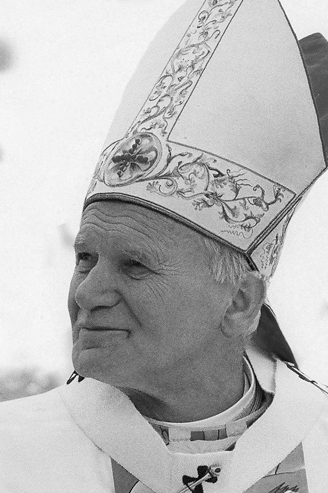
Pope Saint John Paul II’s First Good Friday Homily
ADDRESS OF HIS HOLINESS JOHN PAUL II AT THE CONCLUSION OF THE STATIONS OF THE CROSS AT THE COLOSSEUM Good Friday, 13 April 1979 When we make the Way of the Cross from one station to the next, in spirit we are always at the spot wherethis journey had its “historical” place: where it[…]Continue reading→