
The Catholic Land Movement
Fr. Vincent McNabb, O.P., S.T.M., from the Catholic Land Movement: it’s motives.
C.T.S.: London, 1932.
Out of Egypt have I called my son (Mt 2:15, Jer 3:15).
Let us then set down in order some of the main motives that have led these Catholics to see in obedience to the Holy Father in this particular matter not only a generally right and desirable thing for Christendom to do…
FIRST AND PRINCIPAL MOTIVE: TO WORSHIP GOD
Like the chosen people they are minded to leave the flesh pots of Egypt, not for the “milk and honey” of the Promised Land, but that the people may go and worship God (Ex 6).
They wish to put first things first. Their law, or rule, like the law of the people of God, begins: I am the Lord, thy God, that brought thee out of the Land of Egypt and out of the house of bondage. Thou shall not have strange gods before Me (Ex 20:2, 3). Not only will they not worship by desire what is wrong—like Mammon—but they will not desire as a primary good what is only a secondary good. Thus they will leave the ugliness of the town, not for the beauty of the land, but for the beauty of God’s face; they will fly from the disease of the town, not for the health of the body, but for the health of the soul; they will cut the tangled complexity of town life, not for the simple life with nature, but for the quiet life with God.
SECOND GREAT MOTIVE:TO FOLLOW CHRIST
Moreover, as a greater than Moses has, by His death on the Cross, led them out of a greater bondage than that of Egypt, the God whom they worship and would follow is He whose name was written on the Cross as JESUS OF NAZARETH.
Now Jesus of Nazareth, the Word made Flesh, did not come into our midst to show flesh and blood an example, but to be its Redeemer.
Man’s power of willing what he knew had always been so much less than his power of knowing what to will that what he needed most was not leadership or even example making a plain way still plainer, but redemption making his weak human will stronger.
Now what must be said of the human race in the days before the coming of Jesus must be said today. If we may believe two popes who have written about social matters, mankind has done wrong so effectively that social good has to be, not only stored, but restored. An evil or a mistaken past must now be redeemed at a great price. But only the weights and measures of Nazareth will give individuals and nations the ownership and sovereignty of their own souls. The modern world needs redemption; and redemption means a return to Nazareth. It is for this reason that over the lintel of every home and homestead we would build on the land might well be cut in stone:
And He went down with them and came to Nazareth and was subject to them (Lk 2:51).
THIRD MOTIVE: FAMILY LOVE
One of the most explicit motives of those who are turning their faces towards the land is the desire to restore the Catholic Family. Most of the older men and women who can themselves remember parents and grandparents know that the modern arrangement of the world has put an end to the historic institution called HOME. Many of the younger men and women, too, realise as if by intuition that a state of things that makes race-suicide seem to be the only practical policy is only a state of chaos—if, indeed, it can be called a state.
The splendid vision of wedded love, granted by God to the heart of youth, seems but divine mockery when met by town conditions, which make the begetting of a family seem a crime against the State.
It is to the credit of our sober days that amongst the most sober fugitives from that proximate occasion of sin called “the modern town” are to be found young men and women whose heart is stirring with the self-sacrificial desires of wedlock and parenthood.
It is in these aspirants to wedded vows that that poor prodigal, man, turns from the squalor of a stye and the company of swine to a home furnished and adorned with husband and wife, parent and child.
In that holy place of human love, room and need will be found for the parent, now become the grandfather or grandmother. How ill-organised is a world that has no other place than an “Institution,” a Workhouse, for the wisdom of the old. But what a school of human and divine love, and therefore of wisdom that springs from love, is a Home made possible and safe by the Homestead. Modern seekers after the true method of education will seek in vain until they recognise the wisdom in the phrase once uttered by a woman of the crowd: “I had nothing but home-schooling.”
Yet the home-schooling now almost absent from town life is so fundamental that, in another phrase of a Priest of God: “Political Economy is the child of Domestic Economy.” This only says, in language of the Schools, that God has made the Family to be the unit and model of the State, and that the greatest praise of Sovereign Power is to call the wielder of that power the “Father of his People.”

Carney’s Amoral Majority
After five defections – euphemistically described as ‘crossing the floor’ – and three by-elections, Mark Carney and his Liberals how have their coveted majority. One wonders what bowls of pottage were offered in back-room deals. In the archaic monarchical system that is the Dominion of Canada, this majority allows the newly-minted Prime Minister to rule[…]Continue reading→

A Tale of Two Benedicts
A grace-filled Holy Week to all our readers! As we await and prepare for the Resurrection about to dawn upon us, we might keep in mind two Benedicts: Pope Emeritus Benedict XVI, requiescat in pace, elected on this day in 2005; and today’s commemoration of the mystic pilgrim, Benedict Joseph Labre, who died on this[…]Continue reading→

Saint Lydwina of Schiedam and Suffering Joyfully
Saint Lydwina of Schiedam (1380 – 1433) was one of the countless and glorious ‘victim souls’ in the history of the Church, those whose lives are filled with suffering, often of an unimaginable intensity, but who suffer joyfully. She was a fifteen-year old Dutch girl, out skating one day, when she fell and broke one[…]Continue reading→

The Glorious Martyrdoms of Martin and Maximus
As we enter into Eastertide, we recall on this 13th of April Pope Saint Martin I (+655), one of the noblest, if most tragic, of the successors of Saint Peter. Born in Umbria, Italy, he was of noble lineage, with great intelligence combined with charity and love of the poor and the Church. While still[…]Continue reading→

Saint Stanislaus of Szczepanów
We celebrate Saint Stanislaus today (+ April 11, 1079), in light of this Easter Octave, a bishop and martyr who accepted the episcopacy only at the direct order of Pope Alexander II. He proved a wise and courageous leader of his flock, put to death by his own king, Boleslaus, for rebuking the monarch’s ‘immoral[…]Continue reading→

Saint Gemma Galgani
On this April 11th, in 1903 – the same year that the Italian Guiseppe Sarto was elected Pope later that summer as Pius X – a lovely, young Italian woman died, by the name of Gemma Galgani. She lived a brief life of 24 years, as did a number of other young saints, including Pier[…]Continue reading→
An Ideological and Improper Translation
I noticed something odd with the psalm reading at Mass the other day. Our bishops’ conference here in Canada has decreed that the Mass in English – Novus Ordo – use the ‘NRSV’, the ‘New Revised Standard Version’, an ‘updated’ translation of the original RSV, first published in 1952. This ‘new translation’ has the tendency[…]Continue reading→
Saint Jean-Baptiste de la Salle: A Teacher for Teachers
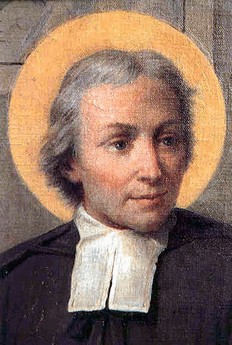
Jean-Baptiste de la Salle (1651 – 1719), a French nobleman, ordained a priest, founded the first order in the Church’s history entirely without priests, and this came about almost by accident. I say ‘almost’, for, of course, there are no accidents with God. Destined for ordination from an early age, Jean-Baptiste never looked back, even[…]Continue reading→
Three Easter Musical Gems: Bach, Palestrina and Byrd
A very blessed and glorious Easter! Christus surrexit vere, alleluia! As we begin this Easter Octave with the great Solemnity of Easter, music to lift the soul would be one of Bach’s Easter cantatas, composed during his time at Leipzig in the early 1700’s, for the six Sundays of this festive season, leading up to[…]Continue reading→
Good Friday and Suffering
Evil and pain is always a mystery, that whole mysterium iniquitatis, of which Saint Paul writes (2 Thess 2:7). In 1984, Pope Saint John Paul II penned an Apostolic Letter on the nature and purpose of human suffering, Salvifici Doloris (curiously, now looking back, the same year he made his first apostolic journey to Canada).[…]Continue reading→