
Wherefore art thou, Modesty?
It may seem a bit odd to speak of modesty when the weather outside is frightful—at least roundabout where I live in rural Ontario. But modesty is not just an outdoors virtue, as a trip anywhere—from the grocery store to the office staff party to the local yoga class—will demonstrate. In the words of the Bard,”Can it be that modesty may more betray our sense than woman’s lightness? Having waste ground enough, shall we desire to raze the sanctuary and pitch our evils there?”
With wars and rumors of wars, tumults and tsunamis, we might ask whether we should worry about modesty. But there is that warning from Fatima, and it is in small fidelities that virtue is to be found. What seems an insignificant error at first can grow into grievous vices. Our world is awash in sexual malfeasance with all of its attendant evils—from prostitution to abortion—and much of it has its beginnings in a lack of modesty.
We might find it difficult to define modesty as a virtue, but we all agree—to some extent—that it should exist. Some things simply should not be seen by most people. The question is all about where to draw the hemline.
To offer some glimpse into the current mind-set, one of my female students—they are all Catholic—mentioned in passing to another female student—yes, this is one of those reports—that it is entirely the “guy’s fault” if he has impure thoughts about her, regardless of what she chooses to wear, or not to wear, as the case may be. Now, the students whom I have the honor of teaching are all practicing their faith and relatively well educated, having absorbed at least a smattering of the Catechism and theology, so I must suppose that she has in mind some echo of that prelapsarian Eutopia, when we were in the paradisiacal garden—as the Vulgate has it—nudus et non erubescebant, i.e., “naked, and not ashamed.” Or, to be more literal, not “blushing” nor “turning red.”
We have now lost that state of paradise, which was more of a way of being than a physical place, when all of our powers, our passions, desires, will, and reason were perfectly integrated and ordered without deviation to our final end—God. Sexual arousal and intimacy in this state between the first Man and Woman would only have occurred at the fitting time, under the sway of reason, grace, and God’s will, with no shame, blushing, awkwardness or lack of trust and commitment.
But we are no longer in the garden—or in that state—and, with the original couple’s rebellion against God, sin in the broad sense has inundated not only the world, but our very souls. This condition we call original sin is described by Saint Thomas as an overall “disposition to sin,” experienced primarily in those disordered movements of the passions contrary to reason, especially the more vehement ones related to food and sex. Our philosophical and Catholic tradition calls this “concupiscence,” and it is worsened every time we indulge it immoderately.
Hence, we are no longer naked and without shame, but rather naked and with a healthy—or sometimes unhealthy—dose of shame.
One might argue, and many have, that this is all a myth, that there is nothing wrong with the human body nor our reactions to other human bodies, that we should get over our shame-inducing hang-ups, and, as the ’70s idiotic idiom had it, let it all hang out. Certain educational theories, in Europe especially, are experimenting with this theory, allowing youngsters, even in elementary schools, of the opposite and same sex to “explore” each other’s bodies—with obvious scandalous and corruptive results. And I have read of an “evangelical” nudist colony somewhere in Florida attempting to re-create the Garden, replete, no doubt, with a wrinkly old pastor. No one aged or was corpulent in paradise.
There is only so much control we can gain in this area, for God made the sexual appetite strong indeed (as Saint Thomas argues, so we would propagate the species and stay together as husband and wife). Furthermore, most people—in fact, everyone really—do not have perfect bodies, and so being open to the “gaze” of others unprotected by the promise of perpetual love is to open oneself to lust, being used, humiliation, and eventual rejection and abandonment.
Hence, we must, like the original couple in the garden after their “eyes were opened,” hide our nakedness with proper clothing. This is what most of us think of in terms of modesty, defined in the Catechism as “refusing to unveil what should remain hidden” (#2521), i.e., to cover up what should be covered. We should keep in mind, however, that this principle applies not just to our clothing, but also to how we move and present our bodies, to our speech, affections, and even our very thoughts.
By unveiling what should not be unveiled, we are inviting the other to sin, or at least entertain sinful thoughts which are an inducement to sinful acts. And since men tend to be more visual and immediate in their sexual appetites, such bodily modesty falls somewhat more upon the fairer sex. But the principles are the same for both.
The Sin of Scandal
Hence, the virtue of modesty can only be understood in connection with the sin of scandal, which, like modesty, is something forgotten or misunderstood. Most people have only seen the word preceded by “priest,” alas.
But Christ had much to say about scandal, a word derived from the Greek verb to “fall” or the noun “obstacle that causes a fall.” When applied to the spiritual domain, scandal has two types (cf., II-II, 43.1, ad 4): On the one hand, active scandal is doing something that may or may not be itself sinful but which leads another person into sin. On the other hand, passive scandal is allowing oneself to be led into sin by another, which is always a sin, for we must consent to such an act with our will, and we may always resist. An act that is fully coerced is not a voluntary act, and hence not imputable to the agent, and therefore not a sin.
Since we are our brother’s keeper, Saint Paul advises avoiding active scandal whenever possible, even in those things not in themselves sinful. As he puts it, he will avoid eating meat sacrificed to an idol—not sinful in the Christian dispensation—if doing so will lead “weaker brethren” into sin.
We should have some awareness of how we appear to others, given that the concupiscent inclination to sin is present in all of us and is exacerbated by all of our personal sins. So the young woman we quoted above was at least partly wrong. It is not always entirely the “guy’s fault,” hence there exists what we may call “scandalous clothing.” On the other hand, it may be his fault when the most modest of apparel does not discourage sinful thoughts in those who have little governance over themselves.
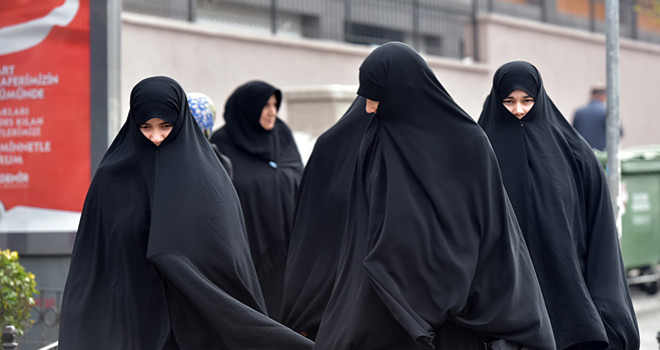
How far do we go with this? It depends on context, intention, and circumstances, as Pope John Paul II explains in his masterful Love and Responsibility (a fine recent translation is available here) written in the 1950s while then-Karol Wojtyla was preparing young people for the great adventure of marriage. What is modest at the beach is not modest in the classroom, and modesty also varies across cultures. Certain strains of Islam take this to an extreme, shrouding women to resemble living body bags. These practices draw ridicule from the secular liberal press which objects to calls for a return to modesty—despite the rise of a pro-Muslim puritanical feminism resulting in a muddling of previously settled political categories. If there is a vice that is contrary to immodesty—one that veils what should be revealed—it is signified by certain forms of Muslim dress such as the burka, which is designed to hide the female face.
For even the most “modest” of religious habits in consecrated life—in which the body is offered as a sacred gift to God in anticipation of the resurrection—allows the face to be seen. It is no coincidence that the Greek word for face, prosopon, was also the term for person in the early Church.
But some parts of the body should—in the main—always be covered and not just covered, but also not revealed by such apparel as skintight yoga pants. And all the worse if these parts are presented in an explicitly sexual, provocative manner. The nudity portrayed in the Last Judgement on the ceiling of the Sistine chapel is symbolic, non-sexual, and arguably not immodest, even if the artist Daniele da Volterra was hired after Michelangelo’s death to put loincloths on what some considered the more racy nudes. Compare this with the nudity in such venues as the now-defunct print version of Playboy—crude and explicitly voyeuristic.
Hence, as Pope John Paul II frames the question, nudity may be more or less overtly “sexual,” and the only domain in which such sexual nudity is permitted is within the intimacy of marriage. Here, the self-surrender or “unveiling” is protected by the irrevocable promises and grace of the sacrament.
If both sexes were to rediscover this truth of sex—to guard what should be guarded, until given as a gift to the other—the world, I posit, would be changed overnight, and all for the better.
I suppose we should always see modesty not as an imposition, but rather as an act of love, of that divine agape which wills the good of the other, so that the beauty and vulnerability of these earthen vessels might be revealed at the right time and in the right way. Just as at the end of time, in that resurrection of all flesh, when the “veil” of the mortal flesh of our animal bodies will be mysteriously transformed in the resurrection, when our true and ultimate nature will be revealed in all its glory.
(This essay first appeared in Crisis magazine on January 9th, 2019)

Carney’s Amoral Majority
After five defections – euphemistically described as ‘crossing the floor’ – and three by-elections, Mark Carney and his Liberals how have their coveted majority. One wonders what bowls of pottage were offered in back-room deals. In the archaic monarchical system that is the Dominion of Canada, this majority allows the newly-minted Prime Minister to rule[…]Continue reading→

Saint Kateri , Canada’s Protectress
This was the title given to Saint Kateri Tekakwitha, by Pope Benedict XVI, when he canonized her on October 28th, 2012, along with six others, in Saint Peter’ Square (she had been beatified by Pope John Paul II back in 1980). With Saint Joseph as our protector, along with the Canadian martyrs, we seem to[…]Continue reading→

Remembering Father Alphonse de Valk
(Today marks the sixth anniversary of the death of Father Alphonse de Valk, C.S.B., a faithful, courageous and indefatigable Basilian priest, pro-life-and-family apostle, and the founder of Catholic Insight magazine. Here is what we wrote those on his entering into eternity five years ago, as we continue to remember him in our prayers and thoughts)[…]Continue reading→

A Tale of Two Benedicts
A grace-filled Holy Week to all our readers! As we await and prepare for the Resurrection about to dawn upon us, we might keep in mind two Benedicts: Pope Emeritus Benedict XVI, requiescat in pace, elected on this day in 2005; and today’s commemoration of the mystic pilgrim, Benedict Joseph Labre, who died on this[…]Continue reading→

My Name is Bernadette
April 16th is a propitious day, for besides the anniversary of Father de Valk’s death, who founded Catholic Insight in its print form decades ago, and the commemoration of the ‘two Benedicts’, mentioned in accompanying posts, today we also recall Saint Bernadette Soubirous, the young visionary to whom the Virgin Mary appeared numerous times at[…]Continue reading→

Saint Lydwina of Schiedam and Suffering Joyfully
Saint Lydwina of Schiedam (1380 – 1433) was one of the countless and glorious ‘victim souls’ in the history of the Church, those whose lives are filled with suffering, often of an unimaginable intensity, but who suffer joyfully. She was a fifteen-year old Dutch girl, out skating one day, when she fell and broke one[…]Continue reading→

The Glorious Martyrdoms of Martin and Maximus
As we enter into Eastertide, we recall on this 13th of April Pope Saint Martin I (+655), one of the noblest, if most tragic, of the successors of Saint Peter. Born in Umbria, Italy, he was of noble lineage, with great intelligence combined with charity and love of the poor and the Church. While still[…]Continue reading→

Divine Mercy Sunday – An Echo of Every Mass
Reach out your hand and put it in my side. Do not doubt but believe’… ‘My Lord and my God!’ (Jn. 20:18)). Today is Divine Mercy Sunday, and as we celebrate the end of the Easter Octave, we contemplate the wounded side of our Saviour, the Church’s source of life. On Good Friday in the[…]Continue reading→

Saint Stanislaus of Szczepanów
We celebrate Saint Stanislaus today (+ April 11, 1079), in light of this Easter Octave, a bishop and martyr who accepted the episcopacy only at the direct order of Pope Alexander II. He proved a wise and courageous leader of his flock, put to death by his own king, Boleslaus, for rebuking the monarch’s ‘immoral[…]Continue reading→

Saint Gemma Galgani
On this April 11th, in 1903 – the same year that the Italian Guiseppe Sarto was elected Pope later that summer as Pius X – a lovely, young Italian woman died, by the name of Gemma Galgani. She lived a brief life of 24 years, as did a number of other young saints, including Pier[…]Continue reading→