
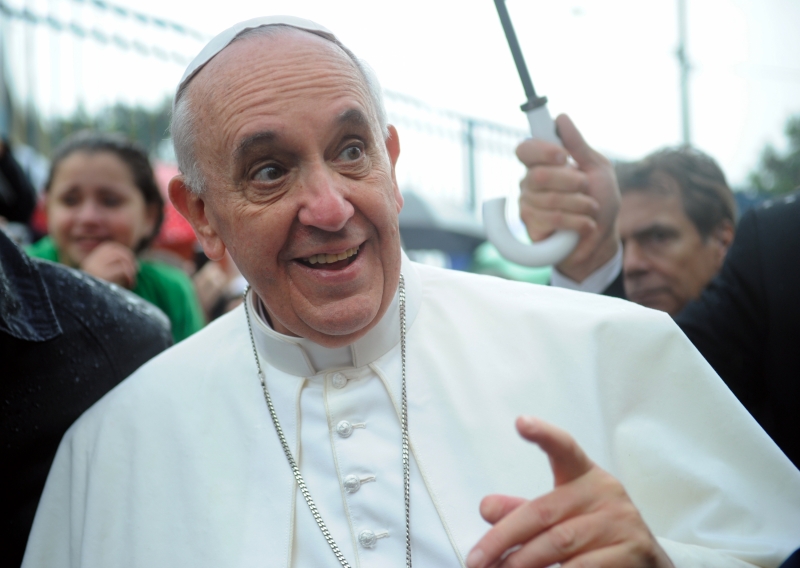
Celebration of the World Day of Peace (1 January 2014)
Paul VI stated that not only individuals but nations too must encounter one another in a spirit of fraternity. As he says: “In this mutual understanding and friendship, in this sacred communion, we must also … work together to build the common future of the human race.” In the first place, this duty falls to those who are most privileged. Their obligations are rooted in human and supernatural fraternity and are manifested in three ways: the duty of solidarity, which requires the richer nations to assist the less developed; the duty of social justice, which requires the realignment of relationships between stronger and weaker peoples in terms of greater fairness; and the duty of universal charity, which entails the promotion of a more humane world for all, a world in which each has something to give and to receive, without the progress of the one constituting an obstacle to the development of the other.
If, then, we consider peace as opus solidaritatis, we cannot fail to acknowledge that fraternity is its principal foundation. Peace, John Paul II affirmed, is an indivisible good. Either it is the good of all or it is the good of none. It can be truly attained and enjoyed, as the highest quality of life and a more human and sustainable development, only if all are guided by solidarity as “a firm and persevering determination to commit oneself to the common good.” This means not being guided by a “desire for profit” or a “thirst for power.” What is needed is the willingness to “lose ourselves” for the sake of others rather than exploiting them, and to “serve them” instead of oppressing them for our own advantage. “The ‘other’—whether a person, people or nation—[is to be seen] not just as some kind of instrument, with a work capacity and physical strength to be exploited at low cost and then discarded when no longer useful, but as our ‘neighbour,’ a ‘helper.’”
Moreover, if on the one hand we are seeing a reduction in absolute poverty, on the other hand we cannot fail to recognize that there is a serious rise in relative poverty, that is, instances of inequality between people and groups who live together in particular regions or in a determined historical-cultural context. In this sense, effective policies are needed to promote the principle of fraternity, securing for people—who are equal in dignity and in fundamental rights—access to capital, services, educational resources, healthcare, and technology, so that every person has the opportunity to express and realize his or her life project and can develop fully as a person.
One also sees the need for policies which can lighten an excessive imbalance between incomes. We must not forget the Church’s teaching on the so-called social mortgage, which holds that although it is lawful, as St. Thomas Aquinas says, and indeed necessary “that people have ownership of goods,” insofar as their use is concerned, “they possess them as not just their own, but common to others as well, in the sense that they can benefit others as well as themselves.”
Finally, there is yet another form of promoting fraternity—and thus defeating poverty—which must be at the basis of all the others. It is the detachment of those who choose to live a sober and essential lifestyle, of those who, by sharing their own wealth, thus manage to experience fraternal communion with others. This is fundamental for following Jesus Christ and being truly Christian. It is not only the case of consecrated persons who profess the vow of poverty, but also of the many families and responsible citizens who firmly believe that it is their fraternal relationship with their neighbours which constitutes their most precious good.
The grave financial and economic crises of the present time—which find their origin in the progressive distancing of man from God and from his neighbour, in the greedy pursuit of material goods on the one hand, and in the impoverishment of interpersonal and community relations on the other—have pushed man to seek satisfaction, happiness, and security in consumption and earnings out of all proportion to the principles of a sound economy. In 1979 John Paul II had called attention to “a real perceptible danger that, while man’s dominion over the world of things is making enormous advances, he should lose the essential threads of his dominion and in various ways let his humanity be subjected to the world and become himself something subject to manipulation in many ways—even if the manipulation is often not perceptible directly—through the whole of the organization of community life, through the production system and through pressure from the means of social communication.”
We cannot however fail to observe that international agreements and national laws—while necessary and greatly to be desired—are not of themselves sufficient to protect humanity from the risk of armed conflict. A conversion of hearts is needed which would permit everyone to recognize in the other a brother or sister to care for, and to work together with, in building a fulfilling life for all. This is the spirit which inspires many initiatives of civil society, including religious organizations, to promote peace. I express my hope that the daily commitment of all will continue to bear fruit and that there will be an effective application in international law of the right to peace, as a fundamental human right and a necessary prerequisite for every other right.
© Libreria Editrice Vaticana © Life Ethics Information Centre 2014
Photo credit: By Tânia Rêgo/ABr (Agência Brasil) [CC-BY-3.0-br (http://creativecommons.org/licenses/by/3.0/br/deed.en)], via Wikimedia Commons.

Saint Kateri , Canada’s Protectress
This was the title given to Saint Kateri Tekakwitha, by Pope Benedict XVI, when he canonized her on October 28th, 2012, along with six others, in Saint Peter’ Square (she had been beatified by Pope John Paul II back in 1980). With Saint Joseph as our protector, along with the Canadian martyrs, we seem to[…]Continue reading→

Remembering Father Alphonse de Valk
(Today marks the sixth anniversary of the death of Father Alphonse de Valk, C.S.B., a faithful, courageous and indefatigable Basilian priest, pro-life-and-family apostle, and the founder of Catholic Insight magazine. Here is what we wrote those on his entering into eternity five years ago, as we continue to remember him in our prayers and thoughts)[…]Continue reading→

My Name is Bernadette
April 16th is a propitious day, for besides the anniversary of Father de Valk’s death, who founded Catholic Insight in its print form decades ago, and the commemoration of the ‘two Benedicts’, mentioned in accompanying posts, today we also recall Saint Bernadette Soubirous, the young visionary to whom the Virgin Mary appeared numerous times at[…]Continue reading→

Canonizing Sister Faustina and Divine Mercy
HOMILY OF THE HOLY FATHER MASS IN ST PETER’S SQUARE FOR THE CANONIZATION OF SR MARY FAUSTINA KOWALSKA Sunday, 30 April 2000 1. “Confitemini Domino quoniam bonus, quoniam in saeculum misericordia eius”; “Give thanks to the Lord for he is good; his steadfast love endures for ever” (Ps 118: 1). So the Church sings on the Octave of[…]Continue reading→

Divine Mercy Sunday – An Echo of Every Mass
Reach out your hand and put it in my side. Do not doubt but believe’… ‘My Lord and my God!’ (Jn. 20:18)). Today is Divine Mercy Sunday, and as we celebrate the end of the Easter Octave, we contemplate the wounded side of our Saviour, the Church’s source of life. On Good Friday in the[…]Continue reading→

First Holy Communion: Sermon from May 16, 1943
Here is a sermon from the good old days by +Rev. Msgr. Vincent Nicholas Foy (August 14, 1915 – March 13, 2017), from 1943. Readers may recall that Pope Saint Pius X, by the decree Quam Singulari in 1910, lowered the customary age of reception of Holy Communion – after the rigours of the plague[…]Continue reading→

In the Glorious Light of Easter, Alleluia!
Set your minds on things that are above, not on things that are on earth, for you have died, and your life is hidden with Christ in God. When Christ who is your life is revealed, then you also will be revealed with him in glory (Col. 3:3-4). The Resurrection of Our Lord and Saviour[…]Continue reading→

An Ancient Homily for Holy Saturday
The time between Good Friday and Easter Sunday is one of waiting, in silence, as the world wonders – anticipates – what will happen, after the death of Christ. We re-live this time each year in the anamnesis of our liturgy, and in turn look forward to the glorious re-creation of all things at the[…]Continue reading→

Europe’s Long Descent
(As we meditate on this day on Christ’s burial, and His descent into hell, it is fitting to ponder here with contributor Peter Marcus how the world seems to be heading there as well. The difference is that, although God cannot ‘redeem’ hell, nor those therein, He can and did redeem the world. There is[…]Continue reading→
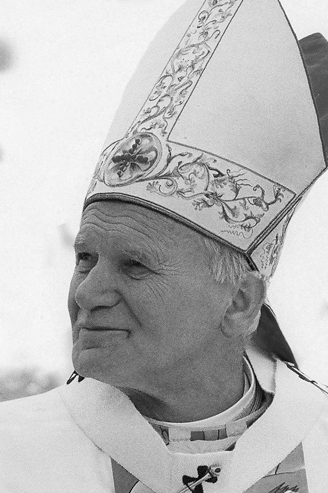
Pope Saint John Paul II’s First Good Friday Homily
ADDRESS OF HIS HOLINESS JOHN PAUL II AT THE CONCLUSION OF THE STATIONS OF THE CROSS AT THE COLOSSEUM Good Friday, 13 April 1979 When we make the Way of the Cross from one station to the next, in spirit we are always at the spot wherethis journey had its “historical” place: where it[…]Continue reading→