
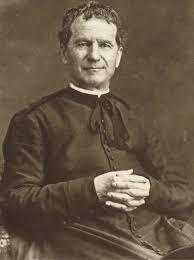
Don Bosco, Still Teaching in the Hallway
On joy, presence, young love, and the quiet holiness of Catholic education
There’s a particular kind of sound you only hear in a school: a quick burst of laughter that tries to hide itself, the shuffle of sneakers between classes, the rhythmic thud of lockers, and the sudden hush when a student realizes you’re closer than they thought. Every day in a Salesian school, that soundscape becomes a kind of living text—one you learn to “read” the way Don Bosco read the streets of Turin: with patience, attention, and a stubborn hope.
On January 31, the Church celebrates St. John Bosco, priest, educator, and father to the young—especially those whom society was already prepared to lose. Don Bosco’s holiness didn’t grow in a quiet corner. It grew in the noise of the streets, where boys carried hunger, restlessness, humor, and heartbreak all at once. He built what he called the Oratory—not merely a religious program, but a home: a place where prayer and play, formation and friendship, discipline and joy belonged together.
I find myself thinking about Don Bosco often as I teach at Don Bosco Cristo Rey High School (DBCR) in Takoma Park, Maryland. The Salesian spirit is not something we only talk about during assemblies or feast days. It shows up in the ordinary scenes that feel almost too small to name—yet somehow carry the real weight of education. The day begins and suddenly you’re not in an abstract lesson about “formation.” You’re in the lived reality of young people becoming themselves.
Sometimes it’s as simple as the two-minute passing period between classes. The hallway becomes a river: backpacks swinging, sneakers squeaking, the sudden sprint of someone who realizes they’re late, the half-shouted “Excuse me!” of a student weaving through the crowd. And then there are the ones who move slowly—students wandering a little too long, not necessarily to cause trouble, but because something is heavy or confusing, or because they are trying to gather themselves before stepping into the next hour. A teacher learns to recognize the difference between mischief and distress. A Salesian teacher learns something deeper: even the hallway can be pastoral space.
Then there is the daily comedy (and sometimes tragedy) of dress code. At DBCR, I have learned there are a million versions of dress code—not because the policy is unclear, but because teenage life is. A tie is missing. A tie is present but undone and hanging like a flag of protest. A student has the right uniform… except for the one item that disappeared into the chaos of a morning commute. Another student is “technically compliant,” but only in the way that makes you smile because you can see the creativity working overtime. These are not merely rule violations; they are often signs: of rushing, of stress, of a morning that didn’t go smoothly.
Don Bosco did not educate by ignoring rules; he believed in reason and structure. But he also knew rules are meant to form the person—not to humiliate them. Even a dress-code correction can either shrink a student or strengthen them, depending on whether it’s delivered as control or as care. That’s why his so-called “Preventive System”—often summarized as Reason, Religion, and Loving-kindness—is less a method than a spirituality. It asks educators to be firm without being harsh, to be present without being intrusive, to correct without breaking a student’s dignity.
And of course, there are the small classroom rituals that seem universal across every school on earth. The endless question that never ends:
“Mr. Santos, do you have a pencil?”
“Do you have paper?”
“Can I borrow… just for today?”
It’s almost liturgical—repeated daily, predictably, with the same hopeful tone, as if the pencil were a sacrament. And somewhere in the middle of a discussion, there is also the other teenage ritual: hidden snacking. A student swears they’re listening while quietly negotiating a granola bar under the desk like it’s a classified operation. Another unwraps something with astonishing stealth—until the crinkle gives them away and half the class smiles. It’s not always disrespect. Sometimes it’s simply real life: a long morning, an early commute, a quick breakfast that never happened. Don Bosco worked with boys who were hungry, tired, restless—bodies trying to survive while minds were being asked to grow. Salesian spirituality doesn’t romanticize weakness; it simply insists that formation begins with understanding, and love is often expressed in the smallest forms of patience.
But perhaps the most unmistakably “Salesian” moments are the ones that feel least academic. They happen during a lunch break, after school, or in that brief moment when a student lingers at the door as everyone else leaves.
Sometimes it begins like this:
“Okay, Mr. Santos… I need to tell you something about this situationship.”
It’s said half-serious, half-embarrassed—like a confession, but also like a request for adult wisdom. And then the story comes out: the texting that started strong, the mixed signals, the hope that maybe it meant something, the sudden silence that feels louder than any argument. Sometimes the student laughs while telling it, but you can hear the ache underneath. Other times it’s not even sadness, just confusion—What am I supposed to do with these feelings? And occasionally it’s something gentler: a first hand-holding moment, awkward and brave, like two teenagers testing whether the world will end if they admit affection out loud.
Adults can dismiss these things as trivial. Don Bosco never did. He understood youth as the season when the heart is learning to love—and learning that love can hurt. In his Oratory, holiness didn’t float above human life; it entered it. The giggle of secret love in the hallway, the shy courage of a student telling the truth, the fragile hope that something might be real—these are not distractions from education. They are part of what education accompanies: the becoming of a person.
And then, unexpectedly, grace arrives in the form of small gestures. Not always at lunchtime, but in the in-between moments: a student stopping by your room with something offered almost shyly—a concha, warm and sweet; pupusas, shared not as a scheduled “lunch thing” but as kindness: “Here, Mr. Santos, I brought extra.” Or the little heart doodle on a paper, a note tucked into an assignment, a quiet “thank you” that doesn’t want attention but still wants to be heard. These moments are not about food or drawings. They are about being remembered. A student saying, in the only language they know at that moment: You matter in my day. You are part of my world.
At the same time, modern Catholic education comes with a weight Don Bosco would recognize immediately, even if the details are different: the pressure of the future. College applications. Deadlines. Essays. Transcripts. Recommendation requests. Interviews. Financial aid forms. There is a quiet panic that settles into many students, even the ones who laugh the loudest. They are still teenagers, but they carry the feeling that everything depends on their performance.
Teachers feel that pressure too—in a different way. There are a million exit tickets, quizzes, summatives, and rubrics; endless paperwork that multiplies quietly while you’re trying to teach; grades to enter, feedback to write, accommodations to honor. And then there’s the moment when students talk about your assignments like they’re legends: the “gruesome interview project of Mr. Santos”—students trying to schedule a pastor or staff member, crafting questions, editing video, worrying whether it will be awkward, discovering (almost against their will) that real learning happens when faith is asked to touch real life.
Don Bosco never wanted education to stay trapped in abstraction. He wanted it to become a lived Christianity—faith practiced, not merely recited; conscience formed, not merely instructed. That is why his educational dream still sounds unexpectedly modern: to form “good Christians and honest citizens.” Not simply graduates, but persons: capable of truth, disciplined by love, and courageous enough to hope.
On Don Bosco’s feast, I find myself returning to a quiet set of questions—not as guilt, but as direction. Do my students experience school as a place where they are known and loved, not in abstraction but in real time? Do I correct in a way that protects dignity and leaves room for conversion? Do I show up for the in-between moments—the hallway, the after-school doorway conversation, the lunch break confession—where trust is formed? Do I still believe in the student who has given up on themselves?
Don Bosco would answer with his life: stay close to the young. Stay hopeful. Be firm without being harsh. Be joyful without being shallow. Be religious without being distant. And above all: don’t give up.
Because Catholic education, at its best, is not only about teaching. It is about building an Oratory wherever we are: a classroom, a hallway, a community—spaces where young people can start again; where even the undone tie can be corrected without shame; where even a fading situationship can be held gently as part of growing up; where the endless “Do you have a pencil?” becomes part of the daily liturgy of school life; and where a small heart doodle can be received as proof that grace is quietly working.
On January 31, we ask Don Bosco to pray for all who teach and all who learn:
St. John Bosco, father and teacher of the young,
teach us to love with patience, to correct with dignity,
to be present with joy, and to form hearts for Christ.
Help our schools become homes of faith and hope—
where the young discover they are seen, they belong, and they are called. Amen.
Mary Help of Christians, pray for us! St. John Bosco, pray for us!

Saint Kateri , Canada’s Protectress
This was the title given to Saint Kateri Tekakwitha, by Pope Benedict XVI, when he canonized her on October 28th, 2012, along with six others, in Saint Peter’ Square (she had been beatified by Pope John Paul II back in 1980). With Saint Joseph as our protector, along with the Canadian martyrs, we seem to[…]Continue reading→

Remembering Father Alphonse de Valk
(Today marks the sixth anniversary of the death of Father Alphonse de Valk, C.S.B., a faithful, courageous and indefatigable Basilian priest, pro-life-and-family apostle, and the founder of Catholic Insight magazine. Here is what we wrote those on his entering into eternity five years ago, as we continue to remember him in our prayers and thoughts)[…]Continue reading→

A Tale of Two Benedicts
A grace-filled Holy Week to all our readers! As we await and prepare for the Resurrection about to dawn upon us, we might keep in mind two Benedicts: Pope Emeritus Benedict XVI, requiescat in pace, elected on this day in 2005; and today’s commemoration of the mystic pilgrim, Benedict Joseph Labre, who died on this[…]Continue reading→

My Name is Bernadette
April 16th is a propitious day, for besides the anniversary of Father de Valk’s death, who founded Catholic Insight in its print form decades ago, and the commemoration of the ‘two Benedicts’, mentioned in accompanying posts, today we also recall Saint Bernadette Soubirous, the young visionary to whom the Virgin Mary appeared numerous times at[…]Continue reading→

Saint Lydwina of Schiedam and Suffering Joyfully
Saint Lydwina of Schiedam (1380 – 1433) was one of the countless and glorious ‘victim souls’ in the history of the Church, those whose lives are filled with suffering, often of an unimaginable intensity, but who suffer joyfully. She was a fifteen-year old Dutch girl, out skating one day, when she fell and broke one[…]Continue reading→

The Glorious Martyrdoms of Martin and Maximus
As we enter into Eastertide, we recall on this 13th of April Pope Saint Martin I (+655), one of the noblest, if most tragic, of the successors of Saint Peter. Born in Umbria, Italy, he was of noble lineage, with great intelligence combined with charity and love of the poor and the Church. While still[…]Continue reading→
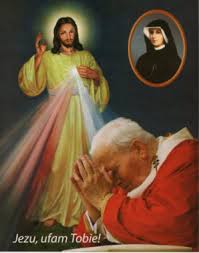
Canonizing Sister Faustina and Divine Mercy
HOMILY OF THE HOLY FATHER MASS IN ST PETER’S SQUARE FOR THE CANONIZATION OF SR MARY FAUSTINA KOWALSKA Sunday, 30 April 2000 1. “Confitemini Domino quoniam bonus, quoniam in saeculum misericordia eius”; “Give thanks to the Lord for he is good; his steadfast love endures for ever” (Ps 118: 1). So the Church sings on the Octave of[…]Continue reading→

Divine Mercy Sunday – An Echo of Every Mass
Reach out your hand and put it in my side. Do not doubt but believe’… ‘My Lord and my God!’ (Jn. 20:18)). Today is Divine Mercy Sunday, and as we celebrate the end of the Easter Octave, we contemplate the wounded side of our Saviour, the Church’s source of life. On Good Friday in the[…]Continue reading→
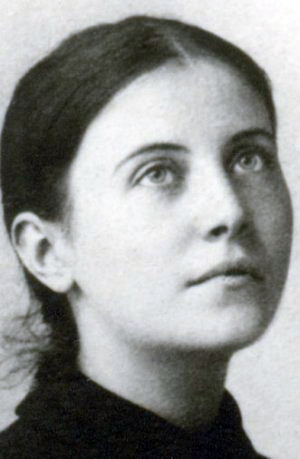
Saint Gemma Galgani
On this April 11th, in 1903 – the same year that the Italian Guiseppe Sarto was elected Pope later that summer as Pius X – a lovely, young Italian woman died, by the name of Gemma Galgani. She lived a brief life of 24 years, as did a number of other young saints, including Pier[…]Continue reading→
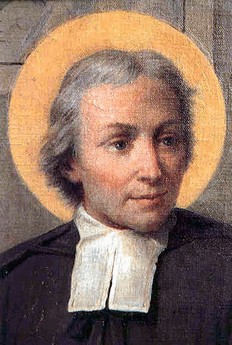
Saint Jean-Baptiste de la Salle: A Teacher for Teachers
Jean-Baptiste de la Salle (1651 – 1719), a French nobleman, ordained a priest, founded the first order in the Church’s history entirely without priests, and this came about almost by accident. I say ‘almost’, for, of course, there are no accidents with God. Destined for ordination from an early age, Jean-Baptiste never looked back, even[…]Continue reading→