

Entropic AI
Entropy may be described as the tendency of all things degrade, to move from order to disorder, from cosmos to chaos, from specificity to entropy. It is the inevitable consequence of any closed system, and encapsulated as the Second Law of Thermodynamics. Any such system – whether that be a machine, a living organism, a star or the entire universe – inevitably loses its capacity to do specific work, and moves towards dissipation and randomness. Cars get rusty, rooms gather dust, houses fall down, people get old and our Sun is using up its hydrogen fuel (even if it has enough for a few billion more years).
In other words, there is no, and never can be, such a thing as a perpetual motion machine. Entropy is the default state, barring a being – or Being – who puts order and specificity back into things.
I never thought explicitly about entropy and artificial intelligence. But the author here makes a good point, for ‘information’ is also subject to entropy. We can have ordered, specific information, or garbled words just one level above absolute nonsense, as anyone who has graded essays and exams can tell you.
The primary task of AI – indeed, all it really does – is to gather and collate information. I initially wrote ‘generate’ there, but AI does not really create anything. Rather, it takes (‘scrapes’ is the operative and significant term) what others – which is to say, humans – have created, then reassembles these bits as something ‘new’.
But it’s not really new, is it? Rather, it’s the old repackaged as new.
The problem here is that as more and more ‘stuff’ on the internet is churned out by AI, the same AI uses this already-repackaged material to ‘create’ new material, in a downward spiral of – you got it – entropy. To paraphrase Saint Peter’s reference to the backsliding sinner – and pardon the vividness of the expression, but it seems apt – it’s like trying to gain nourishment from one’s own vomit.
Of course, one might argue that that’s what humans do, in creating our own work, and this raises a deep philosophical, even metaphysical question, which would take far more than this reflection to answer. Only to say for now that there is much evidence that the human mind is not a machine or an algorithm. One ‘proof’– if we take proof in the sense of one of many convincing and converging arguments – is that if the mind were an algorithm, it would not be aware of its own existence.
Kurt Gödel proved this back in 1931, with his Incompleteness Theorem, which is rather technical and mathematical, but basically proves that one could not ‘prove’ any algorithmic system by a rule within that system. The ‘system’ of math is not self-consistent, but needs some sort of rule outside itself, axioms that are either self-evident, or whose proof resides outside the system.
This was a surprise to many – including mathematicians Bertrand Russel and David Hilbert – who were trying to prove the self-sufficient consistency of math. By extension, they were also hoping to prove the same of the material universe. Hence, there would be no need, or even possibility, for minds, or God, or a creator.
Not so, said Gödel. There is no such thing as a completely closed system, only open ones.
What this means is that the human mind is not an algorithm, for it has access to something beyond itself, and so can imagine, think ‘outside the box’, adapt in a way that transcends the algorithm. Machines cannot do that, but can only replicate, in suitably mechanical fashion. Human minds exist on a ‘universal’ plane, in a way analogous to the mind of God Himself, in Whose image we are made.
So where does that leave us? Here are some final thoughts from the world we see around us.
The self-driving fleet of Waymo vehicles were just taken off the road, after a power outage in San Francisco, causing all the traffic lights to go out. The cars didn’t ‘know’ what to do, so just froze, hazards on, blocking traffic. It’s like something out of a future dystopia starring Will Smith. Human drivers freeze as well, but in part because we’re trained to act like machines, within the algorithm and the rules. When the rules break down, or don’t work, it’s simply human to adapt, improvise, to ‘think outside the box’, which is the same as thinking outside the algorithm.
This follows upon a number of other incidents of these cars driving the wrong way down streets, whipping by school buses as students disembarked, and so on. Yes, humans do such things as well – but, then, we say we’re stupid. Normally we can transcend such situations, and adapt. The machines will always follow whatever algorithm is put into them, and regardless of how complex that be, reality is always more complex still, in fact, infinitely so, from the very hand of the Creator.
Then, we have various artists, authors, musicians – that is, creators – who object to AI scraping their material as passing it off as its (their?) own. Google has taken down any AI-generated images of Disney characters after receiving a ‘cease and desist’ letter. AI cannot create Snow White and Mickey Mouse – they can only use what Disney already created. The only reason AI can compose something resembling ABBA or Bach – but always less perfectly than the original – is because there was first a real ABBA and Bach, with the creativity proper to human minds. More to the point, the only reason there’s AI is because humans created AI.
Then, finally for now, there’s the problem of AI hallucination, which is now seen not as a bug, but as a feature. It fills in gaps in its assemblage of the knowledge with nonsense, bits and pieces put together within the algorithm, for it knows not how to escape it. In fact, it doesn’t know the term ‘escape’, for it does not know its limits, for it does not know at all. Without the creative input of humans, AI would be total chaos, entropy, disorder.
Like anything else, AI is a tool, that can be used badly or well. The problem is that, like any tool that makes things easier – say, a calculator or a car – it’s also easier to lean too much upon its help, to our detriment. AI compounds this problem, and then some, offering not only ready answers and solutions, but instant essays, articles, resumes, music, novels, plot lines, advice and even apparent solutions to all our problems. Without humans imprinting the order of their minds, things will inevitably degrade, as AI continues its march through what remains of the rubble of our culture, reassembling the flotsam and jetsam into even more rubbly rubble.
AI superintelligence? Bah, humbug. You just have to shut off the traffic lights. But there may be actual intelligences – natural or supernatural – behind the AI algorithm.
For our part, we must resist the downward entropic spiral of the entropic AI machine, and find again our creative potential, flowing from God’s own imagination, if we may speak so. This requires work, but the possibilities and potentialities are quite truly infinite.
And, as a final postscript, even if these few meagre words do not match up to that potential, I can attest they were composed by a human mind. But AI would say that, wouldn’t it? The only way to really know would be to stop by for a visit and a cup of cheer. As the ghost of Christmas present said to Scrooge, ‘come in, man, and know me better’.

Carney’s Amoral Majority
After five defections – euphemistically described as ‘crossing the floor’ – and three by-elections, Mark Carney and his Liberals how have their coveted majority. One wonders what bowls of pottage were offered in back-room deals. In the archaic monarchical system that is the Dominion of Canada, this majority allows the newly-minted Prime Minister to rule[…]Continue reading→

Saint Kateri , Canada’s Protectress
This was the title given to Saint Kateri Tekakwitha, by Pope Benedict XVI, when he canonized her on October 28th, 2012, along with six others, in Saint Peter’ Square (she had been beatified by Pope John Paul II back in 1980). With Saint Joseph as our protector, along with the Canadian martyrs, we seem to[…]Continue reading→
A Closed, Unsustainable, Descending Loop
As a follow-up to my thoughts on Payette’s payout, here be a stark image of where are here in Canada. As the graph shows in, well, graphic terms, since 2025, the public sector has contributed to 95.5% of economic growth. The private sector – which funds the public sector, or is supposed to – has[…]Continue reading→
A Tale of Two Benedicts
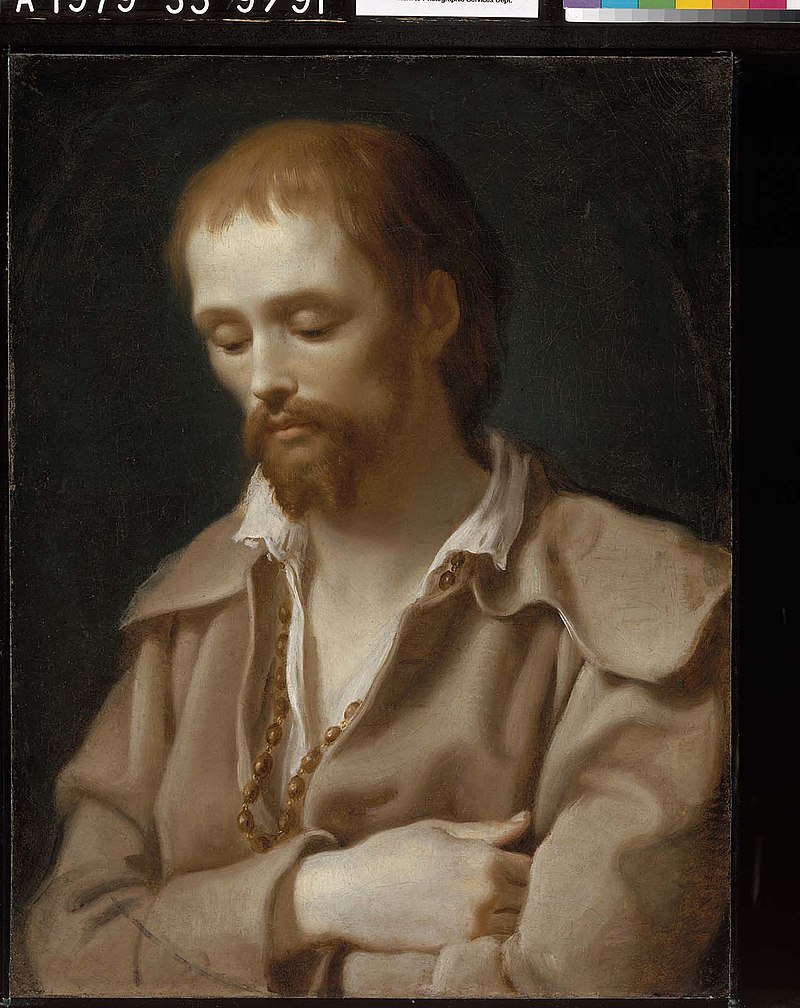
A grace-filled Holy Week to all our readers! As we await and prepare for the Resurrection about to dawn upon us, we might keep in mind two Benedicts: Pope Emeritus Benedict XVI, requiescat in pace, elected on this day in 2005; and today’s commemoration of the mystic pilgrim, Benedict Joseph Labre, who died on this[…]Continue reading→

My Name is Bernadette
April 16th is a propitious day, for besides the anniversary of Father de Valk’s death, who founded Catholic Insight in its print form decades ago, and the commemoration of the ‘two Benedicts’, mentioned in accompanying posts, today we also recall Saint Bernadette Soubirous, the young visionary to whom the Virgin Mary appeared numerous times at[…]Continue reading→
Saint Lydwina of Schiedam and Suffering Joyfully
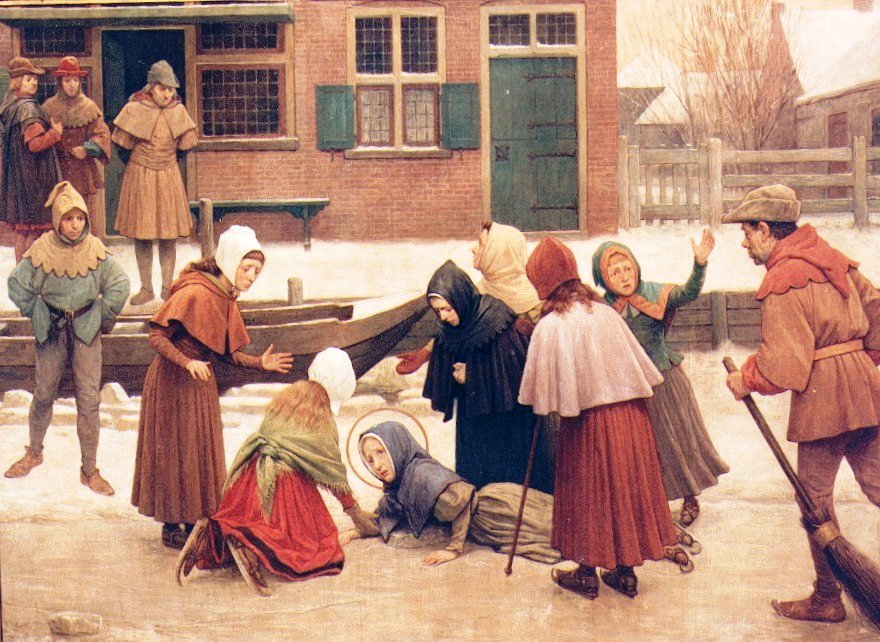
Saint Lydwina of Schiedam (1380 – 1433) was one of the countless and glorious ‘victim souls’ in the history of the Church, those whose lives are filled with suffering, often of an unimaginable intensity, but who suffer joyfully. She was a fifteen-year old Dutch girl, out skating one day, when she fell and broke one[…]Continue reading→
The Glorious Martyrdoms of Martin and Maximus
As we enter into Eastertide, we recall on this 13th of April Pope Saint Martin I (+655), one of the noblest, if most tragic, of the successors of Saint Peter. Born in Umbria, Italy, he was of noble lineage, with great intelligence combined with charity and love of the poor and the Church. While still[…]Continue reading→
Pope Leo and a Rosary for Peace
Pope Leo XIV has asked Catholics across the world to join him in a Rosary for peace today, at 18:00 Rome time (6 pm), which would be noon from where I write (EST). If you are able, whether at that time or another, and in whatever way you pray, to join in intercession with the[…]Continue reading→
Payette’s Payout
I was glancing through some headlines, and noticed a mention of Julie Payette – engineer and astronaut and sometime the Queen’s representative in Canada – which brought back vague memories. She was appointed Governor-General by Justin Trudeau in 2017. Ms. Payette resigned in 2021, amidst claims that she created a ‘toxic work environment’, with allegations[…]Continue reading→

Saint Stanislaus of Szczepanów
We celebrate Saint Stanislaus today (+ April 11, 1079), in light of this Easter Octave, a bishop and martyr who accepted the episcopacy only at the direct order of Pope Alexander II. He proved a wise and courageous leader of his flock, put to death by his own king, Boleslaus, for rebuking the monarch’s ‘immoral[…]Continue reading→