
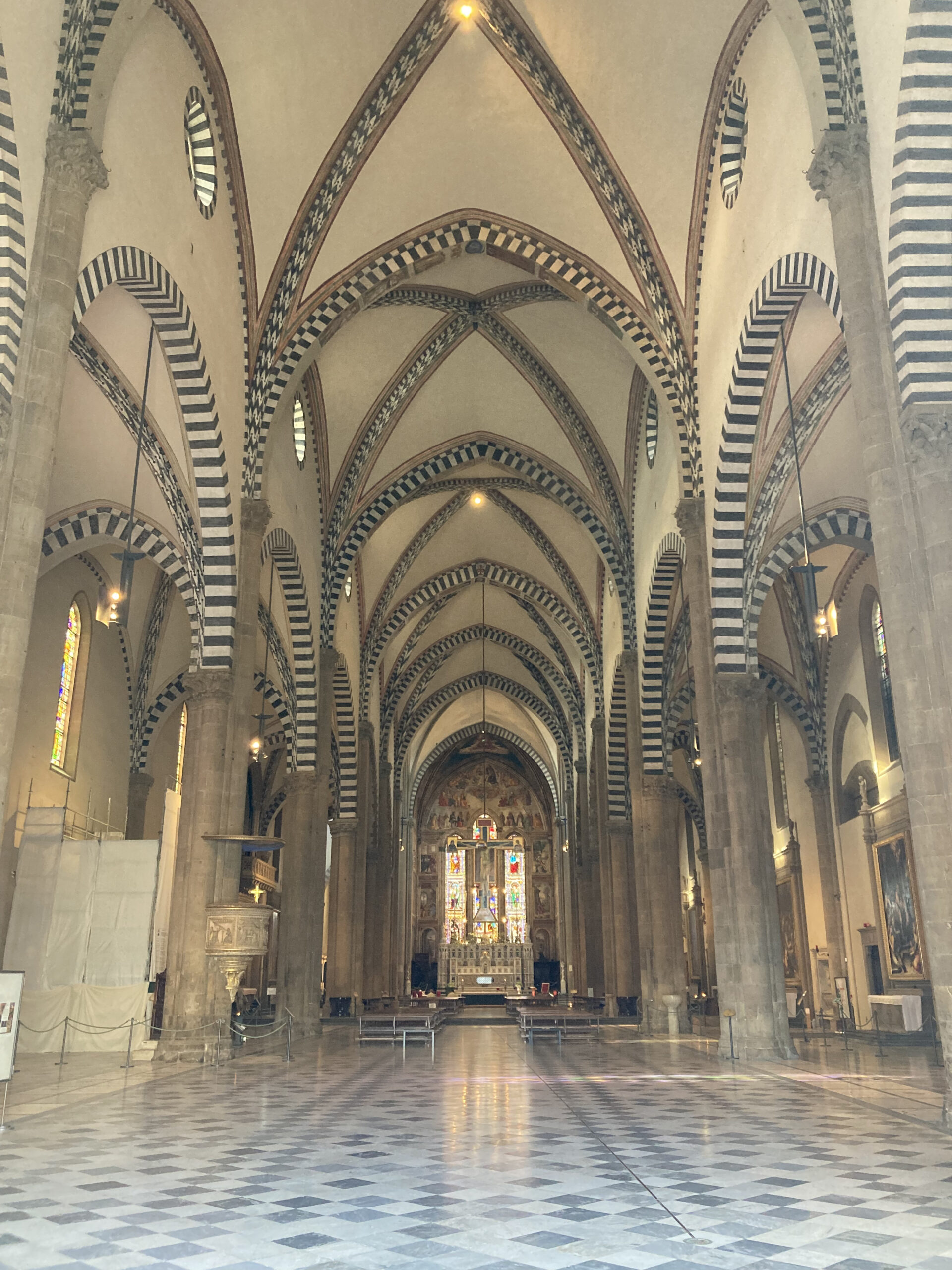
Florence: Art, Beauty and Truth
Firenze! Even the name – at least in Italian – signifies energy, exuberance, enthusiasm. What is one to say of Florence in a few words? I spent but an afternoon wandering the glorious city of saints and sinners, politicians and potentates, of geniuses and giants. One cannot take it all in, even in a lifetime. There are statues and monuments and plaques are everywhere ones turns, some of whom I knew, others not at all, but every one of them ancient and with a glory, at least of an earthly sort.
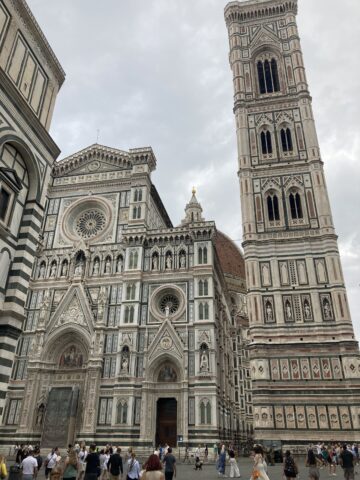
I began my brief visit with Mass, a Novus Ordo chanted in Latin, at the Duomo – the cathedral – of the city, the sheer size and scale of which overwhelms the senses. The dome was the first one built without buttresses, which the Florentines considered unsightly, with brick placed upon brick in concentric, geometric precision, all done by intuition. How many bricks comprise the magnificent structure itself is nearly beyond counting.
The priests and choir didn’t need amplification, but the ecclesia moderna seems addicted to it. At least the celebrant was miked, and his voice reverberated so much it was difficult to make out what he was saying. I’m not sure about the choir, but the text of the chant, still pleasing, was lost to my ears, unless one knew it already. One could hear a whisper in such a space! Ministers came around with a QR code to download onto one’s phone, which allowed the Gregorian notes and melody to appear on one’s phone. I didn’t have data, and, regardless, there was something not quite right in the contradictory confluence of such tech and ancient chant. Still, it wasn’t as bad as another glorious church I stopped by, where I heard the sound of a guitar strumming up for the beginning of Holy Mass. That’s like having a Coke with a Florentine steak.
Still, I appreciated the traditional liturgy, as I do almost any Mass I can get traveling around: The Kyrie and Gloria and proper antiphons are heard so rarely outside the TLM. The cathedral was closed to visitors on Sunday, so everyone there – and there was quite a crowd – was there to pray, even if we were huckled out soon after Mass.
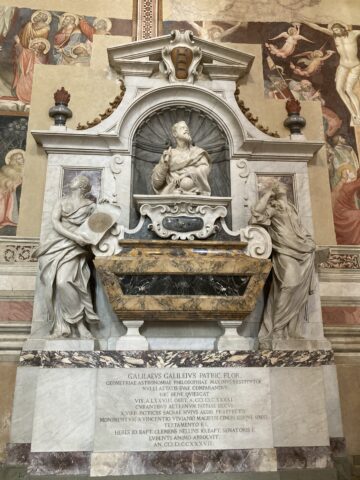
Afterwards, I met up with a recent alumna, who is studying art for a month in Florence (where else would one do so?) and her mother, with whose family I have been long-time friends. We enjoyed a splendid authentic Tuscan meal in a local restaurant, which we chose since it shared the family name of a saint we were discussing just as we walked by, Maria Magdalena da Pazzi. After that, a tour of Santa Croce, where many of the greats are either buried or commemorated: Galileo, Michelangelo, Rossini, da Vinci and, of course, Dante, whose body lies in Ravenna. The Florentines would like the great poet returned, but since Florence exiled him during life, so Ravenna won’t return him in death. Still, we are whence we came, and a Florentine Dante is. Bless, dearest Lady, the and of our birth.
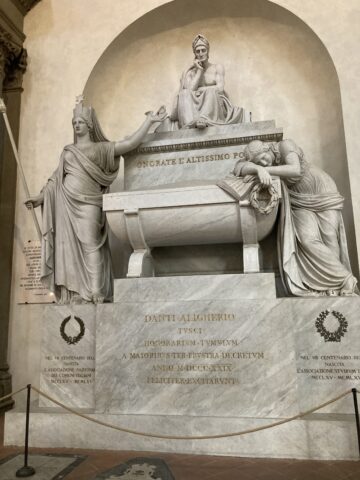
It was Dante who formalized the Italian language, adapted from the original Latin, but put into his own words and tongue. For many, Tuscan is Italian, and we find its origins in the Divina Commedia, which teaches us much else besides. I read through some cantos in Italian as I travelled on the train towards Assisi, and can only wonder how much our own culture was shaped by Florence: In religion – so many saints! As one of the traditional priests mentioned to me, so many commemorated in the usus antiquior are ‘Florentine’. And what of science, with Galileo formalizing the modern scientific method (even if, like Newton who was born the year Galileo died, he stood on the shoulders of giants who came before him, which his independent spirit was too often loathe to admit). But most of all, Florence gives us art, and what treasures! Sculpture, architecture, painting, Giotto, Donatello, da Vinci, and perhaps the greatest of all, Michelangelo, who mastered very art there was. Where would we be without Florence!
There is a controversial sculpture in the one of the piazzas, with replicas of Michelangelo’s David and other great works, and at a distance, a modern statue of a women on a cell phone, her back to the works of art. I didn’t get a photo, perhaps because it would have been a tad too ironic. But the reader may glean the theme: We moderns too often are ignorant of what came before, of what we have been given. We too ‘turn away’ to vapid images on screens, distracted, when so much beauty is before us. (See an article just posted in First Things today, on this theme).
But the sculpture spoke another message, perhaps unintended, that was we have turned from beauty, we have also turned from truth, which is more deleterious. The two, of course, go together. There is no ‘art for art’s sake’, nor is it that truth is beauty, and beauty, truth, as Keats wrote. It’s rather that beauty is a path to truth. And without truth, beauty becomes vacant and insipid, as we see in so much modern art, ugly, quite literally, as sin.
We may also say the same for science. Galileo was enamoured of Copernicanism for its beauty and apparent simplicity. He could not stand the elliptical orbits proposed by Kepler, for they were ‘imperfect’ and unfitting for heavenly orbits. But ellipses are beautiful in their own way, as are Kepler’s astronomical equations. Still, beauty is one sign of a scientific truth, but not the only one. Science simply for science’s sake, as C.S. Lewis foresaw, leads to necromancy and the very gates of the inferno.
There are myriads of crowds in Florence, lining up for the cathedral, the campanile (a sight to behold), the galleries and the museums, in a nation that has, like the rest of Europe, lost its way. There are far, far too few bambinos in Italy, as the elegant ladies walk their boutique dogs, and the men doll themselves up in fancy cars. I’ve got nothing against canines and cars, but children and family come first.
All those people are seeking something – one has to book months in advance to get tickets into the Uffizi Academia. Here’s praying and hoping that they see in the glorious city of artists, scientists and, most of all, saints, that all things are for God, or they’re for nothing at all.
Carney’s Amoral Majority
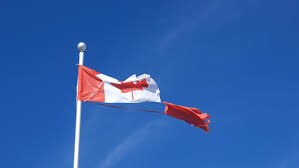
After five defections – euphemistically described as ‘crossing the floor’ – and three by-elections, Mark Carney and his Liberals how have their coveted majority. One wonders what bowls of pottage were offered in back-room deals. In the archaic monarchical system that is the Dominion of Canada, this majority allows the newly-minted Prime Minister to rule[…]Continue reading→

Saint Kateri , Canada’s Protectress
This was the title given to Saint Kateri Tekakwitha, by Pope Benedict XVI, when he canonized her on October 28th, 2012, along with six others, in Saint Peter’ Square (she had been beatified by Pope John Paul II back in 1980). With Saint Joseph as our protector, along with the Canadian martyrs, we seem to[…]Continue reading→
A Tale of Two Benedicts
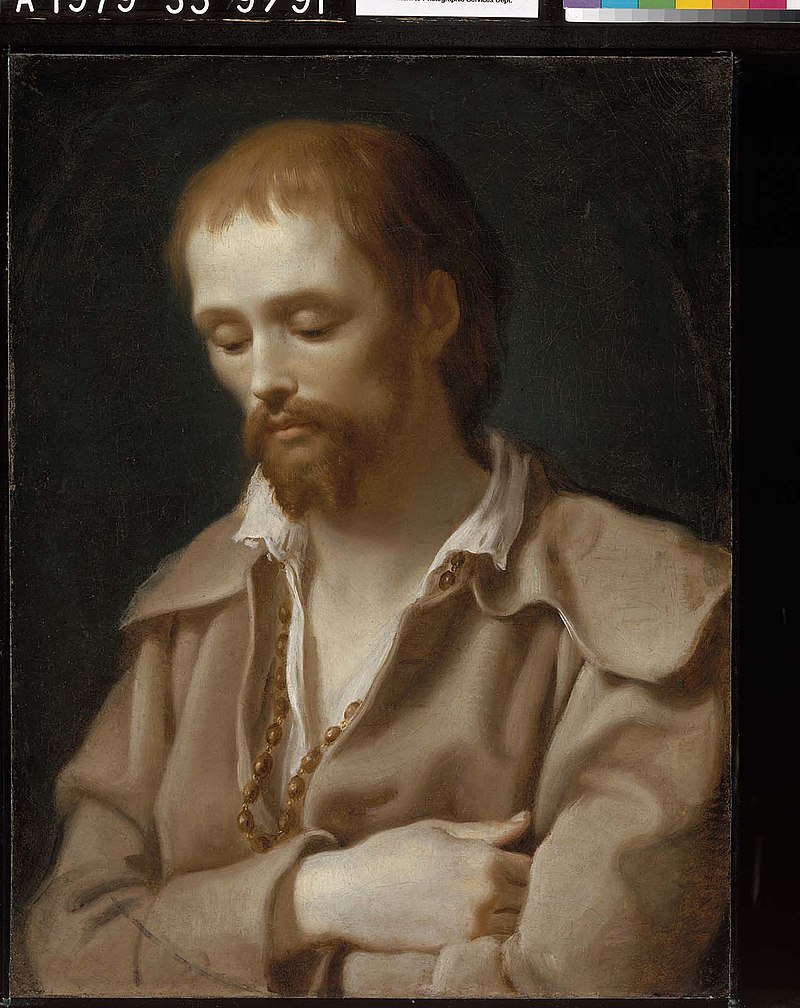
A grace-filled Holy Week to all our readers! As we await and prepare for the Resurrection about to dawn upon us, we might keep in mind two Benedicts: Pope Emeritus Benedict XVI, requiescat in pace, elected on this day in 2005; and today’s commemoration of the mystic pilgrim, Benedict Joseph Labre, who died on this[…]Continue reading→

My Name is Bernadette
April 16th is a propitious day, for besides the anniversary of Father de Valk’s death, who founded Catholic Insight in its print form decades ago, and the commemoration of the ‘two Benedicts’, mentioned in accompanying posts, today we also recall Saint Bernadette Soubirous, the young visionary to whom the Virgin Mary appeared numerous times at[…]Continue reading→
Saint Lydwina of Schiedam and Suffering Joyfully
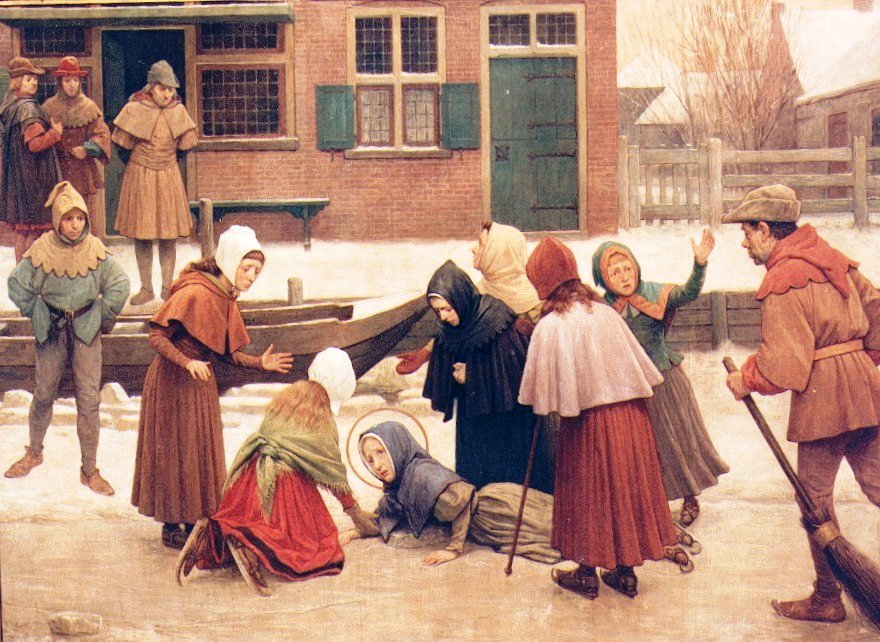
Saint Lydwina of Schiedam (1380 – 1433) was one of the countless and glorious ‘victim souls’ in the history of the Church, those whose lives are filled with suffering, often of an unimaginable intensity, but who suffer joyfully. She was a fifteen-year old Dutch girl, out skating one day, when she fell and broke one[…]Continue reading→
The Glorious Martyrdoms of Martin and Maximus
As we enter into Eastertide, we recall on this 13th of April Pope Saint Martin I (+655), one of the noblest, if most tragic, of the successors of Saint Peter. Born in Umbria, Italy, he was of noble lineage, with great intelligence combined with charity and love of the poor and the Church. While still[…]Continue reading→

Saint Stanislaus of Szczepanów
We celebrate Saint Stanislaus today (+ April 11, 1079), in light of this Easter Octave, a bishop and martyr who accepted the episcopacy only at the direct order of Pope Alexander II. He proved a wise and courageous leader of his flock, put to death by his own king, Boleslaus, for rebuking the monarch’s ‘immoral[…]Continue reading→
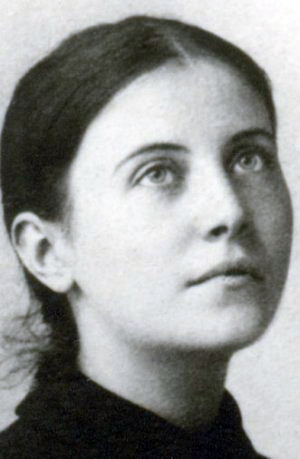
Saint Gemma Galgani
On this April 11th, in 1903 – the same year that the Italian Guiseppe Sarto was elected Pope later that summer as Pius X – a lovely, young Italian woman died, by the name of Gemma Galgani. She lived a brief life of 24 years, as did a number of other young saints, including Pier[…]Continue reading→
An Ideological and Improper Translation
I noticed something odd with the psalm reading at Mass the other day. Our bishops’ conference here in Canada has decreed that the Mass in English – Novus Ordo – use the ‘NRSV’, the ‘New Revised Standard Version’, an ‘updated’ translation of the original RSV, first published in 1952. This ‘new translation’ has the tendency[…]Continue reading→
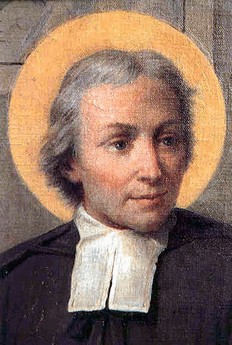
Saint Jean-Baptiste de la Salle: A Teacher for Teachers
Jean-Baptiste de la Salle (1651 – 1719), a French nobleman, ordained a priest, founded the first order in the Church’s history entirely without priests, and this came about almost by accident. I say ‘almost’, for, of course, there are no accidents with God. Destined for ordination from an early age, Jean-Baptiste never looked back, even[…]Continue reading→