
A Pilgrimage from Vienna to Rome
I decided to make a pilgrimage to Rome, prompted by the Jubilee year, and walking through the Holy Doors. But I couldn’t just show up in Rome, so to make a pilgrimage of it, I thought I’d fly first to Vienna, where I’ve never been, to visit the International Theological Institute and a young alumni couple, and make my way from there, mainly by train, stopping along the way. What follows are a few of my initial thoughts and impressions.
I don’t travel afar all that often, and each time it’s a new experience. Airports are odd artificial places. There are few buildings on this planet bigger than terminals, constructed to house – temporarily – a vast conglomeration of people who would not normally conglomerate, gathered together due to the simple fact that they are travelling to some destination or other. As hundreds mill at the gates to board the plane, I wondered of those unfortunate few whose gathering was the last, as their aircraft was one of those – very rare – fated not to make it.
These thoughts are always more vivid as the multi-ton jet speeds down the runway for take-off. I’m amazed at the engines that can accelerate such a vehicle, and even more so when, contrary to what seem to be the laws of physics, the plane ascends, feeling light as a feather. I heard once that planes are painted white to make it easier for people to believe they can fly. But fly they do, the buildings, roads and cars below soon looking like little toys in a child’s playroom which offers some sense of perspective of how small we really are in God’s eyes.
They still don’t fully know how planes fly. Bernoulli’s laws certainly help, but the full nature of ‘flying’ is yet to be fully explained. One way or the other, it is quasi-miraculous that a journey from Toronto to Vienna, which would have taken many months before the development of the combustion engine, now takes but hours.
Our flight followed Lake Ontario the Saint Lawrence River on a cloudless day, and I could see white boats on the water, dreaming of my old kayak and sailboat; then Montreal – I thought I could just see the golden dome of Saint Joseph’s Oratory- then Quebec City, and all the glorious lakes and rivers of northern belle province, before clouds obscured the view.
Vienna: An ancient city, going back to Roman times, the ruins of which still dot the downtown. The gateway to Europe. I was toured around – jet lagged but grateful – by my very pleasant hosts, a young couple, former students of mine, and their very energetic toddler. Tourists milled about everywhere, many with a beauty that seemed to evoke something of heaven. Dostoyevsky wrote that beauty would save the world, but what he really wrote was beauty suffering. What he meant by that has puzzled me, so here’s a thought.
Beauty must be offered to God, in sacrifice, for otherwise it is squandered on oneself in destructive and consuming vanity. I couldn’t help but wonder about those quasi-angelic young women and men, strolling the streets of Vienna. What might happen to those without faith, without any direction or purpose for their beauty, except to be a adulated, admired, perhaps pursued by someone unworthy, until the beauty fades like the flower of the field, and the first signs of old age inexorably creep in, far quicker than one might think?
The same may be said of the glorious cities of Europe. What is a place such as Vienna without the Faith? A series of whitewashed monuments, palaces and empty churches?
Fortunately, from what I can tell, Vienna, and Austria, are not quite there…. at least not yet. Of course there are problems – low birth rates and practice of the Faith diminishing to the vanishing point. Yet that same Catholic Faith has a cultural hold that I have found almost nowhere else, including Quebec. Saint Stephen’s cathedral was full – mostly tourists, sure, but still. By law, and by custom, stores are closed on Sundays, with the streets mostly empty. Holy days of obligation are also national holidays, and treated so, even by unbelievers, which may be most of the population, for all I know. A common greeting is ‘greetings in God’ . Much of the land is still owned by the Cistercians, a powerful force for good in the country. And monuments to the Faith dot the landscape, from splendid churches to ornate ‘plague pillars’, commemorating deliverance from deadly pestilences.
In the small village of Trumau an hour south of Vienna, there is the hidden gem of the International Theological Institute offering a rigorous and orthodox intellectual formation in the liberal arts. Founded in 1996 at the specific request of Pope Saint John Paul II, the school began as a graduate program in theology, but has developed a strong undergraduate curriculum – one of the best in Europe, I am told – and a vibrant Catholic community as well.
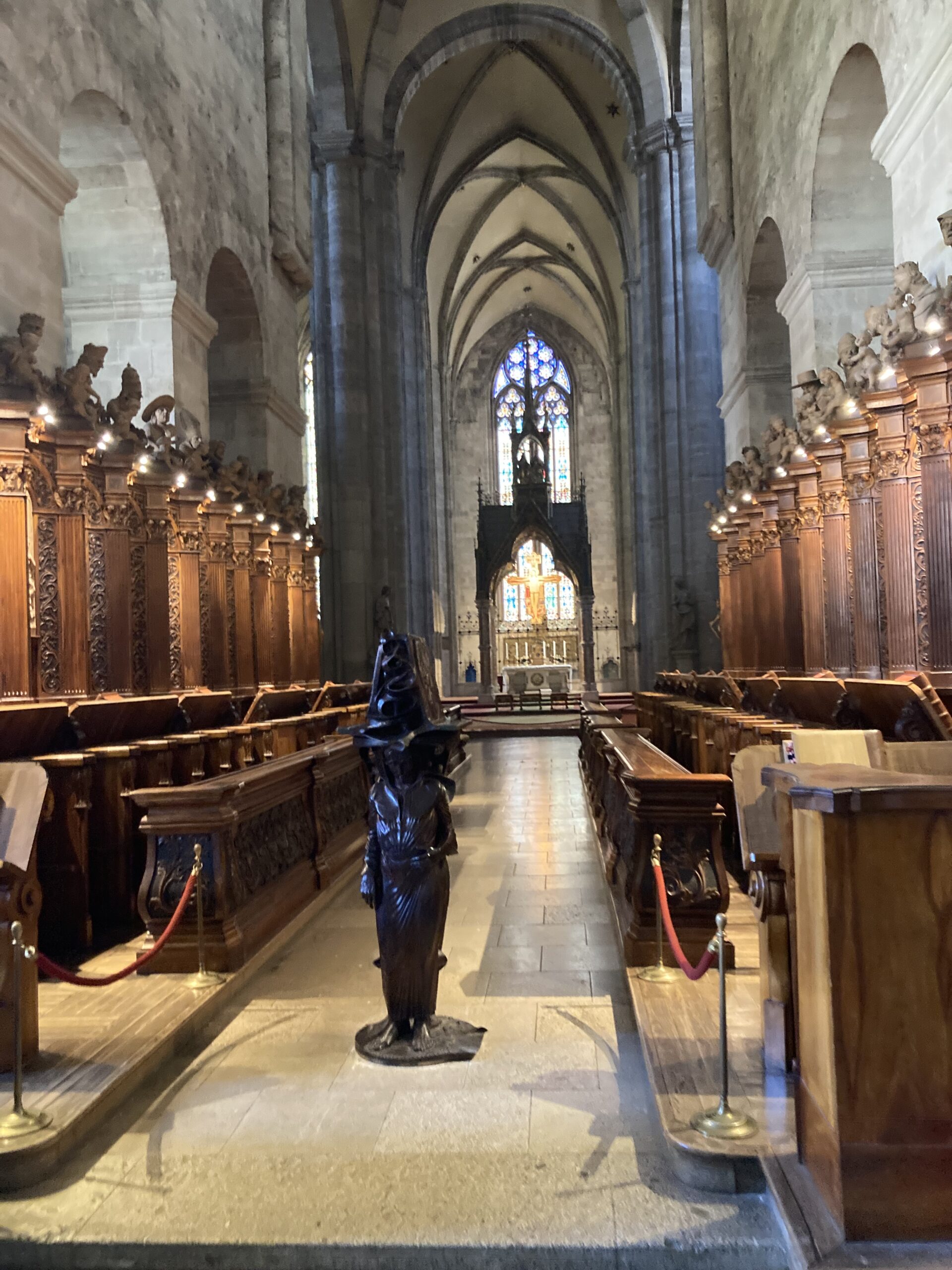
While there, my hosts took me to Mass at the Cistercian monastery of Heiligenkreutz (Holy Cross), built in 1133 by the Saint Leopoldo III, whose son Otto had become a Cistercian. The monks still chant the office in Latin, as they have done for over a millennium, their voices echoing in the splendid stone structure, with its soaring vaults and stained glass.
O beauty, ever ancient, ever new…
There is a Cistercian theme to this pilgrimage, for I am currently on a train to Zurich, to visit an alumna who made her final vows this year in one of their convents just south of there. I will stay in their guest house for a couple of days, before continuing on to Florence, Assisi and Rome.
As the high speed train hurtles on through the towering, rugged Alps, I notice, looking out the window at the lush scenery and the villages – all with a spired picturesque church in the centre – that on one of the summits was a cross. Someone mentioned to me that they all do; perhaps he’s right; at least, we may hope it be so. On such sacramentals a culture may one day be restored.
As Belloc put it, Europe is the Faith, and the Faith is Europe. +

Carney’s Amoral Majority
After five defections – euphemistically described as ‘crossing the floor’ – and three by-elections, Mark Carney and his Liberals how have their coveted majority. One wonders what bowls of pottage were offered in back-room deals. In the archaic monarchical system that is the Dominion of Canada, this majority allows the newly-minted Prime Minister to rule[…]Continue reading→

Saint Kateri , Canada’s Protectress
This was the title given to Saint Kateri Tekakwitha, by Pope Benedict XVI, when he canonized her on October 28th, 2012, along with six others, in Saint Peter’ Square (she had been beatified by Pope John Paul II back in 1980). With Saint Joseph as our protector, along with the Canadian martyrs, we seem to[…]Continue reading→

A Tale of Two Benedicts
A grace-filled Holy Week to all our readers! As we await and prepare for the Resurrection about to dawn upon us, we might keep in mind two Benedicts: Pope Emeritus Benedict XVI, requiescat in pace, elected on this day in 2005; and today’s commemoration of the mystic pilgrim, Benedict Joseph Labre, who died on this[…]Continue reading→

My Name is Bernadette
April 16th is a propitious day, for besides the anniversary of Father de Valk’s death, who founded Catholic Insight in its print form decades ago, and the commemoration of the ‘two Benedicts’, mentioned in accompanying posts, today we also recall Saint Bernadette Soubirous, the young visionary to whom the Virgin Mary appeared numerous times at[…]Continue reading→

Saint Lydwina of Schiedam and Suffering Joyfully
Saint Lydwina of Schiedam (1380 – 1433) was one of the countless and glorious ‘victim souls’ in the history of the Church, those whose lives are filled with suffering, often of an unimaginable intensity, but who suffer joyfully. She was a fifteen-year old Dutch girl, out skating one day, when she fell and broke one[…]Continue reading→

The Glorious Martyrdoms of Martin and Maximus
As we enter into Eastertide, we recall on this 13th of April Pope Saint Martin I (+655), one of the noblest, if most tragic, of the successors of Saint Peter. Born in Umbria, Italy, he was of noble lineage, with great intelligence combined with charity and love of the poor and the Church. While still[…]Continue reading→

Saint Stanislaus of Szczepanów
We celebrate Saint Stanislaus today (+ April 11, 1079), in light of this Easter Octave, a bishop and martyr who accepted the episcopacy only at the direct order of Pope Alexander II. He proved a wise and courageous leader of his flock, put to death by his own king, Boleslaus, for rebuking the monarch’s ‘immoral[…]Continue reading→

Saint Gemma Galgani
On this April 11th, in 1903 – the same year that the Italian Guiseppe Sarto was elected Pope later that summer as Pius X – a lovely, young Italian woman died, by the name of Gemma Galgani. She lived a brief life of 24 years, as did a number of other young saints, including Pier[…]Continue reading→
An Ideological and Improper Translation
I noticed something odd with the psalm reading at Mass the other day. Our bishops’ conference here in Canada has decreed that the Mass in English – Novus Ordo – use the ‘NRSV’, the ‘New Revised Standard Version’, an ‘updated’ translation of the original RSV, first published in 1952. This ‘new translation’ has the tendency[…]Continue reading→
Saint Jean-Baptiste de la Salle: A Teacher for Teachers
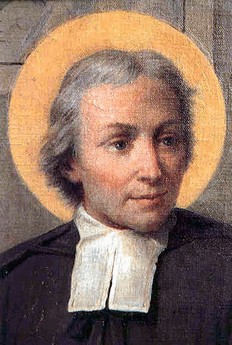
Jean-Baptiste de la Salle (1651 – 1719), a French nobleman, ordained a priest, founded the first order in the Church’s history entirely without priests, and this came about almost by accident. I say ‘almost’, for, of course, there are no accidents with God. Destined for ordination from an early age, Jean-Baptiste never looked back, even[…]Continue reading→